Summary
From dishes left in the sink to postponed piano practice, the author examines family explanations for delay, the role of indecision and regret, and the possibility of changing learned patterns.
At a glance
The author argues that procrastination is a learned pattern that can change, while acknowledging a possible hereditary contribution. The research described associates women’s procrastination and indecision with controlling, authoritarian family environments; those associations do not establish universal causation. Change may be challenging, and mutual support is suggested without a guarantee of success.
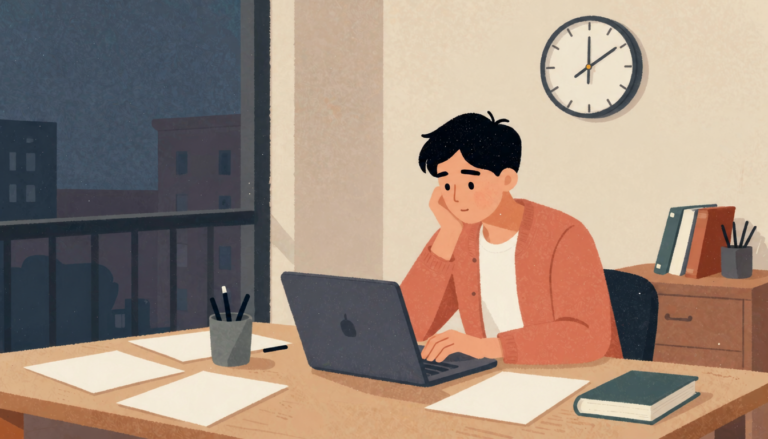
Two hours before their deadline, a friend was slowly tapping at their keyboard, gazing almost tenderly at a nearly empty Word document. As they worked—or barely worked—they told me about their mother.
“At home, Dad is always reminding Mom to wash the dishes. She keeps scrolling through her news feed and saying, ‘I’ll be right there.’ But the next day, the sink is still full. Dad keeps asking, Mom keeps putting it off, and eventually we either run out of clean dishes or Dad gives up and washes them himself.”
They frowned and tapped a few more keys.
“The way she puts off washing dishes is exactly how I stare at my list of deadlines without doing anything. When you think about Mom, this clearly isn’t me choosing to procrastinate. It’s heredity making me do it!”
They are hardly alone in that belief. Media coverage, and even some scholars, have encouraged the idea that procrastinators are born that way.
“I haven’t finished another report. This is driving me crazy. Maybe my parents passed their procrastination genes on to me.”
“Housework? Let me watch another episode first. My parents put off their chores, and so does the whole extended family. It must be a family tradition.”
Children with unfinished homework arm themselves with an explanation about heredity. Adults with unfinished tasks invoke their genes and settle comfortably into another delay.
Let me challenge that explanation at the outset: you are not a born procrastinator, condemned to delay because you inherited your parents’ supposedly defective genes. The argument here is that procrastination is learned. Over time, putting things off becomes a way to avoid responsibility, avoid starting a task, or avoid finishing it—and eventually a way of life.
Can heredity take all the blame?
Heredity is undoubtedly an important part of the explanation for many human behaviors. But if you are hoping it will explain away your procrastination, you may be asking it to carry more blame than it deserves. By now, heredity might reasonably demand compensation for the distress of being everyone’s scapegoat.
Researchers began exploring the possible inheritance of procrastination some time ago. Ferrari and colleagues asked parents and children to report separately how much they procrastinated on certain activities. They found no correlation between the procrastination levels the parents and children reported.
Later, researchers named Gustavon and Mikake examined procrastination tendencies in identical twins to explore the role of genes further. They reported that less than 50% of the shared variation could be explained by heredity. In my reading of these twin findings, this gives reason to question whether genes play the overwhelming role people sometimes imagine when explaining their own delays.
So before blaming your parents for handing down “procrastination genes,” give heredity a break. It is tired of taking the blame.
But does that let parents off the hook entirely?
What matters is how parents raise their children
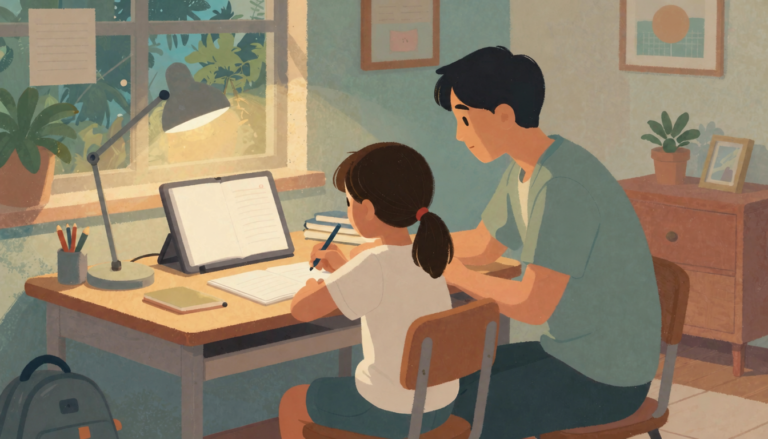
Once we turn from inheritance to the environment in which children grow up, a different question emerges. The issue becomes less whether parents procrastinate themselves and more how they treat their children.
Ferrari and Olivette explored procrastination within the family, beginning with decisional procrastination: the hesitation that leaves someone unable to choose between option A and option B. They examined the relationship between parenting and women’s tendency toward indecision. Women who reported being indecisive also reported controlling, demanding family environments.
Later work extended the discussion to behavioral procrastination more broadly. Among women, having authoritarian parents who placed strong emphasis on rules was associated with a tendency to procrastinate.
I interpret these findings as showing that strict, authoritarian parenting makes daughters more likely to develop procrastination tendencies. Consider a girl who plays piano and has grown up being told what she cannot do, with obedience enforced at every turn. Now imagine her parents insisting that she take first place in a very difficult piano competition. As she prepares, fear of the harsh criticism she might receive if she fails could lead her to put off practicing.
What about the relative influence of mothers and fathers?
The research described here indicates that fathers are more likely than mothers to foster procrastination in their children, especially when a father is authoritarian, emotionally cold, and demanding, and the relationship is distant and full of conflict.
Return to the girl at the piano. Suppose her father is strict, perhaps authoritarian, and she does not even like playing. She feels unable to resist his demands openly. Delaying practice may become her way of preserving a little independence. Of course, that delay may make her father angrier, setting a vicious cycle in motion.
Fear of criticism and the wish to protect some independence offer two different routes to the same outward behavior: practice never quite begins.
The effects of a strict, authoritarian home may also shape where someone turns when life becomes difficult. A person who procrastinates may be more willing to ask friends for help than to approach family.
Perhaps you are facing the pressure of unemployment, the pain of a troubled relationship, or, like the girl at the piano, the disappointment of losing a competition. Friends may feel for you and offer a comforting hug when you need one.
Your family, meanwhile, may have heard so many complaints about trouble caused by procrastination that they are tired of hearing them. Their response might be, “Why have you done this again?” Yet at that moment, you feel hurt and want a hug, not another accusation.
The point is that family environment matters. In this argument, whether your parents postpone washing the dishes does not matter; what matters is how those parents raise you.
Do these delays make you a procrastinator?
The textbook you need to read remains unopened. A client has sent one message after another asking for an update. You finally pull your eyes away from a TV show, only to realize it is too late to collect the package you were notified about. That will have to wait until tomorrow.
Do these familiar “symptoms” necessarily make you a procrastinator?
Tibbett and Ferrari identify two factors involved in the formation of a procrastinator identity: indecision when making decisions, and regret about education, career, and finances.
Indecision can look remarkably ordinary. Should you buy the blue pencil case or the red one? Then again, the purple one looks good too. Ten minutes later, the green one catches your eye. It looks so fresh. Which one should you choose?
And so the choice remains open.
Regret has a different voice:
“I was so foolish. I knew that watching shows and anime made me happy. I knew that keeping things out of sight kept anxiety out of mind, and that delaying action left me an excuse to fall back on. What I didn’t know was how miserable I would feel as the deadline approached. I didn’t know that missing the chance to send out my résumé would leave me feeling lost during graduation season. And that fund I meant to buy yesterday, but couldn’t be bothered to buy? Its price went up today, making my empty wallet feel emptier.”
Then come the tears of regret.
Think back over your own indecision and regret. Do those experiences stretch out like an ocean, or are they scattered like a few droplets catching the sunlight?
I suspect some readers have already thought, “I’ll save this article and come back later to work that out.”
And then, of course, never come back.
A learned pattern can change
If you procrastinate, or recognize a tendency toward it, must you remain tangled in its vines forever?
Of course not.
Much of who you are reflects what you have learned, including patterns such as procrastination. That also means you can learn to let go of something you once learned, although doing so may be deeply challenging.
Choosing to overcome procrastination means taking a difficult road. Still, an old bottle can hold new wine: an established pattern does not rule out the possibility of change.
When the comfort of putting things off draws you in, resist the excuses—especially “My parents passed procrastination on to me.” Hold on to the belief that change is possible.
When you need support, work with someone else. You might check in with each other about completing a written plan, or arrange to go running and check in together afterward.
After all, you are not the only person who procrastinates.
Frequently asked questions
Does the article establish that genes have no influence on procrastination?
No. Although the author argues that procrastination is learned, the twin findings described report that less than 50% of shared variation could be explained by heredity. This does not establish an absence of genetic influence.
How does the article connect authoritarian parenting with procrastination?
The studies described associate women’s indecision and behavioral procrastination with controlling, demanding, rule-focused family environments. The piano examples illustrate two proposed pathways: fear of criticism and delaying to preserve independence. These examples do not establish universal causation.
Do occasional delays establish a procrastinator identity?
The article questions whether familiar delays alone establish that identity. It presents indecision and regret about education, career, and finances as two relevant factors and asks readers to reflect on whether these experiences are pervasive or occasional.
What support does the article suggest for changing procrastination?
The author suggests working with someone else when support is needed, such as checking in about completing a written plan or arranging to run together and checking in afterward. Change is described as challenging, and these suggestions carry no guarantee of success.