Summary
Procrastination can involve difficulty starting, the appeal of immediate rewards and avoidance of unpleasant feelings. Practical changes work best when matched to the obstacle.
At a glance
Knowing a goal matters does not remove friction, competing rewards or discomfort. Clarify the next step, adjust distractions and notice the emotions attached to returning, without expecting a single cure.
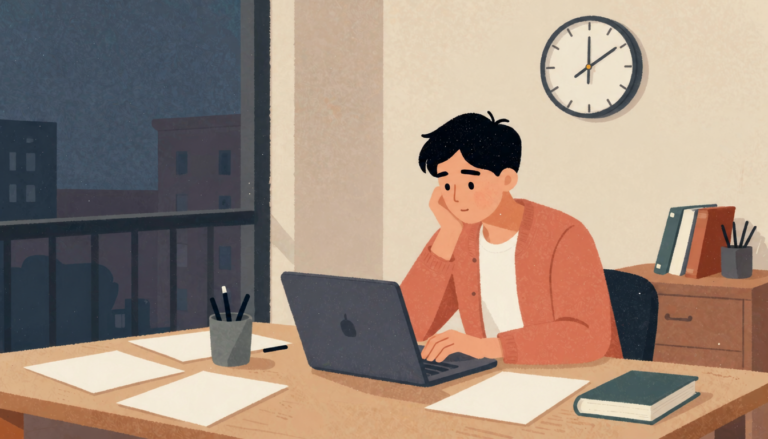
A writer sits down in the morning intending to finish a new article. Choosing a topic feels difficult, so browsing science websites seems like a reasonable first step. The browser is open anyway; a quick look at the news and sports results cannot hurt. Then it is lunchtime.
After lunch comes a nap, a little more browsing, a message from a friend, shopping alerts and social media. By evening, the writer has finally chosen procrastination as the topic and looked up some references. The document is almost open. But it has been a long day, and watching television sounds easier. The writing can wait until tomorrow.
It is tempting to describe this as laziness. Yet the writer wants to finish, knows delay is costly and feels frustrated by the gap between intention and action. Understanding that gap gives us more useful options than repeating a character judgment.
Three perspectives are especially helpful: how we regulate action, how we value competing activities and how we respond to uncomfortable feelings. They can overlap within the same episode.
Starting work and stopping distractions
Self-control concerns bringing present behavior into line with longer-term goals. In the writing example, two demands are involved. One is starting something whose rewards are distant. The other is stopping something that is immediately appealing.
These can be described as initiatory and inhibitory control. Opening a blank document calls for initiation; putting down the phone calls for inhibition. Trouble with either can interfere with the plan, even when the goal itself remains important.
Thinking of self-control as a muscle can be an intuitive metaphor, but it should not become a literal explanation for every delay. You do not need to prove that your willpower has become stronger before adjusting the situation. Making an action easier may be a more direct place to begin.
For a morning run, put the necessary clothes where you will see them. For writing, leave the relevant document and notes ready. Clear enough space to work, silence nonessential notifications and move the phone out of reach. If the task does not need an internet connection, working offline may remove a familiar route into browsing.
Choose changes that fit the task. A writer who needs online sources cannot simply remove every connection, and an important message may require an exception. The aim is to reduce avoidable friction around work and avoidable ease around distractions. It is easier to assess a specific obstacle than to decide whether you are a sufficiently disciplined person.
When you become distracted almost involuntarily, notice the sequence. What was on the screen? What happened immediately before you reached for the phone? That observation can suggest a useful environmental change without requiring a global explanation of your personality.
Why the immediate option can feel more valuable
A second perspective considers subjective value. Finishing an article may bring accomplishment, while scrolling offers amusement. The two rewards arrive at different times, which can make the immediate option disproportionately attractive.
The term delay discounting describes valuing a later reward less than a comparable reward available sooner. A choice between a smaller payment now and a larger payment months later illustrates the idea. It does not mean that everyone makes the same choice, or that choosing the earlier payment is always irrational; circumstances and uncertainty matter.
With writing, the completed article is still several hours away. A pleasant message or entertaining clip arrives now. As a deadline approaches, the task's consequences become more immediate, and the balance may change. That helps explain why urgency can finally get someone moving, although relying on crisis leaves little room for revision or unexpected problems.
There is no objective scale proving that all phone use is less valuable than work. Rest, conversation and recreation have value too. The question is whether your present choice serves the priorities you actually want to follow, including the consequences for later.
One possible response is to make the longer-term benefit concrete: what would having a finished draft let you do next? Another is to make an unwanted distraction less convenient by signing out of an app or removing its shortcut. These are experiments with the decision setting, rather than guaranteed ways to change motivation.
You can also compare whole sequences. Instead of treating the choice as “write or relax,” consider “write a section, then relax” alongside “relax now, then write.” This keeps the later obligation visible. It may help you choose an order deliberately without pretending the leisure activity must disappear.
What planning can solve
Time-management methods turn vague intentions into decisions about priority and action. A notebook or an app can list writing, reading, scrolling and television. Importance and urgency help identify what needs attention first; not every appealing activity belongs at the top.
Then divide the writing into meaningful stages: choose a topic, find relevant sources, draft the argument and edit it. “Write an article” can feel like an undefined demand. “Decide the question this article will answer” gives you something observable to do.
Smaller steps also make progress easier to recognize before the final reward arrives. They do not automatically eliminate emotional difficulty. You can have a clear schedule, a tidy desk and a sensible sequence, and still dread the first paragraph. That is where the third perspective becomes useful.
When postponement offers emotional relief
A task may evoke boredom, uncertainty, frustration or self-doubt. Laundry can feel tedious; exam preparation can bring anxiety; writing can expose a fear that you have nothing useful to say. Avoiding the task may briefly remove those feelings.
The phone is attractive partly because it provides another experience to enter. Relief arrives quickly, even though the obligation remains. When you return to the task, the original discomfort may be joined by guilt about the time spent avoiding it. The next attempt now carries an additional burden.
This can create a repeating cycle: an unpleasant task, an escape, temporary relief, and more distress when the task returns. The cycle is a possible account of procrastination, not a diagnosis or an explanation of every delay. Some postponement reflects a realistic need for rest, missing information or a change in priorities.
For an avoidance pattern, another elaborate schedule may leave the central problem untouched. Ask what feeling the task evokes and what feeling the distraction promises. The answer may be more informative than another resolution to work harder.
Forgive yourself without losing the next step
Self-forgiveness is relevant because harsh self-criticism can become part of the burden attached to returning. In a study following students across two midterm exams, greater reported forgiveness for earlier procrastination was associated with less later procrastination. The study examined an association; it did not establish that instructing everyone to forgive themselves would produce that outcome.
A practical version is to acknowledge the delay and its consequences without turning them into a permanent verdict. You can regret the lost afternoon and still decide what to do with the next part of the day.
Notice what has worked before, too. When did you manage to write despite reluctance? What conditions helped, and what encouragement mattered? Remembering an effective approach offers more usable information than comparing yourself with an imagined person who never struggles.
Then ask for the next physical action. If you were going to begin, what would you do first? Open the document. After that, write a working title or one sentence stating the question. Starting may help engagement develop, but it need not immediately make the task pleasant. You can reassess after a small amount of actual contact with the work.
Spend the next part of your day deliberately
Procrastination exposes a difficult human tension: the life we intend to live and the way we spend the present moment can diverge. Discomfort makes that tension harder, and self-condemnation rarely clarifies the next action.
Look at the obstacle in front of you. Is the first step unclear, the distraction too easy, the reward too distant or the feeling too difficult to face? More than one may apply. A small adjustment matched to that obstacle can make your next choice more deliberate, even when the whole pattern takes longer to change.
Frequently asked questions
Why do I delay something important?
Its first step may be difficult, its reward distant or its feelings uncomfortable, while another activity offers immediate relief.
What can planning help with?
Priorities and smaller stages can make the next action clearer and progress visible.
Does self-forgiveness cause less procrastination?
A student study found an association; that does not establish a universal causal effect.
How can I start?
Identify one physical action, such as opening the document, then reassess after brief contact with the task.