Summary
A park walk, a glimpse of greenery or a moment with nature imagery may offer respite from demanding work. The article explores attention, stress and the distinctive experience of observing living surroundings.
At a glance
Some studies report short-term improvements on attention or stress-related measures after nature walks or viewing nature images. A quiet view or preferred natural sound may offer a useful break, but it is not a guaranteed productivity boost or treatment. Direct outdoor experiences differ from images; choose what is accessible and comfortable.
After hours of work, do your thoughts start to scatter, your eyes go blank, and your productivity stay stubbornly low? What do you usually do to ease that fatigue—close your eyes for a moment, look into the distance, or turn toward the green plant in the corner? Contact with nature may be one way to make everyday life better, beginning with moments as small as this.
Why might a plant or landscape draw your attention when you feel tired? The source jokes about this being encoded in Chinese people’s genes, but it offers no evidence for a nationality-specific genetic explanation. Preferences and access to nature vary between people.
The writer enjoys natural settings and bringing plants indoors. Plants can make a room feel more pleasant, but a review of pollutant-removal studies found that ordinary numbers of passive potted plants are not an effective substitute for ventilation in typical buildings. A nature image may be a pleasant break without being proven to increase workplace productivity.
A chance for attention to recover
The recharging metaphor refers to a possible respite from effortful attention. Some experiments find improvements on particular tasks after nature exposure; they do not establish that any brief contact with greenery reliably improves everyone’s concentration.
The distinction is between directed and undirected attention. Directed attention is like a spotlight; keeping it focused on a single thing takes effort. Undirected attention is more like a wandering firefly, moving freely and effortlessly. In that mode, attention is relaxed and fluid.
In Berman, Jonides and Kaplan’s first experiment, participants completed a nature walk and an urban walk on separate occasions. Performance on a backward digit-span task improved more after the nature walk. This measures a component of working memory and attention, not productivity across an entire workday.
Could the smells or temperature of the natural setting have helped explain that result? In the second experiment, participants viewed images of natural or urban environments in a quiet room, after which the researchers compared changes in cognitive performance. They reported statistically significant improvements in directed attention and digit-span test performance after participants viewed the nature images.
Attention Restoration Theory proposes that gently engaging surroundings can reduce demands on effortful attention. The two experiments are consistent with that account, but they do not prove that changing a desktop wallpaper increases work efficiency. Treat a nature-viewing break as something to try and evaluate, not a guaranteed performance tool.
Green space and health
The argument extends beyond concentration. For the writer, nature is basic health infrastructure, not a luxury.
Green spaces can provide shade and opportunities to spend time away from some urban stressors, but the local conditions matter. A park beside traffic may still have polluted air or noise, and an outdoor setting may also involve heat or allergens. Nature is not automatically a low-exposure environment simply because it contains plants.
Studies have reported associations between green-space access and some health outcomes. Those patterns do not establish that greenery alone prevents diabetes or other disease: income, neighborhood conditions, activity and access to care can also matter. Space quality, accessibility and how people use it should be distinguished from coverage alone.
Mental strain can also come from returning to the same unhappy moment again and again. This is rumination: repeatedly revisiting negative events. Was that something you shouldn’t have said? Why did the other person act that way? The writer describes these recurring questions as draining.
Two studies should be distinguished. Bratman and colleagues studied a 90-minute nature walk and reported reduced rumination and subgenual prefrontal-cortex activity. Sudimac and colleagues studied a one-hour walk and found reduced amygdala activity after the nature condition. These are specific short-term findings, not evidence that one hour universally changes both regions or treats a mental disorder.
A preference for natural scenery has also been positively associated with mood improvement. The writer offers a tentative interpretation: perhaps the more you love nature, the more it gives back.
Why might nature draw us in?
What could make nature feel like such an effective source of replenishment—almost a giant solar charger? The writer turns to evolution as a possible explanation of the fit between people and natural environments.
Evolutionary accounts are hypotheses about why some natural settings appeal to people. They do not establish that preference is genetically fixed or that culture and learning are unimportant. A twin study of nature orientation and experience considered both genetic and environmental contributions; such population-level estimates do not determine an individual’s preferences.
A similar explanation comes from the biophilia hypothesis, which defines biophilia as an inborn tendency to attend to life and life processes. The theorist behind this hypothesis regarded closeness to nature as essential to human nature and saw that bond as a foundation of our rich inner lives.
Finding nature during the workday
Recognizing the benefits is one thing; finding ways to connect with nature as urbanization spreads is another. How can we make room for it in everyday life?
The quiet-room experiment with nature images offers a simple starting point for the writer’s advice: choose nature-themed wallpaper for your screen and, when work leaves you tired, spend a moment simply looking at it.
Sound can be another optional route: a research synthesis examined benefits associated with natural soundscapes. Birdsong and flowing water are not necessarily “white noise,” a specific acoustic term. Choose comfortable volume and stop if a sound is irritating. Perfume is not needed; aromatherapy evidence is limited, and pleasant or natural fragrance does not guarantee stress relief.
These images, sounds and scents are less immersive than being in nature itself. They cannot fully recreate an environment that keeps changing, the chance to interact directly with it, or subtle details that might otherwise escape notice. Those qualities give actual encounters with nature something irreplaceable.
Still, a trip to the forest is rarely practical in the middle of a workday. Small encounters with natural elements can offer breathing space between tasks, and that matters too. Take the opportunities available to make an ordinary moment a little easier to get through.
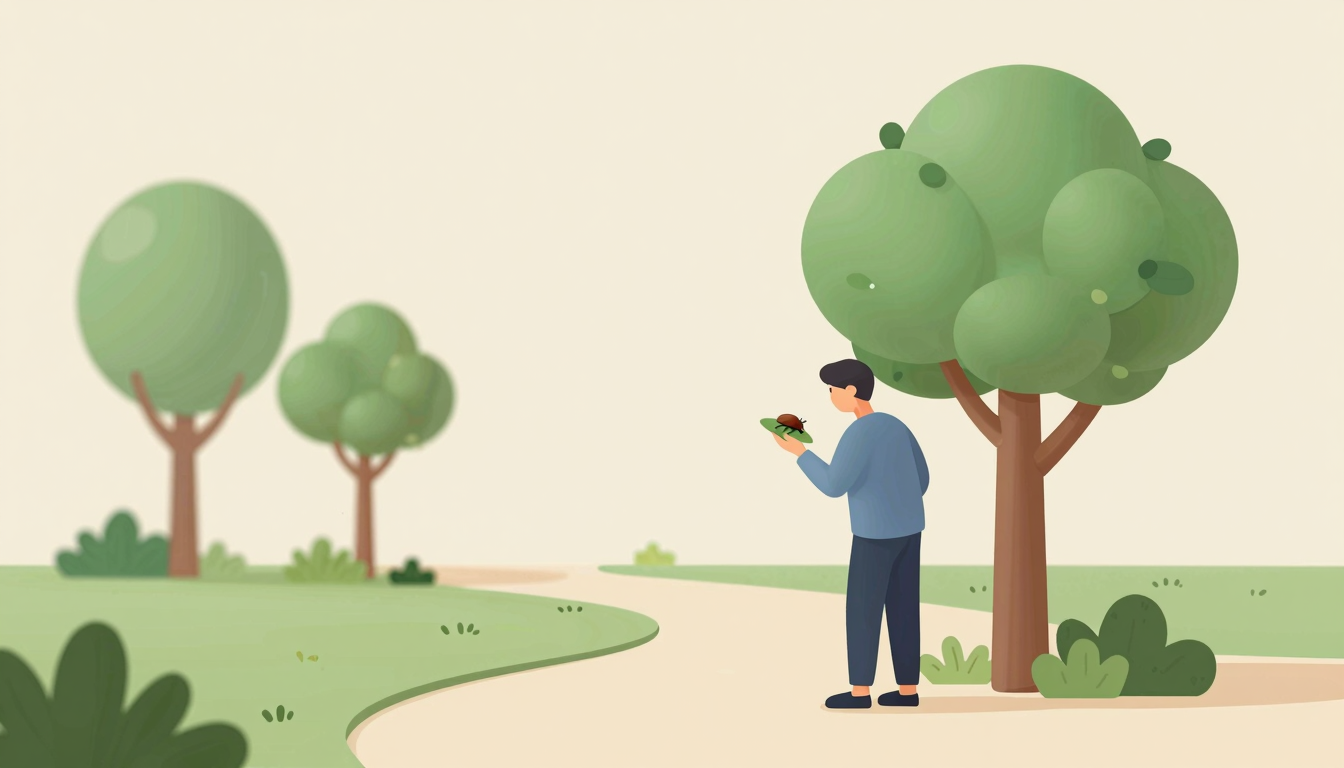
When the opportunity comes, step into a real green space. You may feel fatigue and stress gently fall away as your attention settles on a tree, then an insect on one of its leaves, then the markings on the insect’s shell. For a while, whatever is happening beyond that small scene may no longer seem to matter.
Frequently asked questions
How does the article explain nature’s effect on attention?
The writer proposes that nature gently engages undirected attention while easing the demands on directed attention, giving deliberate focus a chance to recover.
Can nature images, sounds and scents replace being outdoors?
Images or preferred natural sounds can offer an accessible break, but they do not reproduce every feature of being outdoors. Fragrance is optional and is not an established substitute or necessary part of the practice. Benefits vary with the person, setting and outcome measured.