Summary
A birthday comedy's talking teddy bear opens a reflection on unmet connection, the freedom to choose solitude, and small comforts that may make time alone feel warmer.
At a glance
Being alone need not mean feeling lonely: loneliness concerns unmet relational needs, while chosen solitude may bring satisfaction and ease. Drawing on a birthday comedy sketch, the writer suggests personal rituals, hot food, a soft teddy bear and familiar fairy tales as possible sources of comfort. These suggestions invite exploration rather than promise a cure; the warmth experiment described tested touching hot or cold bags, not eating meals.
Did you ever talk to a teddy bear when you felt lonely as a child, playing games with it and hoping that, any second, it might answer? Perhaps it could come alive and keep you company.
That wish comes true in a comedy sketch about a birthday celebration. In a reflection on loneliness, a writer describes seeing it in what was then the latest installment of an annual comedy competition. A teddy bear starts talking and joins Pinocchio and a refrigerator in trying to celebrate their owner's birthday. Their owner is a 26-year-old university graduate.
The writer imagines Science offering the owner a cheerful concession: “Thanks for trusting me—but if you don't want to spend your birthday alone, perhaps you could believe in your teddy bear for a little while.”
Beneath the joke is a more wistful reflection. As the writer observes, growing older can mean both giving up our belief in talking toys and finding ourselves increasingly on our own: eating alone, traveling alone, wandering from place to place alone. Yet just before the bear, Pinocchio and the refrigerator disappear, the sketch leaves a reassurance: even if you are alone, it can be all right.
For the writer, that is the possibility worth holding on to—that being alone need not put comfort beyond reach. But understanding how to soothe loneliness begins with a question: what does feeling lonely actually mean?
What loneliness can mean
The writer begins with a historical account, tracing the term “loneliness” to medicine, where, in this telling, it described a condition involving delayed development of social interaction, language expression and cognitive skills. The writer also credits Weiss with bringing loneliness into psychology in 1973, while noting that psychologists have struggled to reach a universally accepted definition. The discussion organizes several approaches around two characteristics, three temporal categories and four dimensions.
The definition attributed to Weiss centers on an unpleasant subjective emotional experience, or psychological awareness, that arises when a person's social relationships fall short of their expectations. From this, the writer draws out two characteristics: something is missing in a person's relationships, and that lack feels unpleasant. The gap between the relationships someone wants and those they experience matters here.
Maslow's hierarchy places belonging and love after physiological and safety needs. Drawing on that framework, the writer suggests that fractures in our emotional connections can leave those needs unmet. We may lack close friends, feel estranged from others, or experience misunderstanding or rejection. When the connection we need is missing, loneliness can follow.
That experience depends on how we understand our own relational needs. Imagine a friend telling you how comfortable they feel alone, without a trace of loneliness. Their experience may be exactly as they describe it. But if you want companionship, you may still feel lonely when you are by yourself. Someone else's description or judgment cannot determine how being alone feels to you.
Time offers another way to understand the experience. The writer cites a classification by Young and Beek that distinguishes transient, situational and long-term loneliness.
Transient loneliness is the occasional feeling that surfaces in everyday life. The writer offers a personal example: seeing affectionate couples on the street and mentally cueing up a song about being single and alone. The humor captures a passing pang.
Situational loneliness arises in unfamiliar or enclosed environments. The writer illustrates it with people studying or working away from home who find themselves lying awake late at night, tossing and turning and feeling alone.
Long-term loneliness involves persistently insufficient social contact or a continuing lack of satisfying relationships. In this account, it can be regarded as a personality characteristic, also called trait loneliness.
The writer also sees concepts of loneliness as expanding with cultural circumstances and the times people live in. One study cited in the discussion examined contemporary university students' answers to the question, “Under what circumstances do you feel lonely?” By analyzing those responses, the researchers identified four dimensions among these students: interpersonal, social, self-related and developmental loneliness.
In the writer's explanation, interpersonal loneliness concerns the lack of attention, acceptance, encouragement or support from others. It connects directly to the relational absence described earlier.
Social loneliness involves a broader difficulty with being understood. The writer approaches it through the thought that another person cannot fully share your experience. As people adapt to society, personal ideals may collide sharply with social reality. Values can come into conflict or fracture under that pressure, leaving someone feeling misunderstood by society itself.
Self-related loneliness arises when how you understand yourself conflicts with how others evaluate you. The feeling might be expressed as “You don't understand me”: a tension between your own sense of who you are and the person others seem to see.
To explain developmental loneliness, the writer draws on the developmental-psychology view that different stages of life involve particular tasks. Difficulty completing those tasks can bring loneliness. Imagine being in your final year of university: your classmates have made plans for the future, while you still have no idea which direction to take. Seeing them prepare to move forward may leave you feeling as though they have left you behind.
These frameworks represent some psychologists' understandings of loneliness, the writer cautions, rather than a definitive answer. What loneliness means in your own life remains a question worth considering for yourself. Whatever description comes closest, the loneliness you feel is real.
Being alone and feeling lonely
Loneliness often arises when we are by ourselves, but it can also be felt in company, even within a group. And time alone need not feel lonely at all.
In the writer's explanation, solitude is broader and more complex. It usually describes the observable condition of being alone without communicating with others, while also encompassing feelings, cognitive evaluations and behavior. Those aspects of solitude can be positive, negative or neutral.
Larson's definition describes solitude as a state in which a person has no interaction with the outside world or is consciously separate from others, with the freedom to choose their mental and physical activities. The writer reads this as emphasizing conscious separation rather than physical distance alone. That freedom raises a further question: how much say do we have in our time alone?
Larson and Lee distinguish between involuntary and constructive solitude. Involuntary solitude means being forced to spend time alone when you want companionship. Loneliness can be one emotional part of that experience.
Constructive solitude, also called positive solitude, is actively chosen and involves greater autonomy. As the writer explains, when you choose or prefer time alone, the objective absence of social contact need not feel like a lack of connection. It may instead bring satisfaction and ease, making solitude something you seek out.
This possibility leads the writer to propose cultivating a capacity for positive solitude: learning ways to feel comfortable on your own. The birthday sketch supplies a thread connecting four suggestions, beginning with the preparations for the celebration itself.
Giving time alone personal meaning
“Is the birthday over once we've finished the cake?” comes the question in the sketch.
“No—there are still presents to give, candles to light, wishes to make, and cake to eat.”
The bear, Pinocchio and the refrigerator understand the rituals of a birthday. The writer takes their preparations as an invitation to create personal rituals in everyday life, too.
The writer cites research reporting that rituals can activate the brain's dopamine reward system and provide emotional comfort. Beyond that reported effect, the writer argues that a ritual's significance matters more than the act itself. Singing “Happy Birthday” to yourself can be a way of telling yourself that warmth and love remain present, even when you are alone.
You might try buying yourself a small gift that makes you happy, enjoying a delicious cake on a day that matters to you, or making a wish for the future. Celebrating alone can still leave room for these gestures and the meaning you give them.
The refrigerator suggests another, more immediate comfort: something appetizing and hot to eat. It may never come alive to cook you an egg, but you can still enjoy a hot meal. Food raises blood sugar and supplies the body with energy, the writer explains, while physical warmth may offer some comfort of its own.
In a study the writer cites, participants recalled an experience of social rejection to awaken their desire for contact. They were then randomly assigned to touch either a hot or a cold medical bag and completed a social-needs scale. Those who touched the hot bag scored lower on that scale than those who touched the cold one. The writer interprets this result as suggesting that cold increases the desire for contact, while warmth may ease loneliness to some extent.
The experiment involved touching bags. From that finding, the writer makes a playful leap to the dinner table: whether you're having an egg or a bowl of birthday longevity noodles, enjoy it hot.
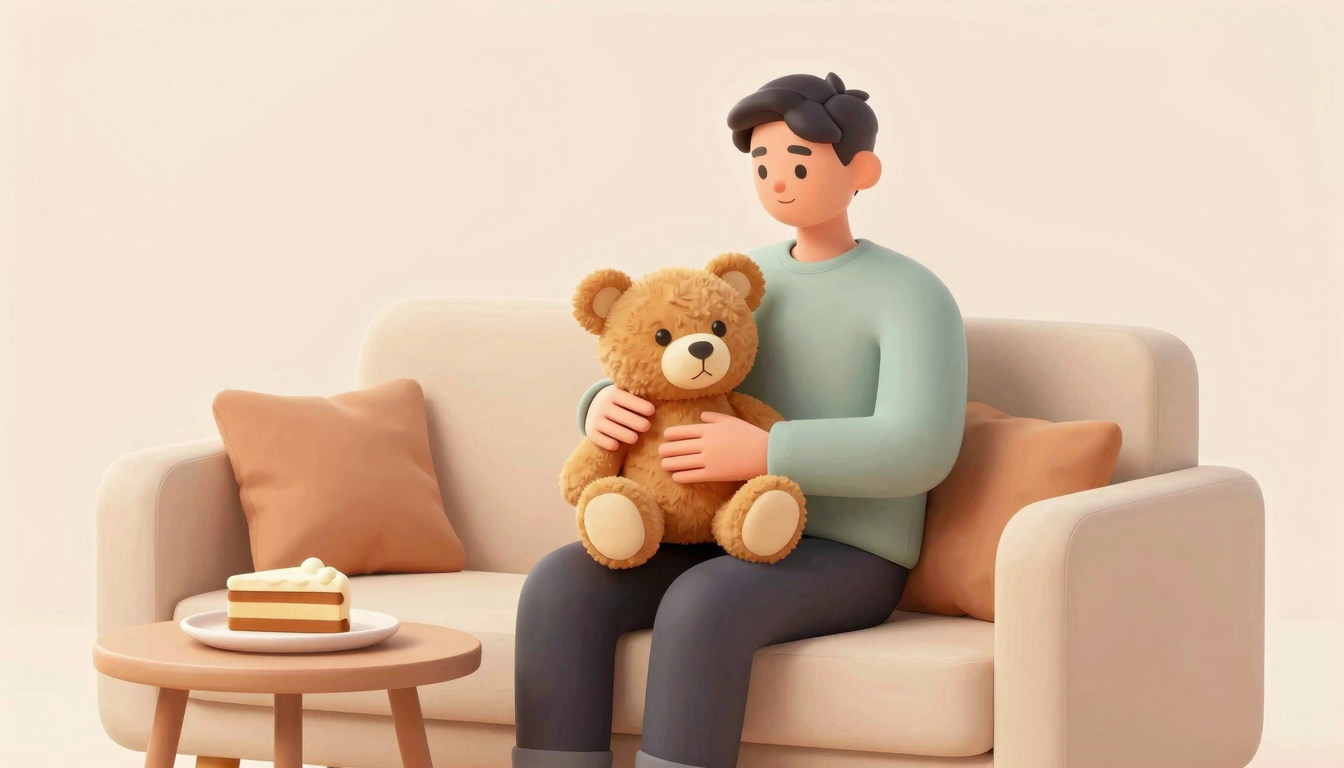
The third suggestion returns to the teddy bear: hug something soft. The writer is enthusiastic about the appeal of a fluffy bear and recalls a claim from an earlier article that soft touch can lift our mood and bring a little happiness when we feel lonely.
A bear can also feel like a friend. Speaking on the program, one of the sketch's creators explained that their love of toys, and even their habit of collecting them, did not mean they were lonely or withdrawn. To them, those toys were friends who kept them company.
That sense of companionship is what the writer invites us to consider. When you feel lonely, might a teddy bear offer some company?
Returning to fairy tales
The bear offers one connection to childhood; Pinocchio opens another. Of all the moments in the sketch, Pinocchio moved the writer most deeply, prompting the final suggestion: return to fairy tales. How long has it been since you last read one?
The writer sees fairy tales as a gift for adults as well as children, a small sweetness that connects us to childhood. When we feel lonely, following a familiar story back into old memories may help us find warmth and companionship there, offering comfort for the loneliness we feel now.
A story cannot make a toy come alive, but it may bring that childhood sense of company a little closer. For the writer, this is one way to develop the capacity for positive solitude: finding resources for comfort that remain available even when we are alone.
Frequently asked questions
Can you feel lonely while surrounded by people?
Loneliness can be felt in company, even within a group. In the account presented here, it concerns the gap between the relationships someone wants and those they experience, rather than physical separation alone.
What is positive solitude?
Constructive solitude, also called positive solitude, is actively chosen and involves greater autonomy. When time alone is chosen or preferred, the absence of social contact need not feel like a lack of connection and may bring satisfaction and ease.
Did the warmth experiment test whether hot meals ease loneliness?
The described experiment tested touching hot or cold medical bags after recalling social rejection, followed by a social-needs scale. The hot-bag group scored lower. The writer's recommendation to enjoy hot food extends from that finding; the experiment did not test meals.