Summary
Whispers and gentle movements can evoke pleasant tingling in some people. Explore what small ASMR studies have measured, what remains uncertain and how to try preferred sounds without treating them as therapy.
At a glance
ASMR, short for Autonomous Sensory Meridian Response, is a pleasurable sensory response characterized by tingling that travels from the scalp toward the back or spine, often accompanied by relaxation. Triggers can include whispering, rain, slow movements and close personal attention. Responses vary: some people experience pleasant tingling, others feel nothing, and a minority may feel discomfort or irritation.
Have you ever heard a soft whisper or the patter of rain, or become absorbed in a baking video, and felt a pleasant tingling begin at the crown of your head and spread downward? That sensation is known as ASMR, short for Autonomous Sensory Meridian Response.
ASMR describes a distinctive, pleasurable response to sights, sounds, touch, smells, or other sensory stimuli. Its characteristic tingling travels from the scalp toward the back or along the spine, accompanied by relaxation and a sense of well-being. The sensation and its emotional effects can last several minutes and are usually predictable. For most people who experience it, it feels positive, though not everyone responds.
The colloquial labels “scalp massage” and “brain orgasm” convey something of its appeal. It can feel like a gentle massage for the brain, bringing an immediate sense of relaxation. But how does that feeling arise? And why does an experience that leaves some people unmoved draw others back again and again?
From sensory curiosity to everyday relaxation
The name ASMR was introduced by Jennifer Allen in 2010, rather than 2007. In an early 2015 survey by Barratt and Davis, 475 self-selected participants described their experiences: 98% used ASMR for relaxation, 82% for sleep and 70% for stress relief. These were reasons for use, not clinical success rates or estimates for the general population.
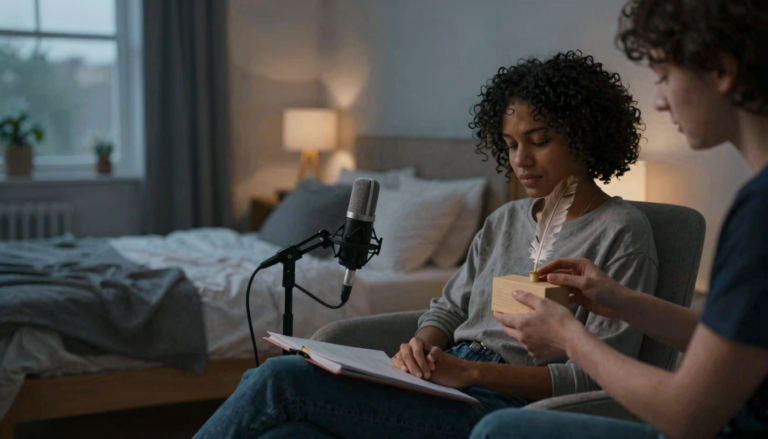
ASMR videos often use quiet speech, repetition and close attention to small actions. Whispering was reported as a trigger by 75% of respondents in Barratt and Davis’s 2015 survey, rather than being a population-wide effectiveness result from Poerio’s 2018 experiment. No universal ideal video length of five to ten minutes is established here.
Other triggers involve watching gestures of care or close personal attention. Simulated salon visits, hair washing, ear cleaning, and massage can create a sense of intimacy through what viewers see. Slow hand movements and attentive interactions at close range also feature among these visual triggers. Watching someone provide care is distinct from receiving physical touch, although the account notes that a minority also experience ASMR in response to gentle touch itself.
What happens in the brain and body?
The pleasure prompted by such quiet, ordinary stimuli has drawn scientists’ interest. Different explanations approach ASMR from different angles; the account’s neuroscience discussion considers both changes in brain activity and physical signs of relaxation.
Small fMRI studies have linked ASMR episodes with activity in regions involved in reward, emotion and sensory processing. Calling these areas a single “pleasure network” oversimplifies their functions. Activity in a region does not by itself explain the experience or show that ASMR and musical chills are the same phenomenon.
Observing gentle care or detailed hand movements may help some viewers feel absorbed or comforted. Mirror-neuron involvement is a possible interpretation, not a demonstrated explanation for why watching folded towels produces tingles. The experience alone cannot establish which neural mechanism caused it.
EEG findings vary by study and comparison. For example, Swart and colleagues found increased alpha and decreased delta power during ASMR relative to baseline. That contradicts a blanket claim that ASMR raises delta activity. Neither this pattern nor other EEG differences establish that an awake viewer has entered deep sleep or a meditation-equivalent state.
In Poerio and colleagues’ laboratory study, ASMR experiencers’ heart rate fell by about 3.41 beats per minute on average while watching ASMR videos, and skin conductance increased. The response was both calming and activating, not a uniform shutdown of arousal. This study does not establish the source’s claimed five-to-ten-beat decrease or reductions in blood pressure, breathing rate and cortisol.
Some people find ASMR pleasant, some feel nothing, and others dislike particular sounds. Stop if a clip causes discomfort and keep sound at a comfortable volume. The evidence cited here does not establish a reliable general-population prevalence of 20–30% or clinical benefit for most people. Persistent sleep or mental-health difficulties deserve appropriate care.
Why responses differ
Sensory sensitivity is one possible correlate of ASMR, but brain activation does not show that experiencers are better at allocating attention to subtle stimuli. Group associations should not be used to rank people’s sensory abilities or infer an individual’s brain function.
A study published in 2017 compared default-mode-network connectivity in 11 ASMR experiencers and 11 controls, finding differences within that network. A 2019 paper examined five resting-state networks. Their findings should not be collapsed into one 2017 claim about default-mode, executive-control and salience networks.
The default mode network, or DMN, is associated with self-referential thinking and mind wandering. Its principal components include the dorsomedial prefrontal cortex, posterior cingulate cortex, precuneus, and angular gyrus. The writer compares it to a background program: it is highly active while we are awake but resting, daydreaming, or letting our attention wander. When a task demands attention, its activity falls as activity in attention networks rises to meet that demand.
Resting-state connectivity differences do not establish that ASMR experiencers drift into mind wandering more easily or have poorer inhibition of sensory experiences. Those would require direct behavioral tests; they are not diagnoses that can be read from the reported group comparisons.
A personality study reported higher openness and neuroticism and lower conscientiousness, extraversion and agreeableness in its ASMR group. These sample-level differences are not a personality test for ASMR, and they do not show that a trait causes the response.
The writer’s broader synthesis places the openness and conscientiousness associations alongside tendencies toward greater empathy, fantasy proneness, sensory sensitivity, and sensory suggestibility. These are group-level tendencies, rather than causes of ASMR or a personality profile that can determine whether any particular person will experience it.
Finding triggers that suit you
Finding a comfortable trigger is a personal experiment. The source attributes a “S.T.E.P.” protocol to a medical association, but an official guideline or validation study was not established for its exact claims. The following are optional listening choices, not a clinical protocol.
Start by noticing which sounds or visual actions you enjoy, if any. A simple personal list is enough; a checklist cannot diagnose ASMR or guarantee that a particular trigger will work.
Choose a pace and sound you find comfortable. The source gives 50–300 Hz and 60–80 beats per minute as optimal settings, but supplies no verified evidence for those precise prescriptions. Acoustic frequency and rhythmic tempo are different quantities, neither of which guarantees relaxation.
Use a comfortable listening setup at a modest volume. There is no established basis here for preferring open headphones or a 15–30-degree side-lying angle to enhance skull conduction. Avoid positions or equipment that cause discomfort.
You can try one sound at a time and compare it with other recordings if you wish. More complex or 3D audio is optional, not a required progression or a demonstrated improvement.
The next time you want to relax or settle down to sleep, you might try an ASMR video. Perhaps you’ll discover that gentle, pleasurable tingling—a feeling like a soft massage for the brain.
Frequently asked questions
What does ASMR stand for?
ASMR stands for Autonomous Sensory Meridian Response.
Does everyone experience ASMR?
No. Responses vary, and even the same sound can elicit different responses in different listeners. Some people experience pleasant tingling, while others feel nothing or become uncomfortable or irritated.
Do the relaxation and sleep percentages show how effective ASMR is?
No. In the account of the 2015 Swansea University study, 98% of participants reported using ASMR for relaxation, 82% to help them sleep, and 70% for stress relief. These describe participants’ reasons for using ASMR, rather than treatment success rates.