Summary
ASMR produces pleasant tingles for some people and can feel relaxing, but responses differ. Early mood and physiology findings do not establish treatment for insomnia or depression.
At a glance
ASMR is a pleasurable tingling response to particular sounds, movements or attentive scenes. Some people find it calming; others feel discomfort. It can be an optional relaxation ritual, with comfortable volume and a clear stopping point, while persistent sleep or mood problems require appropriate care.
Someone whispers into a microphone, slowly brushes a surface or taps a cup. One listener feels a pleasant tingle across the scalp and down the back. Another feels nothing. A third wants the sound to stop immediately.
That difference is central to ASMR. The videos may look similar, but the experience depends on the person, the sound and the setting. For some listeners, they offer a welcome way to unwind. Their popularity as sleep aids, however, runs ahead of what research can establish about treating sleep problems.
What ASMR feels like and what can trigger it
ASMR stands for Autonomous Sensory Meridian Response. It describes a pleasurable tingling experience, often beginning around the scalp and sometimes spreading down the neck or back. People commonly report calmness alongside it. Feeling relaxed by a video does not necessarily mean experiencing the characteristic tingles.
Triggers often involve quiet sounds, deliberate movements or close personal attention. Whispering, tapping, writing and scraping wood are familiar examples. Slow, detailed visual activity can matter as much as sound; a listener may respond to someone carefully arranging objects even when the objects themselves seem unremarkable.
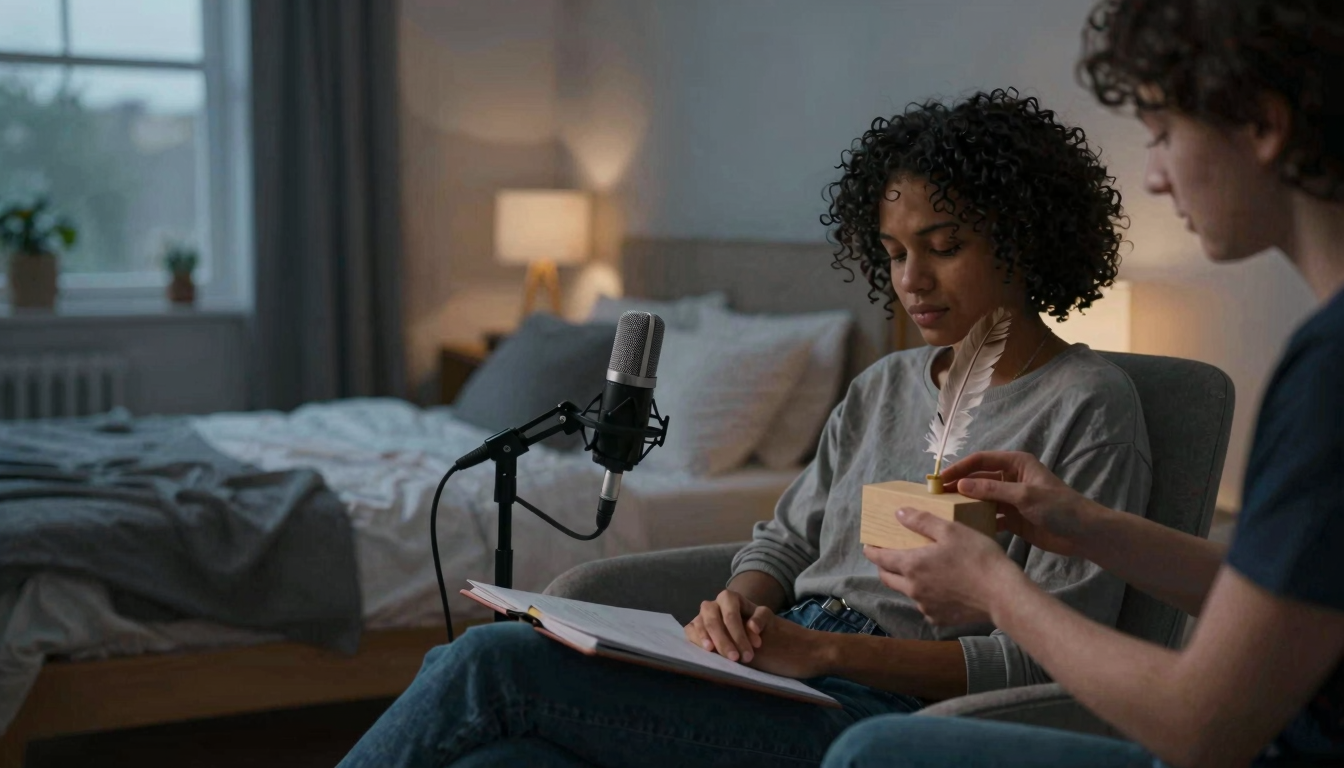
Creators explore these possibilities with elaborate microphone setups and ordinary materials. A pine cone, tuning fork, water cup or feather can produce a different texture of sound. The appeal may lie in the rhythm, proximity, repetition or careful handling, rather than the object alone.
Other videos create a social scene: simulated makeup application, a massage, a haircut or a short story performed for the viewer. Repeated actions and attentive pacing can make the encounter feel comforting. No particular frequency, prop or performance guarantees a response, and an intensely popular trigger may leave you completely unmoved.
What the research can tell us about benefits
Mood and relaxation
Early research has investigated both what viewers report and what happens while they watch. Accounts of feeling calmer or experiencing a better mood are worth taking seriously, but they answer a narrower question than whether ASMR treats a disorder.
Someone can feel better after a short video without experiencing a lasting improvement in insomnia or depression. Questionnaire scores, immediate mood ratings and clinical outcomes measured over time are different kinds of evidence. Self-selected online participants may also differ from people who have never sought out ASMR.
This matters especially for people with insomnia. A pleasant bedtime ritual may help create a quieter transition into the evening, while persistent difficulty sleeping still deserves an assessment of its causes. Established treatment should not be displaced by a video because it has a soothing reputation.
Heart rate, skin responses and brain activity
A 2018 study by Poerio and colleagues found reduced heart rate alongside increased skin conductance in ASMR experiencers watching ASMR videos. The combination suggests that calmness and physiological activation can coexist. The findings concerned people who experienced ASMR; they were not a universal response to putting on a whispering video.
Researchers have also used electroencephalography, or EEG, which records electrical activity through electrodes placed on the scalp. The source account describes a small comparison of people with and without ASMR experiences, using visual and auditory stimuli. It reports differences involving alpha activity, including a stronger response to auditory triggers among experiencers.
Alpha activity is often discussed in relation to relaxed wakefulness, but it is not a direct meter of successful sleep or mental health treatment. Nor does an EEG pattern establish that ASMR is equivalent to meditation. Such findings help researchers ask how the experience works; they do not establish how well it treats insomnia.
The reasonable personal question is simpler: does this leave you comfortable, and does it fit the rest of your evening? Enjoyment does not require a medical explanation or a claim that your brain has entered a special healing state.
Three experiences that can make ASMR less pleasant
Discomfort instead of tingles
Close whispers, exaggerated mouth sounds and repetitive movements can feel intimate to one person and intrusive to another. People without ASMR experiences may find certain performances strange or unsettling. You do not need to train yourself to enjoy them.
Differences in EEG responses have prompted possible explanations about attention or discomfort, but a recording alone cannot tell us exactly what a viewer feels. The most useful evidence in an ordinary listening session is your own response. Stop, lower the volume or choose something else if you become tense.
Misophonia and specific sound triggers
Misophonia involves decreased tolerance to particular sounds or associated stimuli, which can provoke strong unpleasant reactions. It is not simply a fear of sound, and calling it the opposite of ASMR obscures the distinction. The consensus definition emphasizes specific triggers and their effects.
Chewing is an obvious example of how preferences can diverge. It may feature in an ASMR video while being deeply unpleasant to someone else. A person can enjoy one kind of trigger and strongly dislike another.
Research interest in overlap between these experiences does not show that listening to ASMR causes misophonia. Neither tingles nor disliking a chewing video is enough to diagnose anything. Persistent sound-related distress that disrupts daily life warrants appropriate help rather than more exposure undertaken as a personal test.
What viewers call “immunity”
Some regular viewers say familiar videos stop producing tingles. Online communities sometimes call this ASMR immunity. It is an informal description of fading responsiveness, not a demonstrated process that inevitably happens to every listener.
The available account does not establish how common it is, why it happens or whether it lasts. A less intense response should not be treated as evidence of damage. Chasing the original sensation through longer sessions can also defeat the purpose if you meant to go to sleep.
Why some people respond more strongly
Sensory sensitivity
The source discusses associations between stronger ASMR experiences and greater sensory sensitivity. This includes attention to external sensations and awareness of internal bodily signals. A person might notice a delicate sound readily while also finding some background noise difficult to ignore.
These associations should not be turned into a hierarchy of nervous systems. They do not prove that ASMR listeners regulate emotions better, or that every sensitive person will experience tingles. Sensitivity can involve pleasant and unpleasant experiences, depending on the stimulus and context.
Personality differences
Questionnaire research described in the source compared ASMR experiencers with matched controls. It reported higher average openness and neuroticism scores, alongside lower average conscientiousness, extraversion and agreeableness in the ASMR group.
These are group comparisons, not a description of every listener. They do not mean that enjoying ASMR reveals your character, predicts how considerate you are or determines your mental health. The useful conclusion is that individual differences deserve study, rather than that a playlist doubles as a personality test.
Let the ritual serve its purpose
Try ASMR if you are curious and comfortable with it. Use a comfortable volume, choose sounds you actually enjoy and notice whether the session helps you settle. There is no obligation to feel tingles, and no reason to tolerate a trigger that makes you miserable.
If you use it at bedtime, decide when listening ends. A ritual intended to support sleep loses its value when searching for the next video keeps you awake for hours. The best result may be modest: a pleasant pause, followed by putting the device down and getting the rest you needed.
Frequently asked questions
Does everyone experience ASMR?
No. Triggers and responses vary, and relaxation can occur without tingles.
Can ASMR treat insomnia?
Immediate relaxation findings do not establish clinical treatment efficacy. Persistent sleep problems deserve assessment.
Does ASMR cause misophonia?
Overlap or shared sound triggers does not establish that ASMR causes misophonia.
Is ASMR immunity inevitable?
No. It is an informal description of fading responsiveness whose frequency, causes and duration remain uncertain.