Summary
A packed subway may make self-improvement products more attractive. The article explores subjective crowding, reported product preferences and the gap between interest and sustained action.
At a glance
Research reported in the article suggests that social crowding can increase preference for self-improvement products. The reported experiment compared movie-viewing offerings framed as learning English or passing time, rather than directly testing learning apps. Greater preference does not establish sustained studying or continued product use.
Could learning apps become more appealing as a subway car fills up?
Perhaps you have struggled to study efficiently at home alone, yet found it easier to concentrate in a small, crowded classroom. Or felt little motivation to learn during your free time, only to discover a sudden enthusiasm for studying in a noisy mall or on the subway. Might having more people around make us more inclined to study? Research on social crowding offers one possible explanation for what we might otherwise put down to a place’s atmosphere.
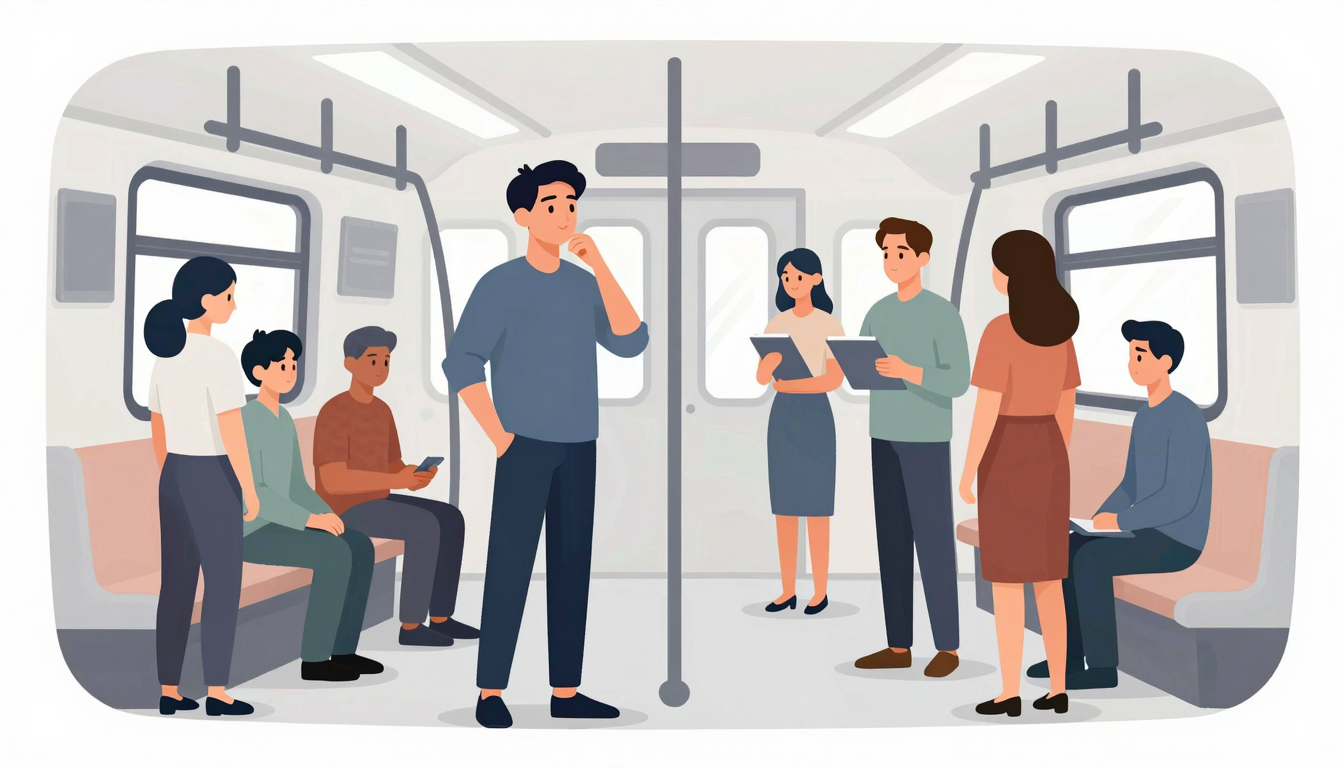
Imagine squeezing onto a subway during the morning rush, still half asleep, searching for a sliver of space among the other passengers. As the distance between you and everyone else shrinks, anxiety and impatience may build. That psychological pressure is one way social crowding can be experienced.
Social crowding describes the subjective feeling that arises when the number of people in a given area leaves less space available than an individual needs. Headcount alone does not determine how crowded a place feels. Physical conditions, the social setting and individual characteristics all matter. High density makes intrusions into personal space more likely and can intensify them, yet two passengers on the same train may have very different experiences.
For a playful illustration, imagine SpongeBob and Mr. Krabs sharing that ride. One might welcome the bustle while the other wants more space. These imagined reactions illustrate possible differences; they are not evidence about personality, housing size or how real people respond.
The surroundings matter, too. Temperature, noise and available space may all affect comfort. Adjusting what is practical can be more useful than assuming everyone should learn to tolerate the same conditions.
Mr. Krabs might welcome a full restaurant while disliking a packed train. The fictional contrast illustrates why context matters; it cannot show that crowding generally increases customer satisfaction.
Crowding may encourage compensatory consumption: spending intended to make up for a psychological lack or a threat to one’s sense of self. Research links crowded conditions with stronger attachment to brands, suggesting that this attachment helps consumers maintain a basic sense of belonging.
Back in Bikini Bottom, a lively restaurant can be imagined as attractive. But a crowd alone cannot establish its revenue, food quality or customers’ satisfaction. Those are different outcomes.
Crowding can also change the opportunities for interaction. Being near someone may make contact possible, but proximity alone does not establish empathy, connection or a willingness to help.
Other research associates greater crowding with more behavior aimed at expressing uniqueness. One way to interpret this is as a struggle to break free of conformity and affirm one’s existence as a distinct individual.
Could feeling more crowded also make you want to improve yourself? Imagine standing in a mall as crowds stream past, surrounded by noise and a mixture of smells. Would you interact less with the people around you, hurry out of the store, or spend heavily?
One proposed account treats crowding as a threat to personal space and self-improvement as a compensatory response. That is an explanation for a preference, not proof that buying a course solves crowding. Leaving an uncomfortable setting may be a sensible choice rather than a failure to improve yourself.
Self-improvement is defined as the motivation to actively pursue personal growth for better development. It can involve improving personal bearing and appearance, building skills and abilities, or improving health and wealth. For a subway passenger carrying no other study materials, a learning app on their phone seems an especially suitable option.
But does crowding make products aimed at self-improvement more appealing? Imagine being bored on a packed subway, opening your phone and hesitating between a vocabulary app and a game. Which would catch your attention? Would the crowd around you make you more inclined to choose the learning app?
In Ding and Zhong’s 2020 study, one comparison used movie offerings framed as learning English or passing time. Crowded-condition participants showed greater preference for the educational option. This did not directly test learning apps or completed learning.
The paper also analyzed 2015 Chinese General Social Survey data. Greater perceived fairness and lower regional employment rates were separate moderators, not conditions that had to occur together. Regional employment is not an individual’s reported difficulty finding work.
This is not a reason to seek a packed train as a study aid. The first experiment’s self-improvement preference result was marginal (p = .062), and the field comparison and observational analysis have different limitations. Interest in a learning product is not the same outcome as concentration or knowledge gained.
The experiments do support the idea that crowding can increase preference for self-improvement products. But preference does not amount to sustained action. What if you open your learning app more often, only to close it after two minutes each time? That would hardly be a lasting strategy.
Frequently asked questions
What is social crowding?
Social crowding is the subjective feeling that the space available among other people falls short of an individual's needs. Physical conditions, social context and individual characteristics influence that experience.
What did the reported self-improvement study compare?
The reported study compared two movie-viewing offerings: one advertised as a way to learn English and another as a way to pass the time. Participants in crowded conditions showed greater willingness to use self-improvement products than those in uncrowded conditions.
When was the relationship between crowding and self-improvement stronger?
The observational analysis found separate moderating patterns for higher perceived social fairness and lower regional employment. Both were not required together, and regional employment should not be confused with a person’s own job-search experience.
Does preferring a learning product mean someone will keep studying?
No. The article explicitly distinguishes greater preference for self-improvement products from sustained action. More frequent app openings do not establish continued use or lasting study.