Summary
A quick reply can become a chain of distractions. How interrupted you feel, how you judge your phone use and the importance you attach to work may shape the fatigue that follows.
At a glance
Personal phone use during work can fragment attention, and feeling interrupted may contribute to emotional exhaustion. A four-day diary study of 67 Dutch employees linked more frequent personal smartphone use with greater perceived interruption and same-day exhaustion. The article recommends quiet work periods, deliberate app use and active management of work–life boundaries.
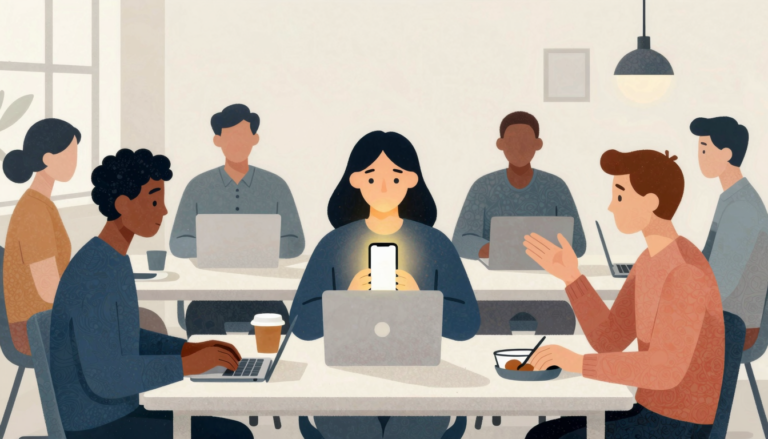
Imagine you’re partway through a document when your phone vibrates. A friend has sent a message. You reply, then scroll through a few posts on Weibo. From there, you open a shopping app and browse its limited-time offers. When you finally turn back to the computer, you stare at the document: where had you left off?
The whole detour seems to have taken only a few minutes. Yet a day filled with these brief diversions can end with little work finished and your mind feeling drained. What looks like an efficient use of spare moments keeps breaking up time already devoted to something else. Recovering your focus begins with noticing those interruptions and how you manage them.
Increasingly, the working day seems to run along several tracks at once: work, replies to family and friends, and a stream of information to browse. Smartphones can give us a sense of control over our time while quietly weakening our awareness of how it passes and blurring the boundaries between work and personal life. When personal phone use slips into working hours, are we saving time, or drawing down the time and energy we have available? Does checking the phone give us a chance to rest, or does it interrupt what we’re doing?
Derks and colleagues explored this question in a four-day diary study of 67 Dutch employees, tracking how often they used smartphones for personal purposes during their actual working days and how they experienced that use. More frequent personal use was associated with a stronger sense of being interrupted, which in turn was linked to greater emotional exhaustion that same day. The researchers identified perceived interruption as a key mediator: feeling disrupted helped explain the relationship between personal phone use and exhaustion.
One way to understand that pattern is to consider what even a few minutes away from work can do to the flow of attention. Checking WeChat, replying to family, browsing social media, or reading the news may each take little time. Yet as these ordinary interruptions accumulate, the mind can feel as though it has been cut into pieces. Repeatedly breaking attention can add a psychological burden, making work harder to carry out efficiently while also interfering with the chance to recover energy. A brief detour onto the phone does not automatically amount to a restorative break.
How we judge that detour also matters. Derks and colleagues reported a stronger sense of interruption among employees who viewed their personal phone use negatively.
Imagine opening Moments, WeChat’s social feed, out of habit when you have no real desire to browse, then feeling guilty afterward. Or you might be dealing with a family matter on your phone while feeling distracted and irritated. Such feelings can reinforce the sense that you have wasted time: “I could have been more focused.” In this explanation, the judgment surrounding the interruption can deepen the exhaustion. It leads to an emphatic interpretation: the psychological impact depends on how we experience and evaluate our phone use, rather than how long it lasts.
People also differ in how tiring they find personal interruptions. Derks and colleagues identified work centrality—the importance work holds in a person’s life—as a relevant factor.
A possible explanation is that people who are more oriented toward work experience stronger conflict between their roles, and greater mental fatigue, when private matters interrupt the working day. Consider someone deeply invested in a career or highly conscientious about work. The more focused they are on work, the harder they may find it to tolerate personal matters entering that time. Someone who places greater importance on family or other roles in life may find those matters less exhausting to handle during work. They may even offer a respite.
This points to a broader understanding of time: its value depends on what we spend it doing, but also on where we understand the boundaries between our roles to lie and how separate we want those roles to remain.
The practical warning is that scattered moments of personal phone use can gradually eat away at uninterrupted time and the ability to focus deeply. Feeling interrupted can make work less efficient and may add to daily fatigue, particularly for people who place a high value on work. Protecting attention therefore calls for deliberate choices about when and how to use the phone.
Set aside quiet periods for focused work, with personal-message notifications turned off. Give your attention a continuous stretch of time in which to stay with the task.
Before opening a personal app, pause and ask, “Do I actually want to browse?” That question offers a way to interrupt the habit of opening an app automatically and drifting away from what you were doing. The aim is to make phone use a conscious choice.
Work and personal life cannot be completely disconnected. Managing the boundary means accepting that connection while deciding when to allow one role into time devoted to another, and when to keep that time protected.
With information constantly arriving, it can feel as though other people and their notifications decide how we spend our time. A message comes in, and we immediately stop what we are doing to reply. A notification sounds, and we automatically switch to another window. Being able to say “no” is one way to reclaim a say in where our attention goes.
On the days when you feel most exhausted, consider how often you have been interrupted alongside how much you have had to do. Frequent interruptions may explain more of that tiredness than the amount of work alone. Gradually, we can learn to protect even a small stretch of time that passes without interruption.
Frequently asked questions
Is checking your phone at work always a restorative break?
A brief detour onto the phone does not automatically amount to a restorative break. Personal interruptions may feel less exhausting, or even offer a respite, for someone who places greater importance on family or other life roles.
What is work centrality?
Work centrality means the importance work holds in a person’s life. Derks and colleagues identified it as a relevant factor in how tiring people find personal interruptions.
What does the article recommend for managing phone interruptions?
Set aside quiet periods with personal-message notifications turned off, pause before opening a personal app to ask whether you actually want to browse, and decide when to allow personal matters into working time.