Summary
A pointing finger may ask for a name, and an unclear word may make sense once you follow the situation. Understanding young children starts with noticing their perspective and learning their particular habits.
At a glance
Combine a child's gestures and speech with knowledge of their habits and the situation. Pointing may seek information or indicate something they want, and differences in viewpoint can make its target easy to misread. Treat unclear words as context-based guesses, while checking whether your own priorities are shaping your interpretation.
Young children are mysterious creatures, capable of materializing beside you—or somewhere in your extended family—at any moment. Their innocent smiles and unhurried movements lull you into lowering your guard. Then, just as you are drifting off to sleep or nearing the end of your patience, they deploy their secret weapon: baby language.
Its power goes beyond the extraordinary intonation or the volume of a small lion. The real challenge is meaning. Somehow, it sounds almost like your own language while remaining utterly incomprehensible.
If you would like to hold your own with the children you encounter on public transportation, or stop responding to every little conversationalist with helpless babbling, welcome to the advanced baby-language training program. Let’s see what it takes to earn that imaginary Level 10 certificate.
Start with what children communicate without words
Beginners should resist the temptation to decode every spoken syllable immediately. To understand young children, first pay attention to what they communicate without words.
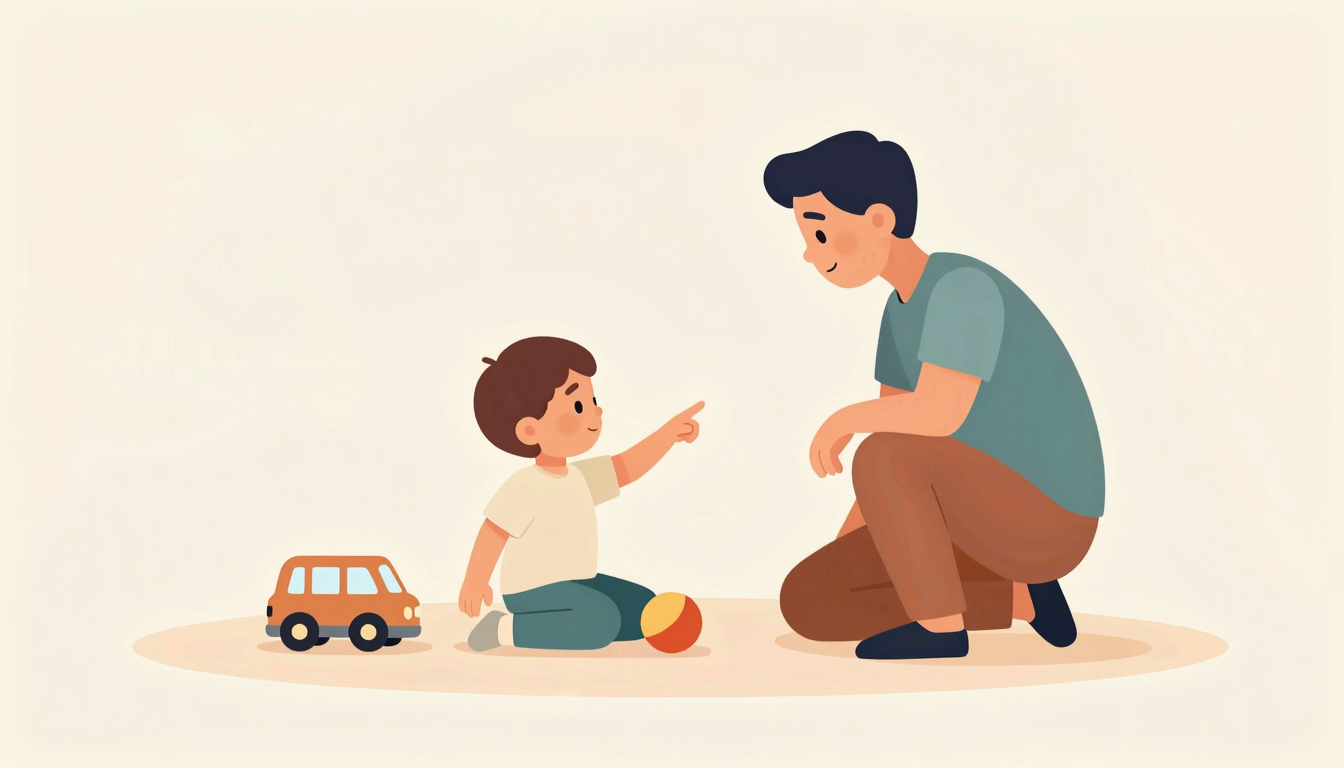
Picture a familiar family gathering. Aunts and other relatives sit around chatting and eating sunflower seeds in front of the television. Inside their circle, a young child plays with a few toys on a padded mat. Every so often, the child raises an arm, extends an index finger toward the television, and makes an unintelligible sound.
Researchers call this a pointing gesture: directing a finger toward an object, location, person, or event. Pointing is among the gestures adults use most often in communication, and among the earliest forms of nonverbal communication children acquire. For students of baby language, it is required coursework.
There are two things to learn here: what the gesture might mean, and how to work out what it actually points to.
A pointing finger may be asking a question
Unlike simply reaching out an open hand, a child’s pointing often expresses a wish for information about whatever has caught their attention.
A child pointing at a pineapple on television, for example, may be seeing that fruit for the first time and wondering what it is called. They may be asking for a name, rather than plotting to wrest a snack from a parent.
Pointing is especially effective at drawing a response from adults, particularly a spoken one. Research on language acquisition has found that adults respond verbally to pointing more frequently than to other communicative behaviors.
Suppose a child reaches toward a toy. A parent might simply hand it over. If the child points at the toy instead, the parent might say, “Do you want the truck? Shall I get it for you?” while passing it across.
The second exchange gives the child considerably more information to learn from. Early in development, children recognize that pointing can bring fuller feedback, helping them discover and understand the world.
Check whose line of sight you are following
Now suppose you bring over a toy, only for the child to ignore it and keep pointing at the pile.
“But I’ve already given you the one you wanted!”
If that is your first thought, you may have walked straight into the next exam question. How certain are you that you identified the right toy?
People can disagree about the target of a pointing gesture because they perceive it from different positions. This is known as pointer–observer misunderstanding.
The person pointing tends to indicate the target along a “touch line” running from their own eye through the tip of their finger. An observer generally draws on two different cues: the line from the observer’s own eye to the pointer’s fingertip, and the direction of the pointer’s forearm, from elbow to wrist.
Those cues do not necessarily lead to the same conclusion. From certain relative positions—when you see the person from the side, for instance—it is easy to rely on a misleading forearm direction or otherwise misjudge the target because your viewpoint differs from theirs.
So when a child points, consider how the scene looks from the child’s position. Repeatedly delivering the wrong toy leaves them with an arm still raised and a message still undelivered.
Understand both the possible purpose of pointing and the possibility of misreading its target, and you have made real progress. Children’s body language is much more varied than this one gesture, however. There is plenty of coursework left.
Learn to make better guesses about words
Body language alone will only take you so far. A fuller understanding comes from combining it with what children say.
One major obstacle is unclear pronunciation. It can be difficult to tell which word a child is attempting, and a wrong guess can produce exactly the sort of exchange that ends up circulating online as a joke. For aspiring Level 10 interpreters, learning to guess well is unavoidable.
Build expectations around the particular child
The first step is to think about what the child might actually need.
A study using a Bayesian model suggests that “child-directed listening” may be a foundation of our ability to understand young children’s speech. In other words, our expectations help us interpret what we hear.
Consider a Mandarin-speaking child who has just started talking and says, “Mommy, I want du-du.” An adult might lean toward interpreting the unclear sounds as dú shū, reading a book, rather than dú chǔ, being alone. We would generally consider a wish to hear a parent read a story more likely than a request for some quiet solitude.
The better we know a particular child, the better our chances of guessing what they mean. Useful expectations come from knowing what that child is likely to do or want.
Yet adults often impose their own judgments instead.
There is another possible interpretation of “du-du.” Perhaps this child has always called a toy car with a horn “doo-doo,” after its sound. In that case, “Mommy, I want du-du” could mean, “Mommy, I want the car.”
A parent preoccupied with giving the child an educational head start, enthusiastically promoting a newly purchased set of early-learning books, might overlook the simpler possibility that the child wants to play. One mistaken interpretation can turn a happy family scene into an arena of deafening tears.
To develop reasonable expectations, ask whether you are reading a child’s wishes through an adult’s priorities. Treat the child as an individual. Ask appropriate questions and gradually build a picture of their habits and preferences. That is how you get closer to understanding their actual needs.
Follow the situation, not just the sound
The other essential ingredient is context. Pay attention to the event the child is describing, rather than concentrating exclusively on a particular word or its pronunciation.
We can get stuck asking, “What word are they saying?” when the more useful question is, “Given the parts I understand, what might have happened?”
Imagine a child who falls during physical activity at kindergarten and scrapes a knee. The teacher responds promptly, disinfects the wound, and lets the parent know. When the child comes home, the parent asks, “Your teacher told me you fell and hurt yourself today. Did it hurt?”
The child thinks for a moment, then delivers a startling answer: “It didn’t hurt when I fell! It hurt a little when the teacher used a bat on me!”
The parent is about to offer some praise when one distinctly out-of-place word registers: a bat?
In Mandarin, the word for the animal is biānfú. Given the wound-care context, a plausible explanation is that the child has mixed it up with diǎnfú, povidone-iodine antiseptic. The child may be describing the discomfort of having the scraped knee disinfected.
Focus only on what the isolated sound could mean, and it is easy to get so tangled up that your own powers of reasoning seem to disappear. Follow the event being described, and the apparently absurd statement becomes much easier to interpret.
Why context changes what we hear
Context plays an important role in how people understand language. Research suggests that relationships between a target word and words in its surrounding context can create a simple but powerful priming effect, helping us process meaning.
A brain-imaging study by Baumgaertner and colleagues examined this process. Participants first read the beginning of a sentence, such as “The pilot steers…” They were then shown continuations from four categories:
- An expected word, such as “airplane.”
- A less expected word that still makes sense, such as “kayak.”
- An unexpected word that does not make sense in the sentence, such as “book.”
- A pseudoword: a made-up item, illustrated in the account by a Chinese character combination romanized as “dèngrán.”
Compared with “airplane,” continuations such as “kayak” and “book” were harder for participants to understand, with increased corresponding brain activity.
Our understanding of a situation creates expectations about the words that will follow. When the actual word clashes with those expectations, confusion is hardly surprising.
For anyone trying to understand baby language, thinking about speech in context may therefore be one of the most important skills of all. What you know about the situation can help you make sense of what the child is trying to say.
The final exam
Young children have limited life experience and have not yet systematically learned pinyin or written language. Unfamiliarity and verbal slips can therefore put plenty of obstacles in the listener’s way.
The road to mastery of baby language is long and demanding. Only a determined few will stay the course and claim the illustrious title of Fandou Garden’s Honorary Leader of the Kids.
Frequently asked questions
Does a child's pointing always mean they want an object?
No. Pointing often expresses a wish for information about something, such as its name. It can also accompany a desire to obtain an object, so its meaning depends on the situation.
Why might an adult misunderstand what a child is pointing at?
Different viewing positions can lead the adult and child to identify different targets. Consider how the scene looks from the child's position, especially if the child ignores the object you offer and keeps pointing.
How can knowing a child help adults understand unclear speech?
Knowing the child's habits, preferences, and particular uses of words helps adults form more reasonable guesses. Those expectations can become misleading when adults impose their own priorities.
How does context help explain a child's confusing words?
Following the event the child is describing can suggest a plausible meaning for an unclear word. Such an interpretation remains a context-based inference rather than proof of what the child intended.