Summary
Primary control aims to influence circumstances; secondary control adjusts goals, interpretations or attention. Lifespan theories explore how they interact as opportunities and constraints change.
At a glance
Action and inward adjustment can support each other. The framework distinguishes actual influence from feeling in control, but neither a stable sense of control nor a healthy outcome is guaranteed. Choose strategies that fit the situation and remain open to help, new information and revised goals.
Can we change the world? The question becomes especially pressing when events expose the limits of our influence. We can try to change our circumstances, or adjust ourselves in response to them. Finding a balance between those approaches is a task that continues throughout life.
Writing nearly three years after the COVID-19 pandemic began, the author described changes that had slipped almost unnoticed into everyday life. What people initially expected to be a temporary interruption had persisted far longer than they imagined. Even those least affected were encountering more things beyond their ability to manage. The experience brought human smallness before nature into focus, along with helplessness in the face of life's unpredictable events. Uncertainty grew as the feeling of being in control diminished.
That helplessness can make life seem empty of meaning. Yet the author's argument is that understanding and managing our sense of control has always been a lifelong task. Learning as much as we can about that feeling helps us respond to it. Adverse changes in our surroundings and the aging of our bodies can reduce what we are actually able to do without necessarily eroding our sense of control. Older adults may have much to offer on this distinction.
Perceived control concerns the belief that one can influence events and conditions through one’s actions. It differs from the actual opportunities, constraints and resources available. Feeling capable does not erase material limits, while feeling powerless does not necessarily mean there is no useful action to take.
This distinction helps explain why a response can restore a sense of control without changing the situation itself. When direct action fails, people with strong perceived control often try alternative behaviors to cope with the source of stress. Those alternatives may replenish their sense of control even if the external problem remains unchanged.
Research links perceived control with well-being and health, but influence can run in both directions. Longitudinal work on control and health examines those changing associations. It does not establish that increasing confidence alone treats anxiety or depression, or removes the external causes of stress.
People may respond to uncertainty by searching for explanations or repeatedly checking information. These behaviors can feel reassuring without improving actual control. A conspiracy belief or frequent social-media use is not, by itself, evidence that control has been restored.
A practical starting point is to identify one manageable action and seek reliable information or help. Confidence in an institution should depend on evidence about its actions, not become an instruction to trust more. Feeling knowledgeable is also different from being accurately informed.
The lifespan perspective holds that psychological development continues through middle and old age. Rothbaum, Weisz and Snyder distinguished primary and secondary control in 1982. Heckhausen and Schulz’s later lifespan theory adapted that distinction; the 2010 motivational theory explains this lineage. They should not be presented as one theory originated entirely by Rothbaum.
In this theoretical account, control is a central theme of development from infancy to old age. People act to make things happen, leaving traces of their existence through their influence on the environment they depend on. The need for control is understood as innate, and the effort to exercise it continues throughout life.
To illustrate its significance, the author asks us to imagine an entirely uncertain environment where we could change nothing. Even our sense of our own existence might begin to blur. Our actual encounters with the world bring both success and failure: sometimes we influence what happens, and sometimes we cannot. These changing results require continual adjustments in strategy. Control theory distinguishes two basic forms of this effort: primary control and secondary control.
In the developmental account, infants' innate need for control leads them to engage actively with events around them. Feedback from those interactions helps develop their sense of control. Rothbaum and colleagues call this behavioral process primary control: it expresses the desire to exert actual influence over the surrounding environment.
Confidence and accuracy need not be opposites. Research on “depressive realism” has produced mixed findings, including a meta-analysis and a preregistered replication that challenged a robust effect. It does not establish that realistic beliefs cause depression or that distorting reality is a sound way to protect mental health.
Confidence does not prevent disappointment. As children grow, they develop feelings of pride, anger, shame, and embarrassment. Disappointing feedback from their interactions with the environment can bring negative emotions that damage their self-esteem and self-efficacy—their belief in their ability to act effectively. In the author's explanation of the framework, children gradually discover secondary control as a way to protect themselves from this harm.
Secondary-control strategies can include adjusting goals, interpretations or attention. In lifespan accounts, such adjustments may support continued effort or disengagement from a goal that has become unattainable. They need not occur only after failure, and they cannot guarantee emotional stability.
The primacy of primary control is a proposition within the lifespan theory, not proof that every person at every age always prefers outward action. Selection and compensation describe ways of adapting effort to changing opportunities. The appropriate balance depends on the situation.
Illness or functional limitations can reduce some opportunities for action, while support, adaptations and resources may preserve others. Old age is not one uniform state of frailty. Ask what a person can influence in the particular domain rather than assuming their age determines it.
Perceived control does not simply track physical capacity, but it is not always stable in old age. Longitudinal research found different patterns for global control and control over daily stressors, including declines in older participants. A stable score in another study would not, by itself, prove that secondary-control strategies caused the stability.
When a problem cannot currently be changed, reframing it or shifting attention may be useful. That does not require blaming yourself, accepting responsibility for someone else’s actions or avoiding a problem that still needs attention. These are options to evaluate at any age, not skills every older adult automatically possesses.
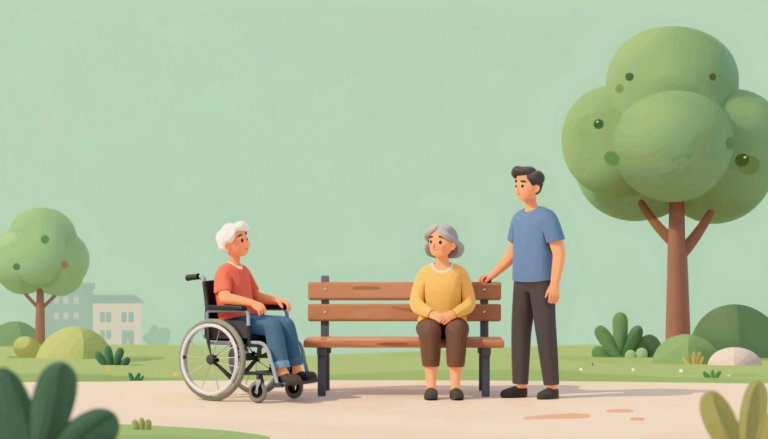
Adjusting how much we rely on primary and secondary control is an ongoing task, and older adults' ways of coping offer some guidance. The pandemic's unpredictability revealed nature's power, but it need not mean that our control over life is illusory or that our efforts have no effect. Accepting uncertainty and limits while continuing to respond to them may open a broader experience of the world.
Frequently asked questions
What is the difference between actual control and perceived control?
Actual control concerns our capacity to influence circumstances. Perceived control concerns our subjective sense of that capacity. The author argues that adverse circumstances and physical aging can reduce actual capacity without necessarily eroding perceived control.
Does secondary control mean giving up on action?
Not necessarily. Adjusting goals or interpretations may support renewed action, or help someone disengage from an unattainable goal. The theoretical primacy of primary control is not a rule that outward action must always come first.
What can older adults' coping teach us about control?
Some people develop useful ways of adjusting goals as circumstances change. Age alone does not guarantee those skills or a stable sense of control. Reappraisal can be worth trying without assuming responsibility for events you did not cause.