Summary
A nightmare disclosure opens a discussion of why conversations stall, why devoted effort can miss a partner’s needs, and how curiosity and shared play keep an exchange alive.
At a glance
The writer suggests that conversations can stall through recurring interaction patterns, care that overlooks a partner’s needs, and fading shared enjoyment. Asking what support a partner wants and responding to their feelings can make room for connection. Examining participation in a pattern does not establish equal responsibility for harmful acts or mean that victims are guilty; change requires effort from more than one person.
“I Had a Nightmare Last Night”
Imagine telling someone you like, “I had a nightmare last night.” They might soothe you with a little lullaby:
“Sleep, sweetheart, sleep. I’ll be with you in your dreams.”
Or offer an explanation:
“Understanding dreams is an important way to reach the unconscious and understand yourself…”
Or brush it aside:
“What’s the big deal? It was only a dream.”
Which reply would most make you want to flip the table?
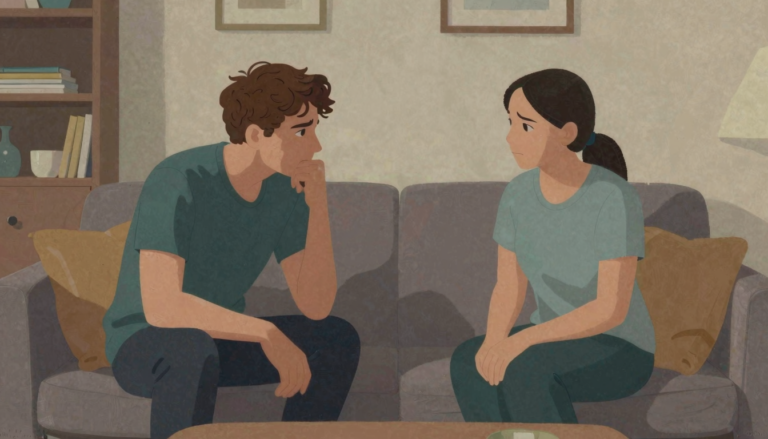
Beneath the joke is a frustration familiar to some people who have been together for years. You say something, hear the reply, and find you have nowhere to go with the conversation. Why has talking to your partner become so difficult? And why do they seem less and less able to show you care?
The essay’s writer offers an uncomfortable possibility: you may also be allowing the conversational impasse to continue. The objection is easy to imagine: “How is that my problem? They’re the one who can’t hold a conversation or show any care. I’m the one being hurt.”
The writer turns to systemic family therapy to examine that possibility. In this account, what happens between partners cannot be reduced to a simple chain in which one person causes a problem and the other merely receives it. Their interactions create cycles nested within other cycles. Understanding a relational problem therefore means looking at more than one person’s behavior, though participation in a pattern does not establish equal responsibility for harmful acts.
An imagined systemic therapist might put the challenge this way: “Your partner brought the conversation to a halt, and you did nothing.”
“I did nothing” can be a declaration of innocence: you did not cause the hurt. But it can also describe inaction that leaves the situation as it is. In the writer’s framing, doing nothing can have considerable consequences for whether a pattern continues, especially when a partner treats you badly.
The therapist’s next question would be, “Why did you do nothing?” There may be meaningful reasons for leaving things unchanged. What are those reasons, and what makes the existing situation one you continue to maintain?
Sometimes, the writer suggests, complaining is less an attempt to change the situation than a way to convince others of a particular account: “My partner is unreasonable—the stereotypical clueless man. I’m the one being hurt, and they’re the reason my life is unhappy.” Framing the problem this way can spare the person complaining from examining their own part in the pattern.
Learning to communicate differently takes time and can be difficult. Complaining is comparatively easy. It can offer a way to avoid the pressure of change and the possibility of trying something that fails. The reasoning might run: “If I do nothing, our unhappiness is entirely my partner’s fault. But if I try to change things and life is still unhappy, I’ll have to take all the blame.” That is the fear being described, not a judgment that an unsuccessful attempt would actually make one person responsible for everything.
The writer explicitly rejects the conclusion that victims are guilty. The point is that change requires effort from more than one person.
“You Say You Love Me, but I Don’t Feel It”
Making an effort brings its own question: does that effort address what a partner needs? Being told “I love you” and feeling loved can be very different experiences. The writer illustrates the gap with two imagined complaints.
One partner might say, “I work overtime, push myself to earn more, and pursue promotions and raises for our future. I buy her designer bags and the latest lipsticks. Why is she still unhappy?”
A woman might ask, “I keep the house in order, do all the cooking and laundry, and look after his parents. Why is he growing colder toward me?”
Both assume that the care they have chosen to give—buying things for a partner or being a capable, supportive presence at home—is what being good to that person means. When they think of everything they have sacrificed, they feel exhausted. Yet, in the writer’s interpretation, neither has stopped to ask their partner, “What do you actually want?”
The comparison that follows is pointed: imagine handling and training a pet entirely according to your own wishes, without considering what it needs or how it feels. Your own feelings and needs come first, leaving little room for respect. The analogy exposes a similar problem in care organized around the giver’s preferences while overlooking the recipient’s experience.
The writer suggests that this mismatch may be familiar in many families: gifts arrive, the household is cared for, yet a partner still feels unloved. The explanation offered is that the person giving care is absorbed in their own feelings and has missed their partner’s psychological needs. One person may be thinking, “Of course I love you,” while the other can only answer, “I don’t feel it.”
“What kind of life do you want?” and “How would you like me to treat you?” make room for a different approach. Asking these questions, understanding a partner’s psychological needs, and offering love in a way they want to receive it means respecting them as a person with wishes and feelings of their own.
Responding to the Feeling Behind the Words
Return to the nightmare. The writer suggests that saying “I had a nightmare last night” often expresses a need for emotional care. The explanation rests on an account of affection as fundamentally a form of attachment, usually built through emotional responsiveness.
Consider the mother and infant described in that account. The baby, still too young to speak, looks at the mother, and she looks back. Their eyes meet. The baby smiles, and the mother smiles in return. Through this exchange, the infant is said to feel assured: “Mom likes me.” The explanation extends to adulthood, when we form new attachments with partners. Responding to each other emotionally remains a source of vitality in those relationships.
Seen this way, “What’s the big deal? It was only a dream” conveys disinterest in what the partner is sharing and impatience with hearing more. It offers no emotional response to the distress behind the disclosure. That helps explain why the person who mentioned the nightmare no longer feels like talking.
The writer links more frequent emotional responses between partners with better relationship quality. When those responses are absent or repeatedly interrupted, people can feel lonely, anxious, and insecure: the person across from them seems not to understand them.
If you don’t know how to respond, the suggestion is to ask sincerely: “Would you like to tell me what happened in your dream, or would you rather I hold you and comfort you?” The question gives your partner room to say what kind of support they want.
Still Enjoying Each Other
There is also the pleasure that once made talking and spending time together so appealing. How does someone you couldn’t get enough of—someone whose every little quality seemed appealing—become a person you struggle to keep a conversation going with?
The writer turns to courtship. Usually, both partners try to satisfy their own desires and each other’s: going shopping, watching movies, kissing and cuddling, doing things they want and enjoy. Much of this comes down to play. Dates become different ways to have fun together. The scenery may be beautiful, but the person beside you seems more beautiful still. You keep arranging another date because you enjoy being together.
As time passes and the relationship settles, perhaps moving into marriage, can you keep that delight in each other? Can you still love playing together and feel that your partner is the most fun person to be with?
The writer describes how marriage can become an exchange between the roles of husband and wife, leaving less room for two people to meet as individuals. An invitation might go like this:
“Want to go to the movies?”
“No, I have to work overtime!”
Or a disagreement might turn on whose family obligations count as shared responsibilities:
“Can you keep me out of your family’s business?”
“Isn’t my family’s business yours too?”
When the interest in having fun together disappears, the writer warns, the dream of early romance can gradually fade and end up buried. People often say that marriage turns romantic love into familial affection. But in the writer’s view, interest in each other and the simple pleasure of liking each other help hold either kind of bond together.
So how might someone you like respond to that opening line? Perhaps like this:
“I had a nightmare last night.”
“Oh? What was it about? Was I in it?”
“Now that would make it a really terrible nightmare.”
“Oh, get out of here…”
Frequently asked questions
Why might a partner’s efforts fail to make someone feel loved?
The writer suggests that gifts, earning money, or household care can miss a partner’s psychological needs when the giver assumes what the recipient wants without asking. The criticism concerns that mismatch, rather than those forms of care being inherently ineffective.
How can I respond when my partner mentions a nightmare?
If you do not know what would help, the writer suggests sincerely asking whether your partner wants to describe the dream or would prefer a comforting embrace. A nightmare disclosure often seeks emotional care, but the question leaves room for your partner to choose the support they want.
Does examining relationship patterns mean victims are to blame?
No. The writer explicitly rejects the conclusion that victims are guilty. Participation in an interaction pattern does not establish equal responsibility for harmful acts, and change requires effort from more than one person.