Summary
A child may need more than a reminder to return to school routines. This article connects pandemic disruption and developing abilities with parental modeling, practical planning and help beginning tasks.
At a glance
Begin by considering both pandemic disruption and the child's developmental stage; difficulties can partly reflect abilities still developing. Model routines, express feelings in words and cooperate as parents. Speak gently and firmly, make explanations concrete, agree on practical steps with the child, and help them begin before handing back the task, allowing further help when needed.
Pandemic disruption can make the return to school routines difficult for the whole family. Children may resist studying, struggle to concentrate, take a long time over simple tasks, work inefficiently, make careless mistakes, lose things or prefer games to schoolwork. Before trying to change those behaviors, we need to understand them. Two contexts matter: the effects of the pandemic and the child's stage of physical and psychological development.
Understand what lies behind the behavior
During the pandemic, children may become clingier, more withdrawn, timid, frightened, restless or quick to lose their temper. These are normal responses to an unsettling situation. Feeling unsafe or agitated makes it harder to establish good habits.
Family rules may also have loosened. Games, cartoons, snacks, late nights and sleeping in may have become acceptable after previously being restricted. Together, distress and disrupted routines can create conditions in which unwanted habits take hold.
Development matters, too. Almost every parent of an elementary-school child has complained about dawdling, inefficient work, a lack of initiative, carelessness or an apparent refusal to listen. It is easy to call a child lazy, forgetful, unmotivated or interested only in play. Yet these behaviors can, to a degree, reflect abilities that are still developing.
Consider why a long explanation about doing the right thing may fail to get through. Elementary-school children are moving from concrete, image-based thinking toward abstract thinking. An adult's general principles may simply be too abstract for them to understand.
Or consider the child who writes something incorrectly, overlooks a question on a test or skips words while reading. Children's perceptual span is still limited: where an adult takes in the whole picture, a child may notice only a small part of it. Their capacity is not yet the same as an adult's.
Uneven handwriting has a physical dimension as well. Fine motor control is still developing, so children cannot necessarily control their fingers with adult precision and flexibility.
Perspective-taking also develops gradually. A kindergarten child may not yet understand that someone else's feelings or preferences can differ from their own. A child who loves toy cars may assume that every other child loves them, too. Younger elementary-school children may know that other people think and feel differently without knowing what those thoughts and feelings actually are. They may say something that leaves a parent furious without anticipating its effect.
Likewise, what looks like a lack of initiative in studying needs to be understood in developmental terms. Attention, perception and memory are moving from processes that occur without deliberate effort toward processes children can direct intentionally. Their ability to take charge of learning is still taking shape.
The useful response is patient skill-building. Instead of attaching labels, help children develop self-control, independent learning, memory, fine motor skills, abstract logical thinking, and the ability to recognize and manage emotions. Those developing capacities support better habits.
Make the family environment support good habits
The atmosphere at home is the soil in which habits grow. Children learn from what parents do, not simply from what they say. Psychological research on imitation supports the importance of adult modeling: parents' behavior can influence children far more than their instructions do.
There are three areas in which parents can provide a useful example: everyday behavior, emotional communication and cooperation.
Show the routines you want children to develop
If a parent sleeps until 10 a.m. and then starts playing games on a phone, it is difficult to expect a child to begin studying independently. If you want regular sleep and waking times, demonstrate them yourself. If you want a child to read, make room for your own reading and spend less time on your phone.
Two practical changes can help distinguish the different activities that happen at home. Where space allows, give learning a designated place, such as a study or a room used specifically for schoolwork. Familiar preparation routines can also mark the difference between one activity and another.
For parents working remotely, that may mean keeping the schedule they followed when going to work. For example, get up at 7 a.m., wash and brush your teeth, change clothes, and take time to groom yourself or put on makeup before beginning work at home. These familiar actions can help you enter work mode more readily than starting in pajamas without getting ready. They also give a child who might otherwise interrupt a clear signal: Mom is starting work now.
Children can follow a similar transition. Help them maintain their school-day schedule as closely as possible, following the school's timetable and online-class arrangements. Washing their face and changing into school clothes can signal that school has resumed and it is time to learn. Although they are at home, this part of the day is for learning rather than leisure.
Put feelings into words
Almost every parent has lost their temper with a child. Parenting can be infuriating, and never feeling angry is an unrealistic expectation. A central part of emotional regulation is managing how the feeling is expressed.
Start by accepting that anger itself is normal. Then express it in words instead of acting it out through an outburst. Describe what you feel and, when useful, what brought the feeling on. This gives the child a chance to understand what is happening without being hurt by an eruption of anger.
Suppose you have repeatedly asked your child to stop gaming and do homework. After the first reminder, you may feel irritated. By the third, you may be seething and tempted to shout or snatch the phone away and throw it.
Try describing the change instead. At the first reminder, you might say, "I'm starting to feel angry. The anger inside me is about the size of a dragon fruit." By the third, you might say, "I've asked you three times to stop playing and start studying. I'm very angry now. I feel like a balloon that's been blown up so much it's about to burst."
Those concrete images can help children understand a parent's feelings and thoughts. They also demonstrate how to express emotions in language.
Cooperate without undermining each other
Pandemic pressures make mutual respect and cooperation between parents especially important. In a household where both parents work, one may go to a workplace while the other stays home with the child. When the parent who has been out returns, taking over childcare gives the parent who has been at home time to deal with work responsibilities.
Such cooperation teaches respect and teamwork. It also gives children clearer expectations and fewer opportunities to play one parent's rules against the other's. When parents repeatedly disagree, blame each other or fail to cooperate over child-rearing, children may become unsure what is expected. They may also ally with whichever parent currently supports their wishes, switching sides when it suits them.
Gaming provides a familiar example. A mother believes games should be prohibited altogether, while a father thinks a little play is harmless. When the child wants to play, the father's backing weakens the mother's ability to enforce her rule. Her resulting resentment and refusal to accept his position may then weaken his authority as well. Mutual criticism and undermining make it harder to guide the child and establish good habits.
Parents do not need identical beliefs or methods to treat each other respectfully. Cooperating and respecting the other person's role as a parent can support habit formation while showing children what respect and cooperation look like.
Four ways to turn communication into action
Communication is a major part of guiding children. Used well, it can strengthen the parent-child relationship while helping habits develop. Four connected approaches address different needs: becoming willing to listen, understanding the message, knowing what to do and getting started.
1. Speak gently and firmly
If children do not want to listen, guidance has nowhere to begin. The same words can feel very different depending on how they are spoken. People often respond strongly to a speaker's manner and attitude, sometimes more strongly than to the content itself.
This matters particularly when pandemic anxiety has left children tense or unsettled. A gentle manner can help them relax and become more receptive. Firmness helps them follow through.
Both qualities are necessary. A parent may be gentle but give way whenever a child looks pleadingly at a snack or starts crying. Repeated concessions teach children that boundaries can be pushed until they disappear.
At the other extreme, a parent may be firm but harsh, shouting, "No!" or "I told you that you can't go outside! Why won't you listen?" The child may comply while feeling distressed or frightened. Harshness can also provoke resistance, defiance or confrontation.
Begin by noticing your volume, pace and tone. Adults experiencing pandemic-related tension, anxiety or panic may become more irritable, speak louder and faster, and sound sharper than they realize.
Practice speaking at a moderate volume and pace, with a gentle but steady tone. Keep that manner when making a request or refusing something, as well as during easier conversations.
Give yourself one concrete goal: choose an interaction tomorrow in which you will practice being gentle and firm. Deliberate practice can affect your own state, too. As you slow down and speak more gently and steadily, you may begin to feel that way inside.
Still, a warm tone does not guarantee understanding. Some parents rarely lose their temper, yet their explanations do not seem to reach their children. That calls for attention to the message itself.
2. Make explanations concrete
Because elementary-school children are moving from concrete thinking toward abstract thought, explanations should become more visual and tangible as the child's age decreases. Long lectures about broad principles often fail to establish habits because the child cannot take in what is being said. Describe the point as concretely as possible and, where possible, let the child experience it directly.
Take handwriting practice. An adult might say, "How can you do well at school if you can't even write properly? Practicing handwriting teaches you to be careful. If you aren't careful now, how will you develop that quality later? How will you get good test scores?"
Those arguments may be too abstract to make sense to a child or spark an interest in practicing.
A more concrete explanation connects writing to an impression the child can imagine: "People sometimes say that handwriting gives them a picture of the person who wrote it. If someone sees beautiful, neat writing, they might imagine a person who looks lovely and neat, even if they've never met you. If the writing is crooked and covered in scribbles and corrections, they might imagine someone untidy. What would you like someone to think when they see your writing?"
This gives the child something more tangible to understand and consider.
Explaining coronavirus presents a similar challenge. Telling a young child, "You can't go outside because there is a virus and you could catch it," may create fear without understanding. Viruses and infection are abstract concepts. A child may obey instructions to wear a mask and wash their hands without understanding why, with fear supplying the motivation.
One proposed demonstration uses flour to make the explanation visible. In this example, an adult takes a handful of flour and blows it forcefully toward the child, scattering it over the child's body to represent particles expelled when an infected person sneezes. When the child touches their clothes or body, flour transfers to their hands. Touching the eyes can then carry it there as well. The demonstration connects this transfer with the instruction not to touch the eyes, mouth or nose.
Within the example, handwashing removes the flour, while a mask is described as preventing it from being inhaled. The intended lesson is to make the reasons for masks and frequent handwashing understandable through something the child can see and experience.
3. Agree on a plan the child can carry out
A child who is willing to listen and understands your point still needs to know what to do next.
The prefrontal cortex and children's capacity for self-control are still developing. Memory, perception and attention are also becoming more deliberate, supporting the gradual shift from passive toward active learning. Initiative and independent follow-through are therefore still emerging. Combined with a reliance on concrete thinking, this makes abstract demands especially difficult to carry out.
"Be more self-disciplined," "Stop playing games" and "Develop good habits" do not provide an executable plan. A child may understand that good habits are desirable without knowing how to establish them.
Make the plan clear, specific and practical. Develop it with the child rather than deciding everything unilaterally. Participation in planning helps make the child willing to follow through.
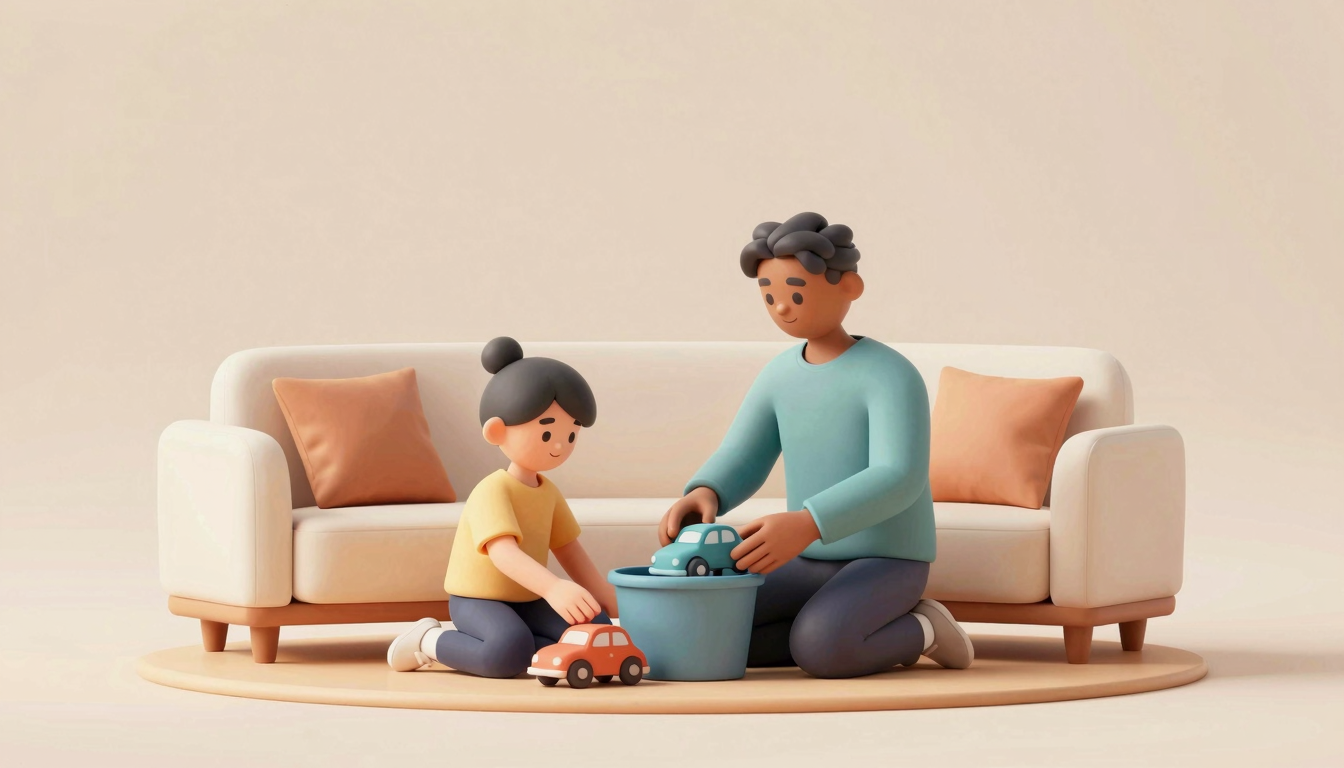
For example, "Put away your toys and keep your room tidy" names a goal, but leaves the process vague. Break it into actions you can agree on:
- Prepare several storage containers in different colors.
- Sort the toys on the floor, grouping the same kinds together.
- Reunite loose or missing parts with their toys, such as a doll's hat or a component that has come off a robot.
- Put each category of toys into its designated colored container.
- Label the outside of each container with the category it holds.
The child now has a sequence of concrete actions rather than a broad expectation to interpret alone.
4. Help the child begin, then hand the task back
Sometimes children know what to do and still do not start. Their ability to carry out a task, control their behavior and direct their own learning is still developing. They may also find it harder than adults to shift attention quickly and flexibly from one activity to another.
At those moments, combine words with action. Give a specific instruction while helping the child begin the desired behavior or stop the unwanted one. Acting together can help attention shift and make your guidance more effective.
The purpose is to get the behavior started. Once the child is engaged, let them do the remaining work themselves. Assistance should initiate their action rather than take its place.
Getting out of bed. Instead of calling repeatedly, a mother goes to the bedside and says gently, "Time to get up, sweetheart. It's 7:30. Open your eyes. I'm going to help you sit up."
She helps the child out from under the covers into a sitting position, then continues: "That's it. Open your eyes. Let's get dressed. Put your arm through here."
She helps the child begin dressing. If the child is awake enough, she says, "Now put your pants on yourself." If the child is still very sleepy, she continues helping with that part. Then she directs the next transition: "All right, out of bed. Put your slippers on and go wash your face and brush your teeth."
Approaching and helping the child start can accomplish more than calling them to get up again and again.
Washing hands. Accompany the child to the sink: "Come and wash your hands. Would you like to press the soap dispenser, or would you like me to do it?"
When the child dispenses the soap, acknowledge the participation: "Great job. Do you remember the seven steps for washing your hands? What's the first one? Let's say them as we wash together."
Beginning together can be more effective than standing nearby and repeatedly telling the child to wash.
Ending a gaming session. Go over and sit beside the child. "You've been playing for 20 minutes. It's time to stop and do your homework."
Look at the progress of the game: "All right, this round is almost over. When it finishes, it's time for homework."
Stay beside the child while the round ends. Then follow through: "It's finished. Give me the phone now, and go start your homework."
Frequently asked questions
Why might children struggle with routines after pandemic disruption?
Pandemic distress and loosened household rules can make habit formation harder. Some difficulties can also partly reflect developing attention, memory, self-control, perception or fine motor skills; the article does not assign every behavior a single cause.
What does gentle but firm communication involve?
Use a moderate volume and pace with a gentle, steady tone, including when making requests or refusing something. Maintain boundaries while avoiding harshness. A warm tone alone does not guarantee that the child understands the message.
How can parents make a plan easier for a child to follow?
Develop the plan with the child and break a broad goal into clear, specific, practical actions. Understanding that good habits matter does not necessarily tell a child how to establish them.
How much help should parents give when a child will not start?
Combine a specific instruction with shared action to help the child begin, then return the remaining task once the child is engaged. In the waking example, additional help is allowed while the child is still too sleepy to manage independently.
Do parents need identical parenting methods to cooperate?
No. Parents can hold different beliefs or use different methods while respecting each other's parenting role and avoiding actions that undermine the other's ability to guide the child.