Summary
A memory box, a crystalline engagement ring and a welcoming mousetrap reveal how Mark Sturkenboom makes everyday objects carry questions about intimacy, patience and letting go.
At a glance
Mark Sturkenboom creates conceptual objects that invite reflection on love, passing time, memory and attachment. Works including Ark, 21 Grams and Overgrown connect personal relationships with preservation, bodily remembrance and patient craftsmanship. He emphasizes the relationship between objects and their users, exploring how changed attitudes—and sometimes relinquishing possessions—might open possibilities of freedom.
We may one day have extraordinary powers to change the world, strengthen our bodies and reshape how we see things. Yet one limit remains: no one can prevent life from ending. Artist Mark Sturkenboom looks for ways to hold on to the traces it leaves behind.
His objects bring love and time into the things we live with. A clock, an urn, a mousetrap or a vase can offer more than practical use and an appealing shape. Looking at it, or using it, may bring us face to face with passing time and a love we have lost. Sometimes an object even asks us to consider whether breaking something we own might open a possibility of freedom.
To own one of these works is already to make a decision that calls for thought.
What would you save?
If a great flood were coming, what single thing would you choose to preserve?
That question lies behind Ark, Sturkenboom's ark for the 21st century. Inspired by Noah's Ark and British writer Julian Barnes's World History, it resembles a spacecraft, waiting for the flood. In the scenario imagined for the work, disaster is its signal to depart.
A glass cover on the deck gives off a dreamlike pink light. Beneath it sits a leather box, ready to hold mementos of the dead, secrets or statements. Sealed inside, they can be passed on to people in the future. As a warning of catastrophe, Ark asks what matters most to us—and what, if anything, might endure forever.
Its restrained, finely shaped form, elegant colors and meticulous handwork express qualities that recur throughout Sturkenboom's practice. Careful craftsmanship carries ideas that reach beyond the object's immediate purpose. Art and design meet here, stretching the boundary between function and concept.
After graduating from ArtEZ in Arnhem, the Netherlands, in 2012, Sturkenboom established his own studio in Utrecht, working in conceptual product design and art. In one self-portrait, he uses a silver vessel as a mirror. Elsewhere in his work, an object becomes a different kind of reflective surface: something through which its owner can examine memory, attachment and loss.
The intimate memories of 21 Grams
21 Grams is a memory box for someone whose partner has died. It gathers the private moments that made a shared life intimate: his scent, music familiar to them both, the pleasure he gave her during sex, the moment of putting on a wedding ring, even opening the door to welcome him home.
These small experiences of love come together in the box. An iPhone rests in a concealed lower compartment, and music flows through flower-shaped openings in the base. A small gold key belongs exclusively to the bereaved person.
Another component is a dildo-shaped storage rod that can hold 21 grams of ashes. The work draws on the idea of 21 grams as the weight of the soul, giving that number a symbolic role in a longing for the deceased to endure.
The memories it holds are bodily as well as emotional. A familiar sound, a scent or the recollection of touch can carry a relationship into the present, even as it makes the partner's absence painfully clear. Sturkenboom returns to this tension when he discusses the work: remembering intimacy can bring sorrow that is difficult to put into words, while the wish to experience intimacy remains.
Keeping craft in motion
Sturkenboom's concern with preserving traces also extends to handcraft. He has a particular affection for these skills, treasuring them while trying to bring them out of a disappearing world and into contemporary life.
Domestic Machinery reflects on the return of sewing as a preindustrial craft skill. It gives a contemporary form to an occupation that may now appear to have lost its purpose, inviting people into a dialogue with the work.
The emphasis falls on the process of working rather than the usefulness of the finished tool. Tools can be fitted onto wheels and encouraged to work together. The machinery then weaves a small electrical cable, producing a different result each time. What survives is a practice in motion, renewed through the encounter with its user.
Overgrown: patience, uncertainty and a proposal
Overgrown brings together Sturkenboom's patience with time and his recognition of the limits of control.
Japanese pearls take years to reach their finest quality. Although people can intervene at an early stage of their formation, the result does not necessarily meet human expectations. Much of the process, and the environment in which it unfolds, remains beyond human control. Waiting is essential.
The pearl-bearing shellfish cultivated by Mikimoto for this work grew in a particular crystallization environment described as going beyond the usual conditions for pearl growth. The result was crystalline material that did not resemble conventional pearls. Mikimoto's craftspeople brought exceptional skill—and, especially, extraordinary patience—to the process that made Sturkenboom's design possible.
In 2014, Overgrown won first prize at the Tradition and Innovation in Dutch Design exhibition, jointly organized by the Japanese jewelry brand Mikimoto and the Royal Netherlands Embassy in Japan.
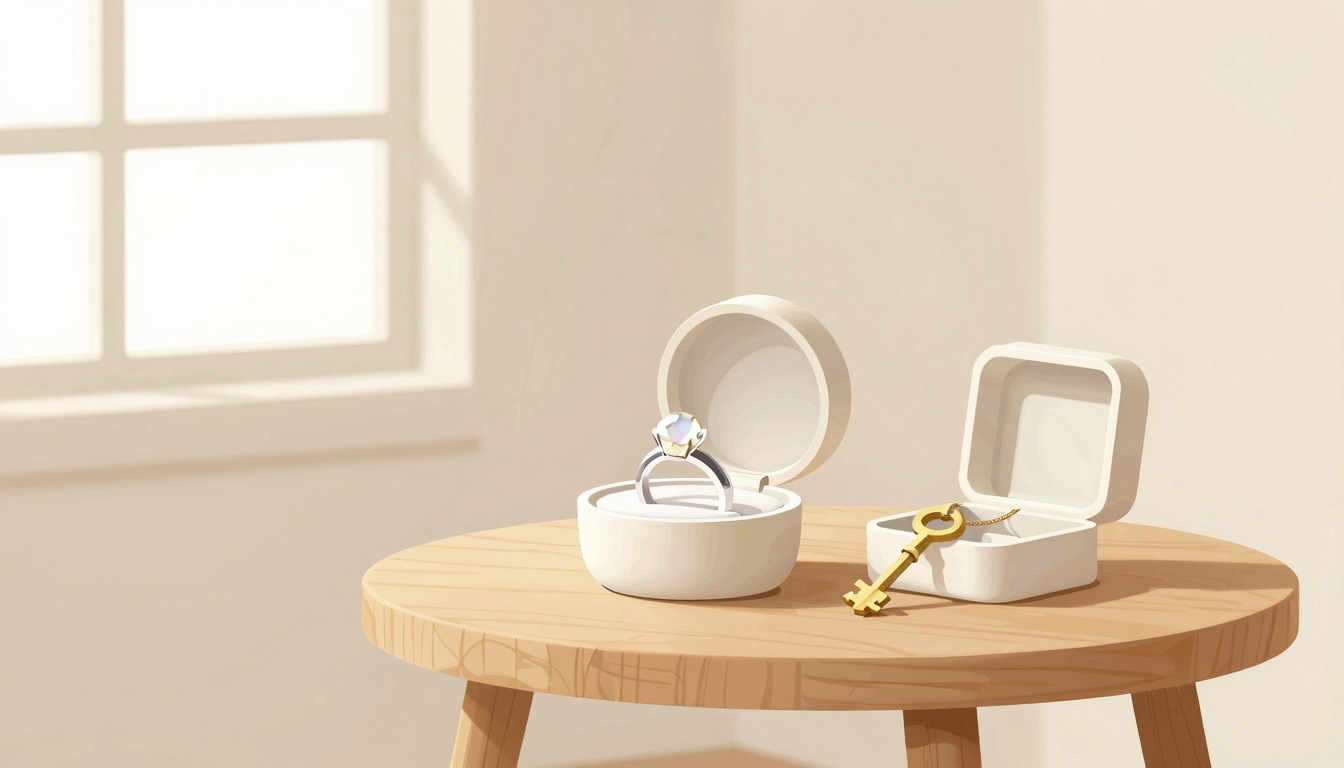
The work gives this long material process an intimate destination. Inside a barrel-shaped container, an engagement ring made from the crystalline material sits beneath a glass cover, waiting to be offered to a beloved.
A separate small box holds the key that opens the container. Sturkenboom designed the key to serve as a necklace pendant. Whoever holds that key necklace is the person who will make the proposal.
Making room for an unexpected guest
If we cannot fully control how a natural pearl forms, could we loosen our grip on everyday life as well? Could freedom bring surprises worth anticipating?
That question led Sturkenboom to Sweet Anticipation, a mousetrap inspired by the ways households police their boundaries. Every home has strict, unwritten rules about who may enter, who may stay and who must remain outside. Those rules apply to animals as well as people.
A mother can bring home a pet mouse from a pet store for her child, and its presence is accepted. A mouse that arrives on its own is usually unwelcome. The work treats this discrepancy as revealing tendencies toward panic and violence in our response to an uninvited arrival.
Sweet Anticipation seeks to turn that arrival into the prospect of a mysterious guest. Instead of the bloodshed and punishment associated with conventional mousetraps, it offers the mouse a safe refuge, complete with water and food. Its larger ambition is to change the owner's attitude.
Imagine the owner waking one morning to a noise and approaching with eager anticipation, delighted to discover that a “guest” has entered the trap. The scene is a possibility the work invites us to consider. A change in outlook might make room for unexpected things to happen.
Objects, attachment and the freedom to let go
Asked whether the unexpected stories behind his works are a deliberate feature of his style, Sturkenboom directs attention to the relationship each object creates.
“My concern is not with how things look, but with the relationship between objects and their users. I think that is where their deeper meaning lies. I try to bring into my work the countless associations that arise in everyday life, along with elements that prompt us to think.”
When the conversation turns to emotional attachment to objects, he links it to the difficulty of relinquishing both people and possessions.
“People find it hard to let go of attachment and possession, whether in relation to people or things. I have been trying to move objects beyond their customary uses and let them regain their freedom.”
He gives Separation Anxiety as an example. Explaining its inspiration, he describes what he presents as a practice among Jewish families: hiding valuables inside violins, jars or vases, then breaking those containers when the treasures are needed.
“Sometimes people gain their freedom precisely by destroying what they own,” he says.
The final question returns to 21 Grams: how does he define it? Is it a sex toy?
“When a partner dies, memories of skin touching skin bring sadness and pain, and that pain is often impossible to express. If a woman wishes, on some night, to revisit the intimacy she shared with her deceased partner, she can use the storage rod.
“But 21 Grams is about more than revisiting past intimacy. It has a more important purpose: to affirm the legitimacy of a passion for life and of desires that cannot be avoided.”
Frequently asked questions
What is Mark Sturkenboom's 21 Grams?
21 Grams is a memory box for someone whose partner has died. It brings together sensory and intimate memories and includes a storage rod that can hold 21 grams of ashes. The soul-weight idea is symbolic within the work. If a bereaved woman wishes, she can use the rod to revisit intimacy; Sturkenboom describes its larger purpose as affirming passion for life and desire.
What does Overgrown explore?
Overgrown explores patience and the limits of human control through unusual crystalline material cultivated by Mikimoto. An engagement ring made from that material waits beneath glass inside a barrel-shaped container. Its key doubles as a necklace pendant, and the person holding it will make the proposal.
What is the idea behind Sweet Anticipation?
Sweet Anticipation offers an arriving mouse a safe refuge with food and water. It seeks to change the owner's attitude from rejecting an intruder to anticipating a guest. The delighted owner described in the article is an imagined possibility, rather than a reported behavioral outcome.