Summary
A little round table, carefully made chests and an aging writing desk carry a daughter back through childhood, her father’s artistic life and the grief of losing him.
At a glance
For the craftsman’s daughter, her father’s handmade furniture preserves the warmth of family life, childhood memories and the care he put into everyday objects. Remembering his tables, chests, wardrobes and desk, she traces his craftsmanship, attachment to his village and love of home. Her account holds affection alongside grief and regret, while leaving her interpretations of his private motives open.
Since her father’s death, the craftsman’s daughter has lost count of the times she has dreamed of his furniture. In the dream, the family home has no roof. Its four walls stand amid broken bricks and tiles beneath a low, clear sky, as though lamenting its past to the world and the ancient land around it. Yet the furniture he made stands tall and conspicuous against the walls of the main room and bedroom, and in the kitchen. Every cabinet door is shut and sealed with mud. Beside a wardrobe, two of his sketches hang prominently on an unfinished wall. An unseen person remarks, “Even his drafts are so neat.”
Relatives and members of the clan fill the house with confused voices, bargaining over the pieces at miserably low prices. To her, the furniture seems to bow its head, helpless before its inescapable fate. She is furious, but no matter how hard she tries, she cannot cry out. At last she forces her eyes open. Another dream. Once again, she lies weeping in the silence of midnight.
There is also the intimate feel of the wood beneath her fingers: its fine, simple grain, each hand-painted branch and leaf. Vigorous plum branches, soft orchid leaves, graceful rocks half hidden among grasses; birds whose eyes seem able to speak, their wings poised for flight. Night brings tenderness with the grief, gently stirring memories that time had submerged, waking them little by little.
Among the earliest are two pieces: a table known by a local name and a square table. Their colors were subdued, their shapes plain and old-fashioned, their carving rough. A close look still revealed chisel marks in places. Her father had worked through the night to make them when he was eighteen or nineteen, his first efforts as an apprentice.
She wonders what dreams made him so eager, still scarcely more than a boy, to express his love of life through his work. Was he longing for a family life of his own? Did he harbor ambitions like those of the legendary master carpenter, or some other youthful hope? She has no answer. Whatever moved him, those two pieces brought warmth and support to an impoverished household. They witnessed a family taking shape and finding its footing, carrying its modest dreams and happiness.
Later, her father spent much of the year away, traveling between villages where people eagerly sought his work. On his occasional returns, his toolbox held an ever wider assortment of axes, planes and adzes, along with treats such as the children’s favorite beef jerky. He also brought stories from beyond their village.
One concerned a herder’s household that, he said, kept a dog-headed spirit. Whenever guests lifted their rice bowls, they would mysteriously feel full, losing all desire to eat. After this had happened repeatedly, someone who knew about it privately offered him a remedy: make a few marks with his carpenter’s pencil on the lintel of the room where the spirit was kept.
“I tried it in secret,” he told the children. “It worked. I never went hungry there again.”
“Was the host being stingy?” they asked.
“Even stingy people welcome craftspeople generously,” he replied.
“If he’s that bad, don’t do any more work for him.”
“How could I do that? They’ve already treated me to good food and drink. That isn’t easy for them. And they aren’t bad people. You have to keep your word.”
His daughter remembers the kindness and warmth on his face as he spoke.
Another visit might bring a story of a poor husband and wife enduring hardship together, or of devoted children and grandchildren whose affection reached across generations. His travels filled the children’s otherwise simple childhood with lives and experiences beyond their own. They were proud of him, and proud of what being his children meant. In the village world his daughter remembers, every household depended on artisans’ hands for its domestic implements. Carpenters and decorative painters were especially sought after and admired. Because of their father, other children looked up to them—a distinction that, she readily admits, thoroughly pleased their small, youthful vanity.
The work that earned him this standing bore his particular taste. He preferred to leave wood its natural color and preserve as much of its grain as possible. To his daughter, its beauty recalled a happy woman who still retained the charm of her younger days. He used traditional mortise-and-tenon joints. The furniture that later became fashionable in town, riddled with nails, seemed to her full of wounds and drained of life.
His reading helped furnish the pictures and poetry he added to the wood. He knew a poetry anthology intimately, drawing on it for his paintings and for words that could express his feelings. His copy of a painting manual had passed through his hands so often that its edges were frayed. His daughter suspects he had also read a work by Li Yu; his cultivated pleasures and distinctive eye for beauty make her wonder, though she does not know.
Once the carpentry was finished, he worked out his compositions on rough paper. Across four door panels he might arrange bamboo, orchids, plum blossoms and chrysanthemums, adding rocks, birds and insects, or paint scenes of the four seasons. He accompanied the pictures with verses of his own or poetry he already knew. Sometimes, with the sketches completed, he asked the children what they thought. At first they offered their advice in earnest: there should be a frog in the pond, or a child accompanying the old man with a walking stick. Then the suggestions grew silly. “Paint a sow scratching herself!” “Paint the ox I’m riding dropping dung!” “Paint me eating an oil cake!” He looked at them and smiled without a word.
His daughter wonders whether he was lonely—whether, by asking, he hoped to glimpse another world through his children’s eyes.
With the preparations complete, he set aside an uninterrupted stretch of time and found a quiet corner to paint the furniture. His usual medium was ink alone, its varying density giving the scenery distance and height, the human figures their different builds and statures. He tended the work as carefully as an infant and would let no one near. To the children, his solemn expression was almost unbearably funny. Eventually someone would fail to stifle a laugh, and their normally gentle father would bark, “Away with you!” They scattered, some doubled over with laughter, others laughing so hard they spat out their food. A few glared reproachfully at the ones who had failed to behave. Those attempts at grown-up gravity only made everyone laugh harder.
The final stage was a thin coat of clear varnish, protecting the wood from damage while leaving its natural appearance visible. Between cooking meals, the stove served to heat pine resin. It could not be kept off the heat for long or it would solidify; to his daughter, it was like a crying baby that could not bear to leave its mother. Only when the coating was finished did the furniture emerge like a young woman ready for marriage. By then, the refreshing scent of pine resin filled the little courtyard.
Years of practice refined his skill. In 1974, he made his wife a pair of door-fronted chests, taking particular care in selecting the wood. It was still inexpensive poplar, but the fronts were smooth and level, free of knots except at one inconspicuous corner. There, a small, unavoidable knot had left a gap, which he repaired with a precisely fitted piece. To his daughter, the flaw only revealed how accomplished his hands had become, adding to the furniture’s beauty.
The seasons unfolded across the yellowish wood: straight bamboo and willows stirred by the wind; a scholar studying indoors by a window; a monk riding a donkey through snow across a plank bridge. Cicadas sang in deep shade, insects chirped among grasses and stones, white snow lay unmelted through the year, and streams flowed without cease.
The chests finally made up for what had been lacking in his wife’s original dowry. She loved understated elegance and praised his workmanship to everyone she met. His daughter remembers that praise as the most satisfying reward for the exceptional care he had given these pieces. About six or seven years later, he made matching supporting bases. Chests and bases complemented one another so well that, to her, they recalled her parents’ lifelong care and support for each other.
The dowry chests he made for his younger sister’s wedding were altogether different. For this sister, the daughter’s paternal aunt, he departed from his usual restraint: vivid red grounds, brass lock fittings and designs drawn in gold powder. Bamboo and rocks appeared alongside plump pomegranates split to reveal their seeds and goldfish flicking their tails. His daughter wonders whether her young father hoped that his sister, lonely and burdened by hardship, would find in married life the household abundance and prosperity pictured on those chests.
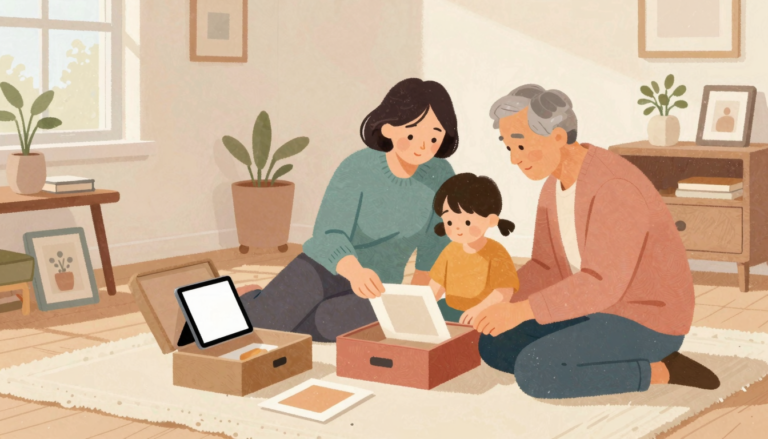
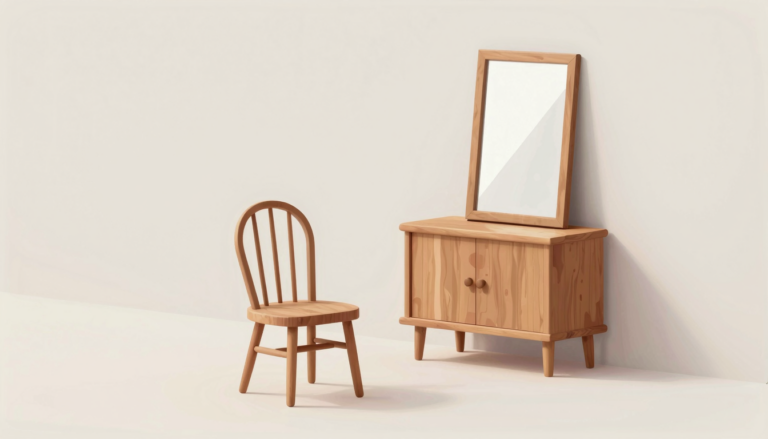
For his children, he made furniture suited to their small, noisy world. He originally built the little round table for his daughter and her siblings, four children who needed somewhere to eat and write. Four sturdy square pine stools completed the set, all finished in the same traditional Chinese reddish ochre. To keep the children from fighting over tabletop space, he painted four different fan-shaped designs. This time he set aside the seasons for subjects they would enjoy: pink lotus flowers, a frog poised to leap, an old ox returning from pasture, a hen and chicks catching insects, and an old man fishing. At mealtimes, the children chose their seats by their favorite pictures.
When the youngest sister was old enough to join them for meals, the arrangement no longer sufficed, so he altered the tabletop. They affectionately called it their little round table; it was inseparable from daily life. The little newcomer became a target of the others’ teasing and attempts to crowd her out. Their domestic comedy, with its battles fought without gunfire, played out day after day.
The table had other duties, too. Its top and legs came apart easily. When visitors arrived and the small table on the heated platform could not accommodate everyone, the round top could be removed and fitted over it. In the twelfth lunar month, people crowded into the house to ask their father to write Spring Festival couplets. To make room, the little round table was dismantled and stood in a corner, quietly waiting for its young owners to reclaim it.
In her memory, it waited so long that its painted lotus withered, its chicks became mothers, and its old ox could scarcely walk. The children had grown up, and the table’s work was done. Two tall wardrobes followed, along with a finely made bookcase and a sturdy writing desk.
She remembers the bookcase distinctly: a Czech-style design fashionable at the time, simple, practical and handsome. It stood tall in the bedroom she shared with her sister, beside their mother’s sewing machine. By then she had many books, their colorful volumes neatly arranged on its shelves. Apart from mountains and rivers, she could imagine no more beautiful sight. There were Shakespeare’s sonnets, another writer’s subtle brilliance, Lu Xun’s incisive language and penetrating clarity; the snow in one story, the tears in another, the love in a third. Reading held her long past bedtime while her mother kept sewing beside her. Late on those nights in the twelfth lunar month, a single lamp lit two hearts burning with a love of life.
Her own words eventually reached print. The publication of her piece of roughly a thousand Chinese characters about her father’s deep love brought the quiet, reserved man immense satisfaction and comfort in the company of his boastful colleagues.
While the bookcase opened her world, the wardrobes seemed to preserve the world her father cherished. He studied furniture wherever he found it, examining actual pieces and illustrated references, and understood that different forms had different ways of expressing life. For the two wardrobes, he followed Ming-period models: four tall supporting legs, four doors and two drawers. The wood kept its natural color, bearing ink paintings and verses in which sunset lingered over green hills and flowing water wound tenderly around a home.
To his daughter, those pictures and words expressed his deep attachment to his native village, his reluctance to let go of an agrarian way of life, and his simple love of living. She wonders whether the little village that had nurtured him and his ancestors was his poetic blueprint, the place in which he imagined his future. She sees in his work how unwilling he was to leave the home where he was born and raised.
Yet soon the family moved from the village they had inhabited for generations to the county town of Huangyuan. She does not know how long he had spent preparing himself, or how much inward struggle the move had cost him. Later, whenever he spoke of those impoverished village days, his face filled with warmth and happiness. He always came back to the same remark: “The poor days were better.” It puzzled her then. Now she understands his words as longing for the years themselves, rather than for their hardship. The village held his ancestors and relatives, the children’s childhood, and the life they had shared as a family.
In town, the writing desk became his constant companion. Unless he was out, his daughter remembers him seated there, his back seeming carved in stone: on bright mornings, through bitter winters, on warm afternoons. An old inkstone, a plain desk object, a small pad of clean, soft felt, a few sheets of raw or sized painting paper, and goat-hair brushes of different sizes hanging neatly in a row were enough to give him a peaceful afternoon. Afternoons became months, years, more than a decade. His children came to recognize the romantic temperament deep within him and his extraordinary generosity and kindness. They felt helpless about aspects of the life he led, yet found themselves carrying it on without having meant to.
At that desk he copied one painter’s works, studied another’s, depicted a landscape associated with a poet, welcomed the moon of another poet’s verse into his imagination, and wrote out a classical prose work. Year after year, the surface grew smooth as jade, and the desk itself seemed to grow old. It accompanied so many solitary hours of beauty and happiness, so much surging feeling, poetry and painting. In his daughter’s memory, those years of work also hold the gradual loss of his straight back and the brightness of his eyes.
The desk stood like a kindly old person who had seen much of life. It tolerated the grandchildren’s mischief, accepted his children’s mockery, and witnessed the warmth and coldness of human dealings. Through it all, it held something of his warmth.
By 2011, serious illness had left him unable to work with his brushes, ink, paper and inkstone. His loneliness deepened. Several times, his daughter saw him sitting at the desk without saying a word.
Her mother told her that on several occasions, despite her objections, he had sorted through sketches he had not yet turned into finished paintings, carried them outside, and quietly burned them in a corner of the flower garden. His daughter understood this in light of the rule he had enforced since the children were small: no word, no sheet of written paper was to be wasted or treated carelessly. She believed he could not bear to leave his own work to be mistreated.
In 2013, his children bought their parents a new home in Xining, hoping they could spend their later years somewhere warmer and more spacious. As renovation approached, however, his furniture became a source of worry. He repeatedly told his son not to buy any new pieces, afraid there would be nowhere for the ones he had made. To his daughter, his anxiety was inseparable from a lifetime of thrift: how could he let go of what he had accumulated little by little, the work into which he had poured so much care?
He first asked her younger sister to take his chests. “You could even put them in your coal room,” he suggested. Her sister hesitated. How could they be put somewhere like that? When he approached the daughter recounting these memories, she readily agreed; she could not bear to turn away his kindness. His haggard, sorrowful face brightened. The gloom of recent days lifted into a rare smile, and he grew almost as excited as a child. Watching his happiness, she felt an ache she could scarcely express.
For a moment, she imagined acquiring a little cottage in the countryside, a place for his furniture. She could live there simply and self-sufficiently, like a village woman. There might be happiness in such a life. But reason told her that people could not live inside a fairy tale—even if life could not do entirely without fairy tales.
When the family moved, her younger brother stubbornly insisted that every piece their father had made be installed in the new home. Their father’s sudden death caught him unprepared. Overcome with regret, he wept bitterly. After that, he could not bear to part with the furniture, which seemed still to hold the warmth of their father’s hands.
Later, she and her brother visited a furniture market. Surrounded by an abundance of solid-wood pieces, he spoke with guilt and regret: “If only I’d known. I should have pushed Father around here earlier so he could see all this.” She understood what he had wanted to give their father: the pleasure of seeing how wooden furniture had developed, a feast for the eyes of a man who had loved it all his life. She wonders whether such an outing might have eased the regrets and lingering concerns he carried with him when he died.
Perhaps what drew her father to wooden furniture was the warmth of home it seemed to hold—a warmth that spoke to someone whose childhood had been lonely and marked by hardship. That is how his daughter has come to understand his attachment. Wherever people make homes, she reflects, wooden objects find a place. Yet even the most luxurious, imposing pieces in a showroom lack the atmosphere of lived days and the household memories held by his furniture.
Looking back on his brief carpentry career, she sees wood as his painting paper and love as his ink. On it he expressed joy, anger, sorrow and pleasure, along with the suffering and desolation of human life. The countryside was his finest exhibition space. She imagines him traveling and singing like a Gypsy singer, carrying his poetry from place to place through the things he made.
For her, those pieces remain the fullest expression of the virtues he practiced throughout his life: benevolence, righteousness, propriety, trustworthiness, gentleness, kindness, respectfulness and frugality.
Frequently asked questions
Was the father’s furniture actually sold in the ruined house?
The ruined house and relatives bargaining over the furniture appear in the daughter’s recurring dreams after her father’s death. The account later says that her brother insisted on installing every piece their father had made in the new home.
Did the father always keep his furniture’s natural wood color?
He usually preserved the wood’s natural color and grain, using ink painting and a transparent finish. His sister’s wedding chests departed from that restraint with vivid red grounds, brass fittings and gold-powder designs. The children’s table and stools were finished in reddish ochre.
Why did the father say the poor days were better?
His daughter comes to understand the remark as longing for their shared years in the village, rather than for material hardship. In her interpretation, those years held his ancestors and relatives, the children’s childhood and the family’s life together.