Summary
Being drawn into parents’ disputes can mean choosing sides, carrying adult responsibilities, or becoming a scapegoat. The article explores these patterns and ways to restore boundaries and emotional security.
At a glance
Divorce can have negative effects on children, but a substantial impact does not automatically mean lasting harm. Its effects depend partly on the family environment before separation and parenting afterward: leaving prolonged conflict may relieve stress, while cooperative parenting and relatively stable family functioning can help. The article proposes parental conflict as a source of harm and explains how keeping children outside adult disputes can support their emotional security.
Does divorce necessarily cause children profound harm? The familiar insistence that parents should give children an “intact” home can make staying married seem like the clearest measure of doing right by them. But the state of a marriage tells us less than we might think about what it feels like to live inside that family.
Before the early 1990s, research generally emphasized the severe effects of divorce on children. Later research offered a more qualified picture: divorce does have negative effects, but children who experience lasting negative effects are a minority. Divorce is certainly a major life event. A substantial impact, however, does not automatically mean injury.
From divorce to the conflict surrounding it
In 1990, Wheaton proposed the stress-relief hypothesis: the effects of a major life event depend on the environment that preceded it. If children have been living with prolonged parental conflict, including arguments or violence, divorce may be a major and sudden disruption that nevertheless releases some of their stress.
What happens afterward also matters. If parents develop a cooperative approach to raising their children and keep family functioning relatively stable, both parents and children can benefit.
Applying these ideas to family relationships suggests a hypothesis: perhaps what harms children is parental conflict rather than the divorce event itself. That shifts our attention from whether a marriage continues to how parents’ disagreements shape their children’s lives.
Inter-parental conflict, or IPC, refers to verbal disputes or physical aggression between parents arising from disagreements or other causes. It is commonly described in terms of how frequently it occurs, how intense it becomes, and whether it is resolved (Cui and Fincham, 2010).
There are several ways this conflict can affect children.
What children learn, lose, and fear
Children learn from what their parents do. In Bandura’s social learning theory, people acquire behavior by observing and imitating models. At home, parents are children’s most immediate models.
When parents repeatedly respond to disagreements with hostility, avoidance, escalation, or even violence, children may adopt those same responses to problems. Yet discharging emotion is not the same as resolving the issue that produced it. Learning these patterns can interfere with children’s ability to solve problems and with their relationships.
A family is also a small universe of connected relationships. An ecological account attributed to the American psychotherapist Bowen describes psychological development as taking place through interactions among environments such as family, school, and society. Within the family microsystem, the couple relationship, parent–child relationships, and sibling relationships form subsystems that influence one another.
When parents are absorbed in recurring disputes, more of their energy goes toward managing their difficulties with each other. They may become impatient or easily irritated with their children and spend less time with them. The parent–child relationship can hardly remain untouched.
Conflict can also undermine emotional security: the feeling that one’s surroundings meet one’s need for safety. The emotional-security hypothesis describes how instability in the parental relationship can make children feel less secure at home. When that insecurity persists, it threatens psychological development and may contribute to adjustment difficulties (Davies and Cummings, 1994).
When children become part of the dispute
Family relationships need boundaries as well as connections. When those boundaries become unclear, a child may be drawn into a triangle with the parents.
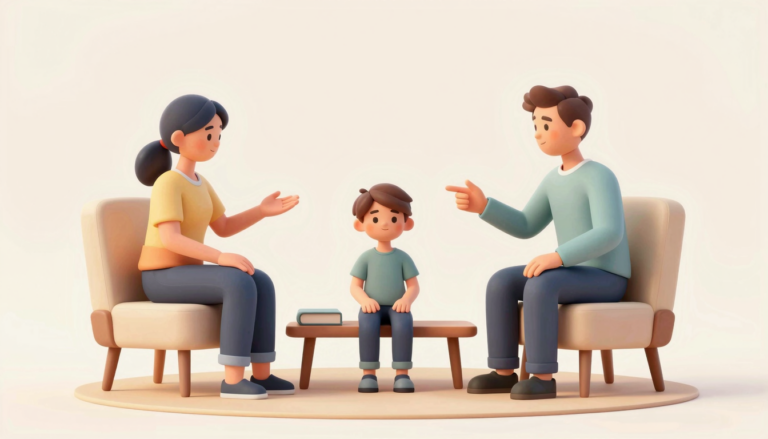
In parent–child triangulation, a disagreement between the adults no longer stays between them. The child is pulled into their negative emotions, pressured to take sides, made to absorb their anger, or expected to assume responsibilities that belong to the parents. Three forms illustrate how this happens.
An intergenerational alliance forms when a child is pressured to join one parent against the other. Questions such as “Which of us do you love more?” or “If we divorced, who would you want to live with?” can put children in this position. Such questions can threaten their sense of security and make them afraid.
Parentification occurs when a child takes over the parents’ responsibility for caring for the family while the parents are in conflict.
Scapegoating occurs when parents redirect their dispute toward the child’s education or upbringing, avoiding the conflict in their own relationship. In many family-therapy situations, the child is initially brought for help, but consultation reveals that the underlying difficulties lie with the parents. Having the least power in the family, the child has been forced into the role of scapegoat.
Research from the 2000s linked greater involvement in parental conflict with higher levels of depression and anxiety, as well as a greater likelihood of emotional distress and problematic behavior. These difficulties can in turn weaken interpersonal skills and may even affect satisfaction with marriage in adulthood.
What parents can do to give children room to breathe
The first step in dismantling a triangle is recognizing that an entrenched pattern of involving children in parental conflict can harm them. Responsibility for changing that pattern belongs to the adults.
Parents should avoid having conflicts in front of their children. When conflict cannot be avoided, they need to handle it reasonably and effectively, showing through their own behavior how a disagreement can be resolved.
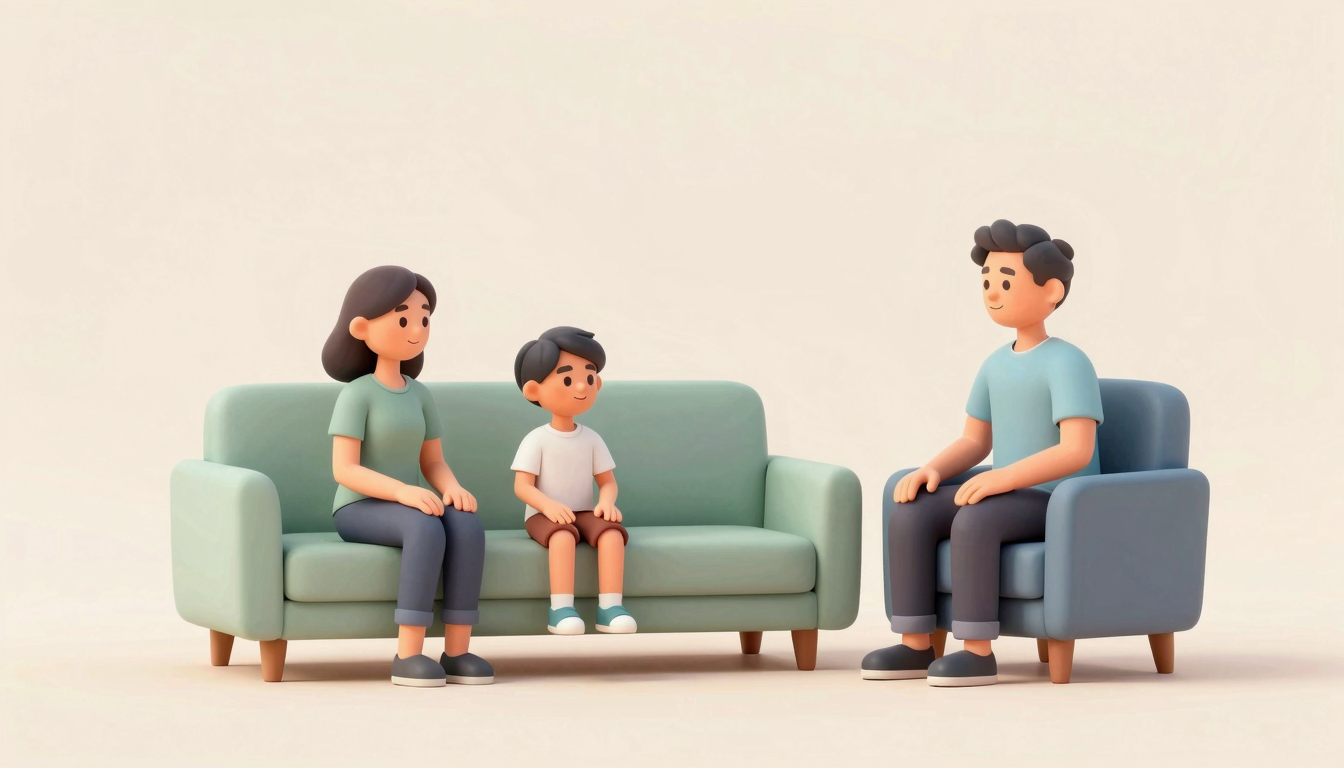
Marital grievances should not be imposed on children. Parents need to distinguish between matters that can appropriately be discussed with them and disputes that would pull them into the struggle. Keeping that boundary does not mean leaving children without any understanding of what is happening. More communication can help them understand the current state of their parents’ relationship without making them participants in the conflict.
Attentive time together, respect, listening, and love can help children rebuild their sense of security. The aim is a family atmosphere with support, safety, conversation, and enjoyment—one in which children have room to breathe within their relationships.
That requires parents to address their own difficulties and accept their responsibilities within the family, rather than passing them to their children. A balanced, happy family cannot be built by asking its least powerful members to carry the adults’ unresolved problems.
If prolonged conflict remains unresolved, parents can seek help from a counselor. Even if, after trying to work through their difficulties, they decide to end the marriage, they can still establish cooperative parenting, maintain an appropriate level of interaction, and communicate well. Research has found comparatively better behavioral outcomes and better father–child relationships among children whose parents resume cooperation after divorce.
How children can regain their own footing
Children are younger and have less power within the family. They may become caught in a triangle without realizing it. That does not mean they have no capacity to change their position, and it does not make the parents’ relationship theirs to repair.
Personal maturity plays an important role in stepping out of an uncomfortable relational role. One indicator of that maturity is differentiation of self: the ability to balance reason with emotion and closeness with independence. People with greater differentiation are less easily unsettled by other people’s emotions. They can experience intimacy while retaining a sense of themselves.
For children caught in their parents’ conflict, developing that capacity can involve several kinds of effort.
Separate your own problems from your parents’ disagreements. When the problem belongs to your parents, practice giving it less of your attention instead of trying to please them into harmony. Their disagreement does not have to become your task.
Find ways to handle your feelings. Distress and insecurity arising from parental conflict need an outlet. Talking with someone you trust, exercising, or making art can offer ways to express what you feel and soothe yourself.
Recognize where responsibility belongs. Your parents are adults who can be held responsible for their behavior. Regard them as people capable of dealing with their own disagreements. Step back from the dispute, establish boundaries, remain neutral, and leave communication and resolution to them. This means recognizing the separation between their difficulties and your own life.
Ask for support. A school or community counselor, or another trustworthy person, can help. Your parents’ problems are not a reason for you to feel ashamed. You are a person in your own right and deserve to treat yourself with care.
Consider independent living once you reach adulthood. If family conflict remains unresolved, living independently can provide a way to leave the environment that keeps drawing you into it.
Each of us is a unique little planet in our own universe, with an orbit and a direction of our own. Children forced into parental conflict can feel like planets knocked off course, drifting into an orbit that does not belong to them. Yet the universe has its own patterns and order. With suitable ways forward and hope for the future, we can find our own paths again and shine in our own worlds.
Frequently asked questions
Can divorce relieve children’s stress?
When children have lived with prolonged parental conflict, including arguments or violence, divorce may relieve some stress despite being a major disruption. Benefits afterward depend on conditions such as cooperative parenting and relatively stable family functioning.
What is parent–child triangulation?
Parent–child triangulation happens when children are drawn into their parents’ conflict, pressured to take sides, made to absorb anger, or expected to carry parental responsibilities. The article describes intergenerational alliances, parentification, and scapegoating.
Should parents explain relationship difficulties to their children?
Parents can help children understand the current relationship situation while distinguishing appropriate discussion from disputes that would involve them in the conflict. Keeping children outside marital disagreements does not require withholding all information.
What can children do when they feel caught between their parents?
They can distinguish their own problems from their parents’ disagreements, find outlets for feelings, establish boundaries, and seek support from a trustworthy person or school or community counselor. Responsibility for resolving the parents’ relationship remains with the adults. If conflict remains unresolved, independent living is an option after reaching adulthood.