The Quiet Omen / Signs, Psychology
Why Some Rooms Feel Wrong the Moment You Enter
The uneasy feeling we get in certain places is rarely just imagination; often it is the body reading atmosphere before the mind has evidence.
- Published
- Read time
- 6 min
- Topics
- Meaning Making / Objects as Signs / Pattern Recognition
- Sections
- 3
What this essay is really about
The uneasy feeling we get in certain places is rarely just imagination; often it is the body reading atmosphere before the mind has evidence.
- The uneasy feeling we get in certain places is rarely just imagination
- often it is the body reading atmosphere before the mind has evidence
Sometimes you know before you know.
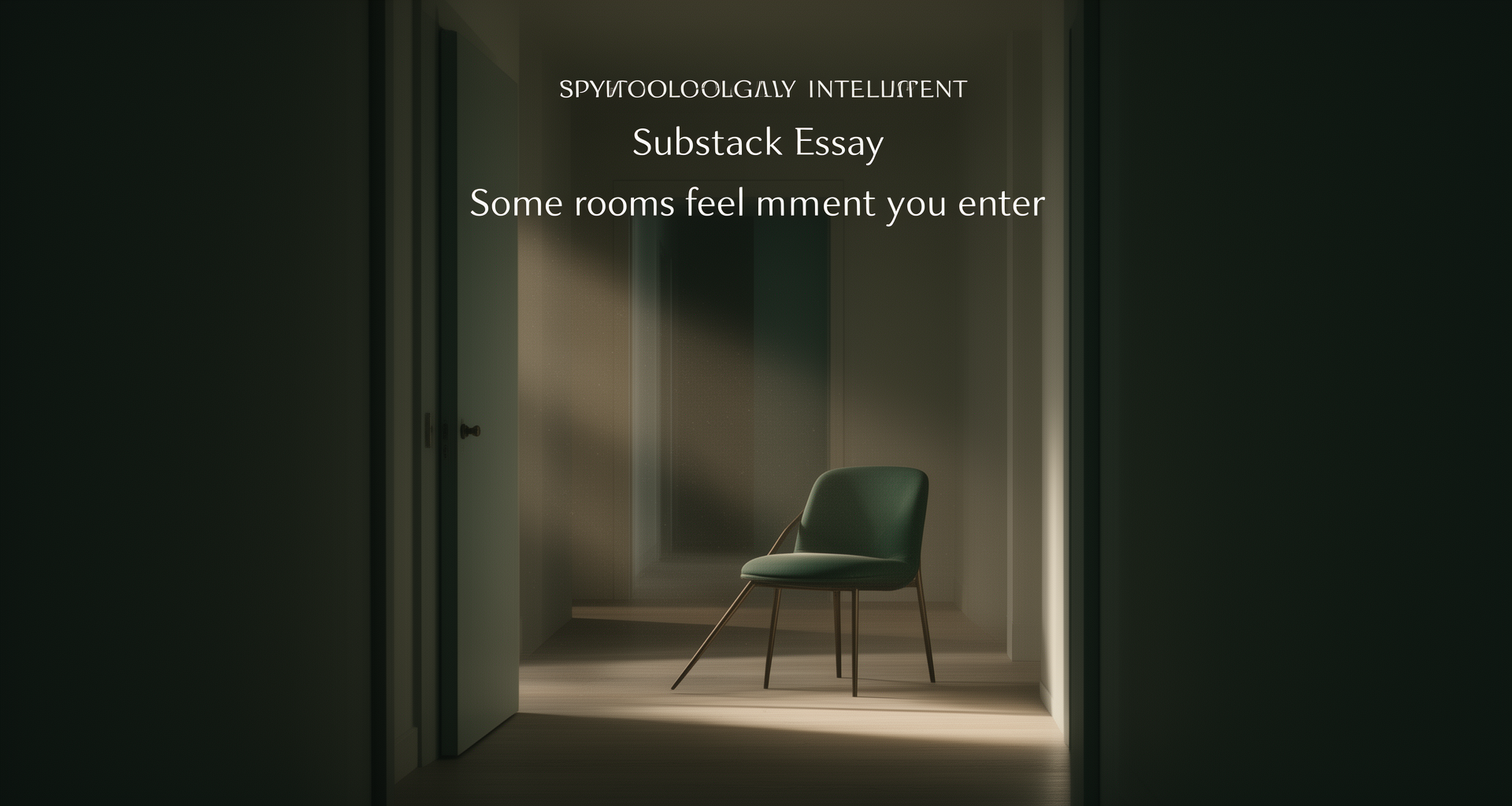
You step into a room and something in you refuses to settle. The furniture is ordinary. The light is ordinary. No one has said anything strange. There is no obvious threat, no broken object, no dramatic omen arranged for your attention. And still, your body pauses at the threshold.
Something feels wrong here.
Most people have experienced this. A hotel room that seems sad before you unpack. A friend's kitchen where the conversation is technically polite but the air feels tight. A childhood hallway that still makes your shoulders lift. An office where everyone smiles too quickly. A house that looks beautiful in photographs but feels, in person, as if it is holding its breath.
The rational mind may rush in to correct the feeling. It is just unfamiliar. It is just lighting. It is just your mood. You are being dramatic.
Maybe.
But the first intelligence we bring into a room is not verbal. It is atmospheric.
Long before we explain a place to ourselves, the body begins reading it. It notices distance, silence, exits, temperature, posture, smell, clutter, rhythm, tone, and the small changes in other people's faces. It notices whether voices are relaxed or managed. It notices whether the room has a center or feels scattered. It notices whether people are moving freely or performing safety.
This is not theatrical magic. It is the older part of perception asking, before language arrives, "Can I soften here?"
That question may be one of the deepest measures of a place.
A room can feel wrong when the body does not receive permission to relax.
This is why the feeling can arrive so quickly. You may not have a reason yet, because reasons are slower than perception. The mind wants evidence. The body works with pattern. It has spent years learning the weather of tension: the voice that is too even, the silence after an argument, the careful hospitality of people who are angry underneath, the forced cheer of a family trying not to name something.
Sometimes the room is not dangerous at all. Sometimes it simply resembles a place where you once had to be alert.
That distinction matters.
When a room feels wrong, it may be telling you something about the room, something about the people in it, or something about the memory you carried through the door. The sensation is real, but reality does not always mean prediction. A feeling can be true without being literal.
This is where symbolic life becomes useful: it lets us respect the charge without surrendering judgment.
Traditionally, thresholds have always mattered. Doorways, gates, kitchens, bedrooms, corridors, and staircases are not just architecture. They are passages between states. You cross from public self into private self, from outside into inside, from guest into witness, from ordinary time into the emotional weather of a household. A threshold asks the body to update its story.
Sometimes the story updates badly.
You walk into a room and feel watched, even if no one is looking. You feel unwelcome, even if you were invited. You feel grief, even if nobody has mentioned loss. You feel as if something has already happened, or is about to happen, or has been happening for years and everyone agreed not to say it.
Rooms keep residue in a practical sense before they keep it in a mystical one. Arguments leave traces in posture. Anxiety changes how people use space. Neglect gathers in corners. Care also leaves evidence: a chair placed where someone likes the morning light, a glass of water by a bed, a window opened because the room needed air.
The symbolic reading begins from the same truth: places are not neutral containers. They are rehearsals of how life has been lived inside them.
A home where no one is allowed to be sad will feel different from a home where sadness can sit down. A workplace where mistakes become humiliation will feel different from a workplace where errors are repaired. A bedroom used only for collapse will feel different from a bedroom that has been protected as a place of rest. Space absorbs behavior because behavior shapes space.
The room may not remember in the way a person remembers.
But the body remembers how rooms behave.
One reason certain places feel like warnings is that they compress time. The present room touches an earlier room. The current silence touches an old silence. A stranger's living room touches your grandmother's hallway. A rented apartment touches a season when you were lonely. A particular smell, shade of light, or arrangement of furniture opens a drawer in the nervous system.
Then the mind says: this place feels wrong.
What it may mean is: I have been somewhere like this before.
This is not a small thing. Much of adult intuition is memory arriving without its paperwork. We call it a vibe because we do not yet have the file name.
Of course, intuition can be mistaken. A place can feel strange because you are tired, hungry, overstimulated, or entering with dread from somewhere else. A room can seem hostile because your body is already braced. The danger of symbolic interpretation is that it can turn every discomfort into a verdict.
That is why the better question is not, "Is this room bad?"
The better question is, "What is this room asking my body to do?"
Does it ask you to shrink? To perform? To stay alert? To become agreeable? To ignore what you notice? To take care of someone else's mood? To leave part of yourself outside the door?
Or does it ask you to breathe, speak normally, look around, sit down, and return to yourself?
This question is often more revealing than the original feeling. It turns the omen into information. Not proof. Not prophecy. Information.
Sometimes the answer will be simple. The room needs air. The light is harsh. The chairs are arranged like an interrogation. The body is reacting to design, not destiny.
Sometimes the answer will be relational. Someone is angry but pretending not to be. You are being welcomed in language but held at a distance in tone. The atmosphere is not evil. It is dishonest.
And sometimes the answer will be interior. You entered carrying a private fear, and the room gave it a shape.
None of these possibilities should be dismissed. They simply require different responses.
If the room is practically uncomfortable, change what can be changed. Open the window. Move the chair. Step into better light. Leave for a few minutes and return. The smallest alteration can break the spell because the spell was partly sensory.
If the room is relationally tense, trust the information without turning it into accusation. You do not need to announce that the room feels wrong. You can become more observant. You can speak less quickly. You can notice whether your body becomes calmer or more guarded as the interaction continues.
If the room is touching an old memory, be careful not to punish the present for the past. Name the resemblance quietly. Say to yourself, "This reminds me of something." That sentence can create enough space between then and now for the current room to reveal itself more accurately.
The point is not to become suspicious of every place. The point is to become more literate in atmosphere.
Modern life teaches us to treat rooms as backdrops, as if only the visible conversation matters. But much of our actual life happens in the field around the conversation: the pause before someone answers, the chair no one uses, the kitchen where everyone gathers because it is the only room that feels forgiving.
We are not only minds moving through buildings. We are nervous systems crossing thresholds.
So when a room feels wrong the moment you enter, do not rush to call it nonsense, and do not rush to call it a sign. Stand at the threshold a little longer. Ask what your body noticed before your mind could defend itself. Ask whether the place is speaking, or whether memory is speaking through the place.
The answer may not be dramatic.
It may simply be this: some rooms ask us to become smaller than we are. Some rooms ask us to remember what we have survived. And some rooms, quietly and without explanation, tell the truth before anyone in them is ready to.