Summary
Thread, boats and familiar objects give spatial form to memory and absence in Chiharu Shiota’s work. This article revisits the Long Museum’s 2021–2022 exhibition and distinguishes it from her 2015 Venice installation.
At a glance
Shiota draws through space with thread. Red evokes connection, black the vastness of the universe, and white a beginning. Boats bring journeys and displacement into the work. The Shanghai exhibition ran from December 19, 2021 to March 6, 2022; the Japan Foundation records 180,000 keys in the separate 2015 Venice installation.
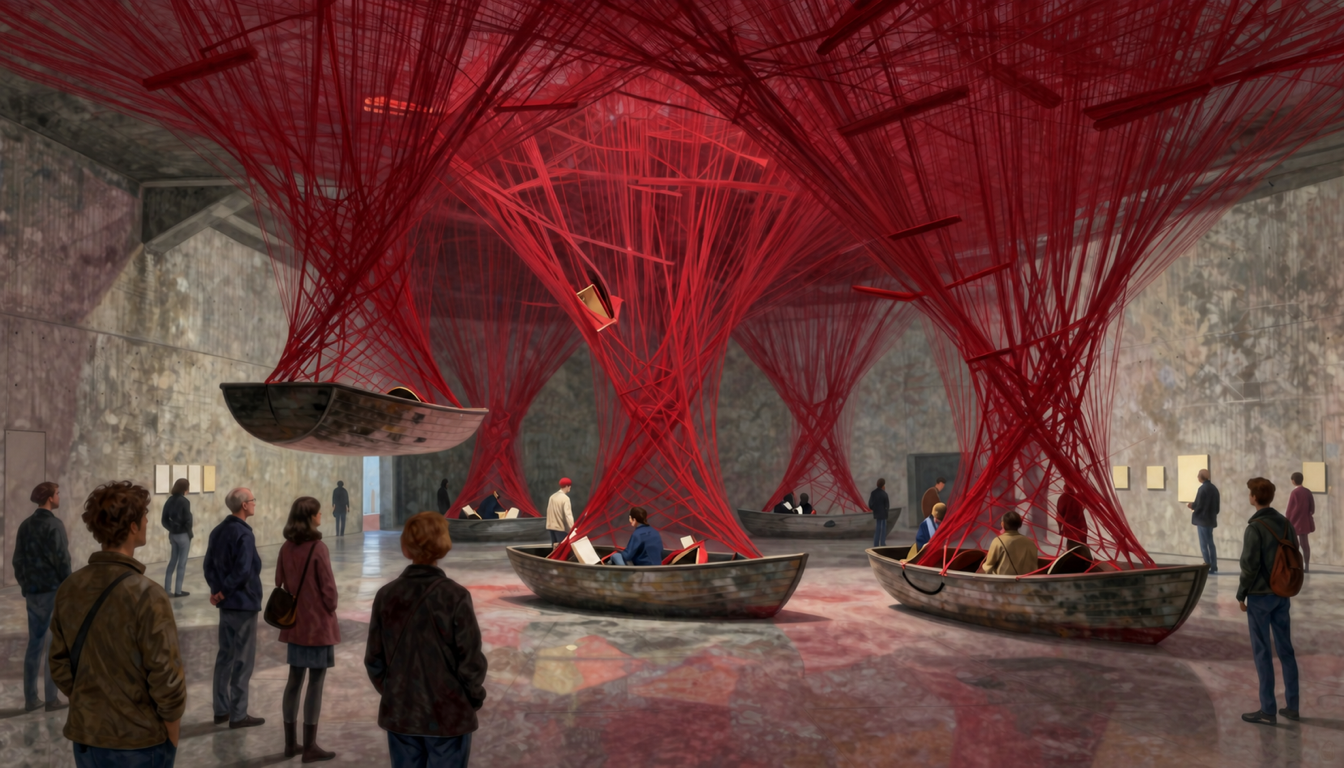
Red thread filled the entrance to a twelve-meter-high concrete gallery at Shanghai’s Long Museum West Bund. The scene belonged to The Soul Trembles, presented there from December 19, 2021, to March 6, 2022. Strands tangled, crossed, opened out and broke away, gathering around small boats made from iron rods. In Chiharu Shiota’s Uncertain Journey, the boats seemed to move through the exhibition without knowing where they would arrive.
Farther inside, the same material created an entirely different atmosphere. Black thread stretched between floor, ceiling and walls, forming a vast web around sixty charred chairs and a burned piano. Where the red installation felt restless and anxious, this one felt heavy with fear.
The work, In Silence, reaches back to a fire Shiota witnessed when she was nine. A neighbor’s house had burned down, and a scorched piano was left outside in the yard. For days afterward, she felt a wordless silence around it. The memory stayed with her.
The exhibition looked back over the preceding twenty-five years of Shiota’s work. Monumental installations appeared alongside sculpture, photography, painting and drawings connected with stage design. Across these forms, thread offered a way to give memories and emotions a physical presence.
Drawing Through the Air
The abundant red thread in Uncertain Journey belongs to a material language that runs through much of Shiota’s work. Everyday possessions, relationships, memories and emotions become caught up in the same weave.
Color changes what that weave suggests. For Shiota, red expresses the bonds people form with one another. Black evokes the vastness of the universe, while white points toward a beginning and a sense of purity. Red is also the color of blood: its countless strands can hold connections that are deeply felt but difficult to explain.
Thread serves her much as brushes and paint serve an artist working on a flat surface. By changing the position of her hands, she draws in three dimensions. Separate lines accumulate into a plane; the plane spreads until it occupies the space. What begins as a slender strand becomes an installation with enormous visual force.
Her first use of thread dates to 1994, when she was studying at Kyoto Seika University. In the performance work From DNA to DNA, two tangled masses of red yarn faced each other, one at the ceiling and one at the floor. They twisted into strands that reached toward one another, meeting in midair to form a single line. The installation opened a way beyond the traditional two-dimensional surface.
Boats Without a Certain Destination
Boats recur in Shiota’s work alongside thread. In Where Are We Going?, small boats wrapped in white thread hung in a winding formation above the Long Museum gallery. They seemed to sail through the air, drawing visitors into an uncertain journey while suggesting that something new might be beginning.
For Shiota, a boat carries the loneliness and disorientation of traveling across the sea. Born in Osaka in 1972, she had family roots in Kochi Prefecture. Each summer, her parents took her by boat from Osaka to Kochi to visit her elderly grandfather and pay respects to her grandmother, who had died. The journey brought unfamiliar surroundings, people and objects into her childhood. It felt almost like arriving in another country, and the strangeness left a lasting impression.
Travel later became a more permanent departure. Inspired by the work of performance artist Marina Abramović, Shiota applied to study in Germany at twenty-four. She went on to study with Abramović and Rebecca Horn and settled in Germany. Childhood voyages and the experience of living far from home took shape in her imagination as small boats.
For Japan’s pavilion at the 2015 Venice Biennale, Shiota created The Key in the Hand. The Japan Foundation’s official record describes 180,000 keys collected from around the world. Red yarn filled the space above wooden boats. Each key brought someone’s particular memory into the larger web.
The boats bring the journeys of people and objects into the work. Alongside the keys, they make memory feel both personal and shared. This discussion concerns the Venice installation; The Key in the Hand was not presented as a work in the Shanghai exhibition described here.
A Human Presence Without Human Figures
The objects and colors vary, but the emotional range remains unmistakable: unease, anxiety, disorientation, loneliness, dreams, silence, fear and supplication. No human figure needs to stand inside the work for human memory to be everywhere.
The Soul Trembles gives spatial form to experiences that have shaken Shiota inwardly, including feelings too difficult to put into words. By surrounding visitors with thread, boats and familiar objects, she seeks to pass that powerful sensation on to the people who enter the exhibition.
Sources and Historical Context
The Long Museum’s exhibition record gives the Shanghai dates as December 19, 2021–March 6, 2022. Shiota’s official record of From DNA to DNA dates the work to 1994. Her artist profile describes the connection between everyday objects, personal experience and absence in her work.
The source profile states that it first appeared in Shanghai Airlines magazine, issue 1 of 2022. Its reference to a The Bund interview could not be independently located for this revision, so unverified interview quotations and the reported favorite-work claim have been omitted. The Venice key count has been corrected using the organizer’s record linked above.
Frequently asked questions
What does thread represent in Chiharu Shiota’s work?
Thread gives physical form to memories, emotions and relationships. The red, black and white strands carry different associations, explored in the article alongside their use in particular works.
Why do boats recur in Shiota’s installations?
The article connects boats with childhood voyages, living far from home, uncertainty and new beginnings. The 2015 Venice work is discussed separately from the 2021–2022 Shanghai exhibition.
What inspired In Silence?
The installation draws on Shiota’s childhood memory of a neighbor’s house fire and a charred piano left outside afterward.
When did Shiota begin using thread as an artistic material?
The article traces her use of thread to From DNA to DNA in 1994. Her official work record identifies it with the Kyoto Seika University graduation exhibition at Kyoto City Museum of Art.