Summary
A break or sleep interval may help you return to a prepared problem with a different perspective. Restructuring, associations and overlooked cues offer possible explanations, while knowledge and checking remain necessary.
At a glance
After initial work, time away may help you approach a problem differently. Sleep can support some insight tasks, but benefits vary. Prepare first, take a suitable break, then return and verify the idea; sleep does not supply missing knowledge or guarantee a solution.
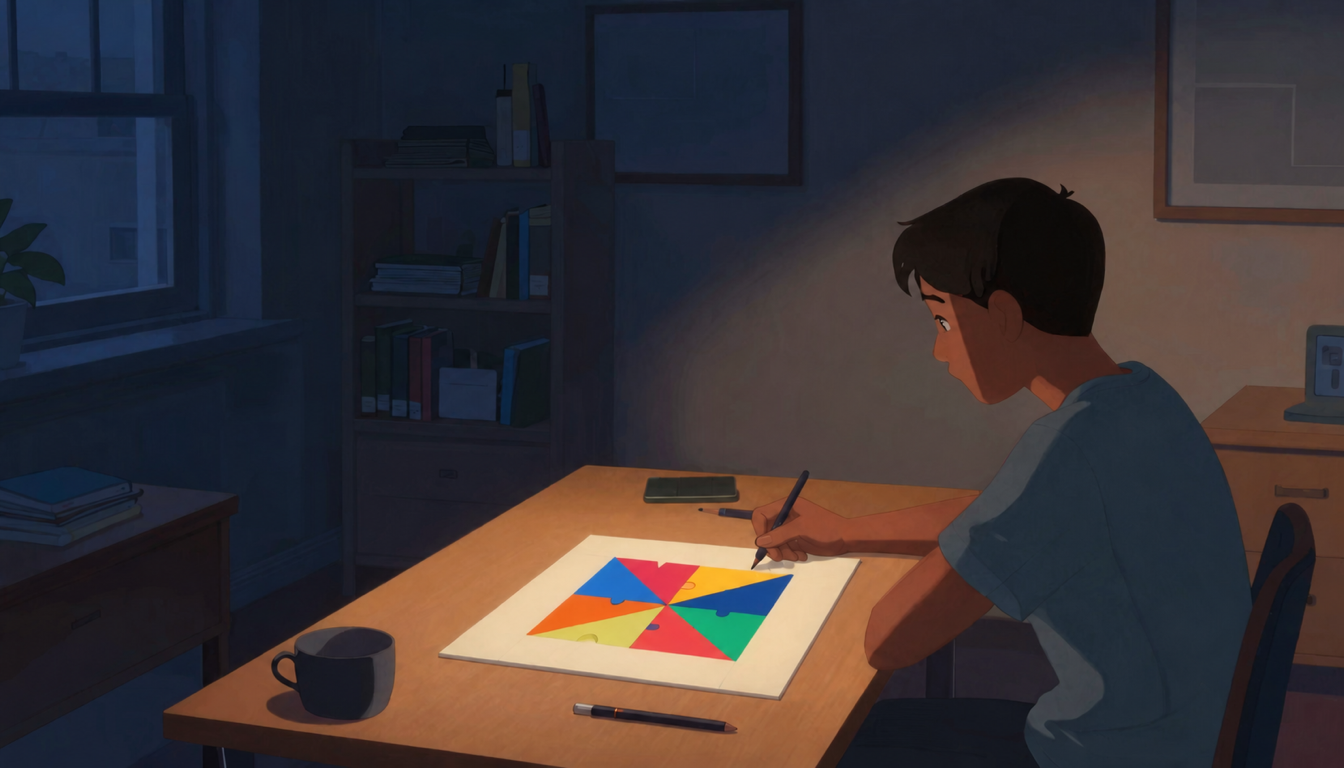
It is late, you have an early class tomorrow, and the only thing written beneath the maths problem is “Solution.” You have tried the same approach several times. Eventually, you switch off the lamp and go to bed.
After waking the next morning, you glance at the page and notice a route you could not see the night before. The problem has not changed. Something about the way you are approaching it has.
That experience can feel like a rescue from nowhere. Psychologists discuss a related pattern as incubation: setting a problem aside and later returning with a more useful idea. Sleep can be part of that interval, but neither sleep nor a break guarantees a solution.
What incubation means
Incubation begins with a problem you have already engaged with. You stop consciously working on it, do something else or rest, and then return. The benefit, when it occurs, is a better approach or a solution after that interval.
This is different from never beginning. The first attempt gives you information about the problem and may reveal why your current method fails. A break then changes the conditions under which you return to that information.
Graham Wallas’s 1926 account of creativity is often summarized in four stages: preparation, incubation, illumination and verification. Preparation supplies the work and knowledge. Incubation is the interval away. Illumination is the apparent arrival of an idea. Verification is where you check whether it works.
The model is useful as a way to describe a process, rather than a timetable every idea must follow. In particular, the satisfying flash of understanding is not the final stage. An elegant thought can still be mistaken.
The familiar story of Archimedes noticing something important while bathing captures the appeal of insight after stepping away from a problem. In the story, he is considering whether a gold crown contains another metal. It is best treated as a famous historical anecdote, not a controlled demonstration of how incubation works.
What sleep may contribute
Sleep gives a break a distinctive biological context. Memory processing continues during sleep, and researchers have asked whether this can help people reorganize what they learned or notice a relationship they had missed.
Wagner and colleagues’ study, “Sleep inspires insight,” investigated insight in a particular trained task. Evidence of a benefit in such work does not mean that every difficult assignment will be solved overnight. Different tasks require different kinds of knowledge and reasoning, and an ordinary rested return may also feel much easier than a late-night struggle.
Three possible accounts help distinguish what “sleeping on it” might mean. The elephant analogy below is fictional and deliberately simplified. It illustrates different explanations rather than describing people whose dreams established those mechanisms.
Seeing the same information differently
Imagine three people trying to identify an elephant from the part each has touched. One feels the leg and concludes that it is a pillar. Another feels the trunk and thinks of a python. The third feels an ear and thinks of a fan.
The first person remains stuck because the experience has been represented as “a pillar.” In a restructuring account, a later return allows the remembered details to be organized differently. The object was not perfectly straight; it broadened below and curved above. Those features may fit a limb better than a column.
The important change is not the addition of a fact from nowhere. It is the relationship among facts already available. In a maths problem, an equivalent shift might involve noticing that the expression can be grouped differently or that the question has been framed too narrowly.
Sleep-related memory processing is one proposed route to such restructuring. You do not need to remember a dream about the problem for a change in approach to be possible.
Connecting with knowledge you already have
The person who touched the trunk has relevant knowledge but has not connected it with the experience. In the illustrative story, a memory of a childhood teacher describing elephants becomes useful: a long trunk can resemble a snake without being one.
Spreading-activation accounts suggest that an initial attempt activates some related information and that further associations can make overlooked knowledge available. The new idea can feel sudden even though its ingredients were learned earlier.
This differs from changing the representation alone. The emphasis is on a connection between the current puzzle and something else in memory. It also makes preparation important: a process cannot draw on knowledge that was never acquired.
The classroom scene is a story about that distinction. It is not evidence that a sleeping mind searches an archive in the orderly way a narrator describes afterward.
Making use of an overlooked cue
The third person has heard a passerby mention an elephant but has not yet used the remark. Later, the cue connects with the remembered large, fan-like ear and other features of the animal.
A cue-assimilation account emphasizes information encountered around the problem. A clue that seemed irrelevant during the first attempt may become useful when it is related to what you already know.
This is different again from claiming that sleep supplies new knowledge. The cue was available; its relevance had not been recognized. In real work, a useful hint might be a diagram, a sentence in a textbook or a question someone asked before you took a break.
The three accounts can overlap. Reframing a problem may help an association become relevant, and a cue may encourage reframing. They should not be treated as three proven, exclusive routes that can be identified from the feeling of having an insight.
A break is useful only if you return and check
Research on sleep and incubation has limits, including differences between tasks and experimental conditions. Some problems may benefit more than others. A break can also leave you with no new idea, which does not mean you slept incorrectly.
Walking offers another possible change of activity. Oppezzo and Schwartz’s experiments found benefits for creative idea generation during and after walking, with less consistent improvement on a convergent task requiring a particular answer. That distinction matters: generating possibilities and solving a specific maths problem are not the same outcome.
If you are stuck, a short walk or another manageable pause may therefore be worth trying. The purpose is to leave an unproductive loop, not to complete a precise exercise dose that guarantees creativity.
Before the break, identify what you understand and where you are stuck. Afterward, return to the actual question. Test the new route, work through the steps and check the result. If the difficulty is missing background knowledge, seek that knowledge rather than waiting for incubation to create it.
Together, sleep and the incubation effect can be part of a useful problem-solving process. They do not replace preparation, clues or verification. The next morning’s clarity feels surprising because you could not force it the night before; what makes it valuable is whether it leads to an answer you can show to be right.
Frequently asked questions
What is incubation?
Setting a previously attempted problem aside and later returning with a more useful approach or solution.
Must I dream the answer?
No. A possible benefit after sleep does not require a remembered dream.
What are the three explanations?
Changing the problem representation, connecting related knowledge and using an overlooked cue. These may overlap and are not established from a single experience.
Does walking solve every hard problem?
No. Walking research found clearer benefits for creative idea generation than for a task requiring one particular answer.

