Summary
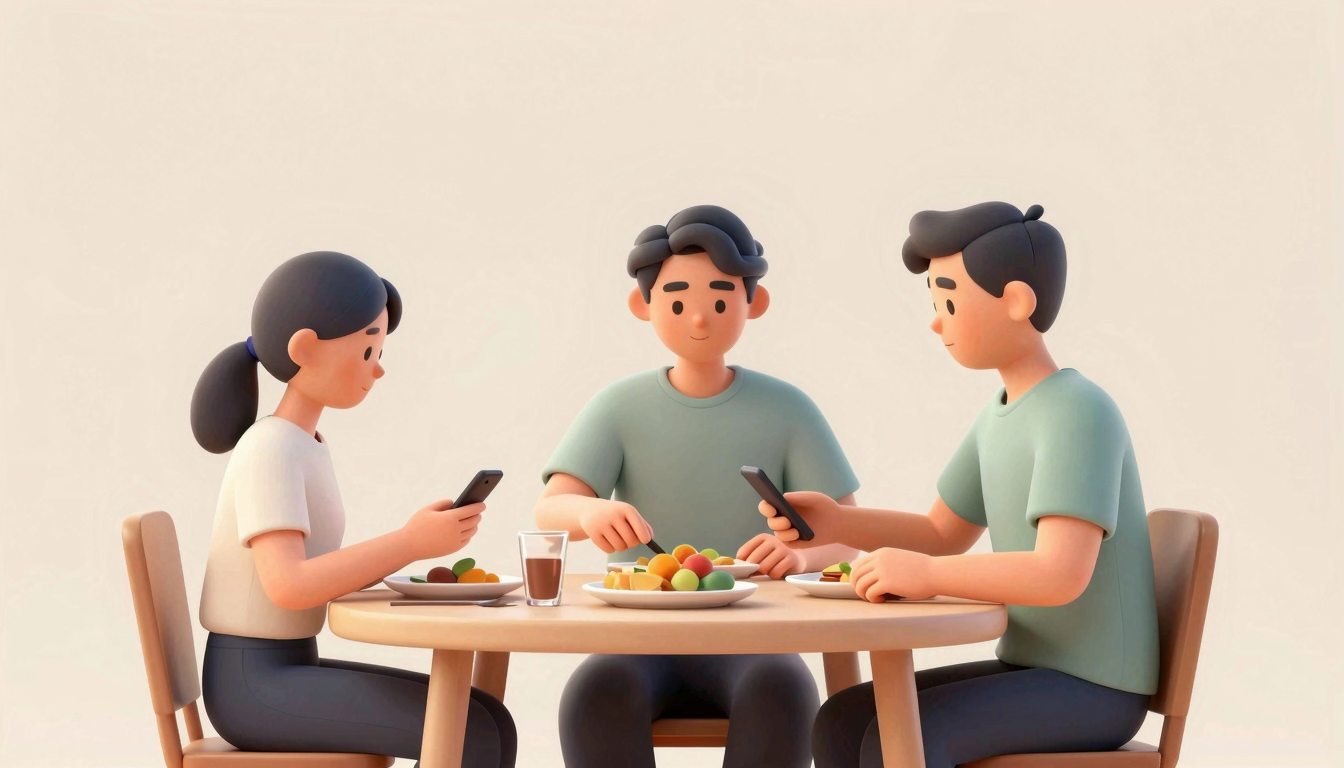
A shared meal brings phone habits into focus: attention to companions, awareness of eating, and the challenge of deciding how much time a device receives.
At a glance
The studies described link phone use during face-to-face encounters with greater distraction and less connection and enjoyment. In a snack experiment, participants consumed more calories while using a phone or reading a magazine than without a distractor, with no significant difference between the two distraction conditions. The researchers proposed interference with food memory as an explanation.
What happens when phones join a shared meal? Conversation may feel more awkward, and eating may become easier to continue without much thought. Those concerns invite a closer look at how a small screen changes the time we spend together.
Writing during a period of pandemic restrictions whose end remained uncertain, the original writer addressed students whose ordinarily varied holidays might have narrowed to eating, sleeping, and scrolling. The invitation was simple: look at your average daily screen time over the preceding month. How much of the day had the phone occupied? When you become absorbed in scrolling, does it begin to feel as though the device has become the master of your time?
Phones have become central to everyday life for understandable reasons. They combine communication, entertainment, travel, and money management in one place. Their rapid adoption has brought considerable convenience, alongside growing dependence. The writer evokes familiar scenes from those long days at home: parents absorbed in short videos, grandparents repeatedly checking WeChat groups, and readers holding their phones close, their expressions shifting from serious to cheerful. Fascination with the screen gives way to a question: how can we prevent that absorption from becoming excessive or uncontrolled?
The writer calls this concern “problematic mobile phone use,” also using the term “phone addiction.” Examples include becoming immersed in a phone, struggling to control how long one uses it, checking it in inappropriate situations, and feeling afraid when it is unavailable. The writer acknowledges that there is no precise standard for determining when phone use becomes problematic.
What phones change about time together
Phone use during social encounters is widespread. In a Pew Research Center survey, nearly 90% of phone users said they used their phones during face-to-face social activities. The writer tentatively interprets that prevalence as suggesting that people see little harm in the habit.
Canadian researchers explored those effects in two studies published in the Journal of Experimental Social Psychology in 2018. They asked whether—and how—phone use affects the social and emotional benefits of face-to-face interaction.
For the first study, 304 participants came to a café for what they were told was a study of the dining-out experience. They attended in groups of three to five friends or family members. Each group was randomly assigned to a condition in which phones remained available or one in which they were put away.
In the phone condition, participants were told that a research assistant would text them a survey question after they ordered. To ensure they received it, they had to keep their phones on the table with sound or vibration enabled. In the comparison condition, the question appeared on paper, and participants silenced their phones and placed them in a box.
Participants in the phone condition reported less connection with their companions, greater stress arousal, less positive emotion, and less enjoyment. The researchers also reported that phones interfered with attention to the interaction, weakening its emotional rewards.
The second study examined everyday social experiences. For one week, 123 participants completed five online surveys a day, each covering the immediately preceding 15 minutes. They answered questions about how often they had used a smartphone, whether they had interacted with anyone face to face, and whether that interval had been interesting and enjoyable.
During face-to-face interactions, those who had used a smartphone reported greater distraction, more negative emotion, less social connection, and less enjoyment than those who had not.
The writer sees the two studies as converging evidence that phone use during shared meals and other face-to-face encounters can diminish the psychological benefits of spending time together.
Distraction and how much we eat
At the same table, distraction may affect more than the interaction. A 2019 paper in Physiology & Behavior examined phone use during eating and calorie intake in a four-day snack experiment involving 62 adults.
The researchers reportedly controlled factors that could influence the results. Participants ate under three conditions: without a distractor, while using a phone, and while reading a magazine. Each condition offered the same varied selection of foods and drinks, including soda water, biscuits, chocolate, yogurt, bread, and fruit. There was no time limit; participants could continue eating until fully satisfied. Researchers assessed calorie intake after each condition.
Total calorie intake was significantly lower without a distractor than during either phone use or magazine reading. Intake did not differ significantly between the two distraction conditions.
The findings suggest that distractions unrelated to eating can increase intake in this setting. The researchers proposed interference with food memory as the main explanation: attention elsewhere may make it harder to form a memory of the food consumed and accurately process how much has been eaten, hindering the development of fullness.
The writer describes technology as changing eating habits, with phones increasingly present at tables and electronic devices becoming a main source of mealtime entertainment for adults and even children. If an increasingly difficult-to-control appetite troubles you, do you regularly eat with your attention on a screen? That is a habit to examine, while leaving open what explains your own appetite.
Phone use and reported health concerns
Beyond meals, a survey published online in Addictive Behaviors examined problematic phone use and health among 729 students from five Hong Kong secondary schools. The students completed a problematic mobile phone use scale, the Depression Anxiety Stress Scales, a brief pain assessment, and the Epworth Sleepiness Scale.
Longer phone use was significantly positively correlated with depression, bodily pain, and daytime sleepiness scores. Students classified as problematic phone users also scored significantly higher on all three measures.
Girls in this sample spent more time using phones than boys and were reported to have more serious health problems.
Across the three papers, the writer draws a broad conclusion that poor phone habits can carry substantial costs for social life, eating, and mental health. The evidence takes different forms: experiments examining social experience and food intake, alongside surveys linking phone use with reported experiences and health concerns.
Making room for deliberate use
The practical benefits remain substantial. During the pandemic restrictions described here, primary and secondary schools and universities had begun teaching online. Electronic devices, including smartphones, supported the move from physical classrooms to online lessons and helped students continue learning while schools were closed.
For the writer, necessary classes still do not justify prolonged periods of immersive phone use. Keeping up with lessons and managing phone use sensibly can go together. The recommendations that follow express that practical aim.
Begin with the relationships around you. The writer encourages maintaining and developing relationships in everyday physical settings rather than depending excessively on online socializing. Group gatherings were still inappropriate under the pandemic conditions described, but time at home offered opportunities to talk with grandparents and other relatives and help ease older family members' loneliness. Younger readers were not the only ones confined at home. Their older relatives were confined too and, in the writer's view, more susceptible to loneliness.
Unnecessary notifications offer another place to intervene. The writer recommends disabling alerts from apps such as Weibo and short-video platforms. Even a notification left unopened can seem to say, “Come and look.” These frequent invitations to check the phone are, in the writer's assessment, a major everyday distraction.
Give attention somewhere else to go by building constructive habits. Free time can include exercise that fits into a small space or household tasks. Before bed, calligraphy may offer a way to settle the mind, or reading can become a regular habit.
Daily screen-time limits or limits for individual apps provide another way to manage use. The purpose is to decide how much time the device receives. As the writer puts it, we are our phones' masters.
That reflection began personally for the writer, who recalls accidentally seeing their own average daily screen time and wondering whether their use had become problematic.
The writer notes that there is no precise standard for determining problematic phone use. Very frequent checking throughout the day or agitation when separated from a phone may be warning signs. The writer's hope is that noticing these patterns will encourage deliberate time management and help prevent problematic use, rather than becoming another cycle of “I understand the advice, but I still can't put it into practice.”