Summary
From the pull of doomscrolling to a child’s first bicycle ride, the writer examines how attempts to escape anxiety can differ from learning to move through it, while preserving a boundary for excessive anxiety.
At a glance
The writer argues that manageable anxiety can prepare us for action, draw attention to potential threats, and motivate practical steps. Respecting it can also mean helping children move through difficult feelings with acknowledgment, trust, and support. This argument has a limit: excessive anxiety and anxiety disorders call for effective help and medical guidance.
Can anxiety sometimes be useful? This discussion considers manageable anxiety as a signal to prepare or seek support. Recognizing that role does not require dismissing anxiety disorders or their treatment.
The source essay offers a broad historical story about religious and medical interpretations of anxiety, but it does not provide enough traceable evidence to establish when people first viewed anxiety as harmful. Word origins cannot settle whether a present-day experience needs treatment.
Ideas about anxiety have changed across psychological theories. The essay’s compressed account of Freud should not be treated as a verified chronology or as evidence that anxiety is present in every mental illness.
Clinical classification does not make every anxious feeling a disease. The American Psychiatric Association distinguishes ordinary anxiety from disorders involving excessive fear or anxiety and interference with life. An account of useful anxiety should preserve that distinction.
Medication can help some people, but benzodiazepines are not nearly free of side effects. The FDA warns of misuse, addiction, physical dependence and withdrawal, including serious risks when combined with opioids or other depressants. Treatment decisions belong with a clinician; do not abruptly stop or rapidly reduce a prescribed benzodiazepine on the strength of this article.
An unspecified report of overdose deaths cannot establish why people took a drug or whether appropriate treatment is merely an attempt to avoid all emotion. Benefits, adverse effects and treatment goals need individual assessment.
“But who says anxiety is necessarily bad?” the writer asks in an imagined exchange.
“So you’re saying it’s good? What use could it possibly have, apart from making us uncomfortable?” comes the skeptical reply.
One way to understand anxiety is to ask what anticipating danger can help a person do. That is a functional question, not proof that every enduring human trait has a useful purpose. Sweetness is not a reliable test of food safety, and the essay’s stories about teeth and color vision do not establish anxiety’s function.
A response that can be useful in one setting may be costly in another. Anticipating a deadline may prompt preparation, while persistent threat monitoring can interfere with sleep or concentration.
A functional account considers how appraisal can prepare us to act. Anxiety may include a racing heart, altered breathing or stomach discomfort. These sensations do not mean the body or brain is operating at its best, and unfamiliar or concerning physical symptoms should not automatically be attributed to anxiety.
Its unpleasantness can also give us a reason to act. The account invokes negative reinforcement: a behavior becomes more likely when it reduces or removes an unpleasant stimulus. Broad anxiety about the future, for instance, can push us toward something specific and within our control—making a plan or beginning a small task at hand. Steadily carrying out those actions may ease the anxiety, encouraging us to act again. Uneasiness, worry, and tension can thus help set useful action in motion.
Anxiety also shapes what we notice and remember. The writer explains that potential threats draw our attention toward threat-related information and make it easier to remember, while unrelated information is more readily ignored or downplayed. In moderation, this can make us more sensitive to danger. Excessive anxiety, however, can narrow our attention to distressing details while obscuring favorable evidence.
The writer offers a personal example from public speaking: when intensely anxious, a single yawn in the back row captures their attention, while listeners who are smiling and nodding go unnoticed. The same sensitivity that alerts us to a possible problem can leave us with a distorted impression when anxiety becomes too strong.
The practical question, then, is how we might use anxiety. Burying ourselves in a phone is a familiar attempt to find relief. It seems to soothe us for a while, with time apparently the only price. The writer argues that this relief can nevertheless be unhealthy over the longer term, while distinguishing between very different ways of spending time online.
Online contact can provide support, but its value depends on the relationship, content and circumstances. The source does not identify a study sufficient to establish that supportive text messages are generally more effective than video for young people. Choose a form of contact that helps the actual exchange.
Browsing can feel absorbing or soothing, but passive use is not uniformly harmful and posting is not uniformly beneficial. Notice whether a particular session leaves you connected and informed or more distressed and unable to stop.
Doomscrolling—repeatedly consuming negative material online—captures this contradiction. When anxious, we may become absorbed in news about discrimination, politics, viruses, war, unemployment, or other sad and troubling subjects. Scrolling offers a tempting temporary escape even as the content feeds our anxiety. The writer sees an understandable impulse behind it: we gather more information, even bad information, in an effort to reduce uncertainty.
Seeking information makes sense. The difficulty, in this account, is that the digital environment favors negative material while algorithms keep supplying content we already agree with or find interesting. The resulting “echo chambers” or “information cocoons” can narrow the range of information we encounter even as we scroll more. People in different chambers find it harder to communicate across those boundaries, contributing to polarization.
Games may provide a break, but a game’s repeated actions do not prove that it requires no attention or induces flow. Consider whether play helps you return to what matters or displaces sleep and responsibilities; the source supplies no basis for treating a particular game as an anxiety intervention.
These attempts at relief lead back to the question of what we are trying to achieve. Anxiety need not always be eliminated. The writer’s proposed first step toward using it is a change in attitude: approaching it with respect rather than aversion and fear.
That change matters for children and parents alike. Both need an appropriate understanding of their own anxiety, and parents accompanying their children’s development need to recognize the role it can play.
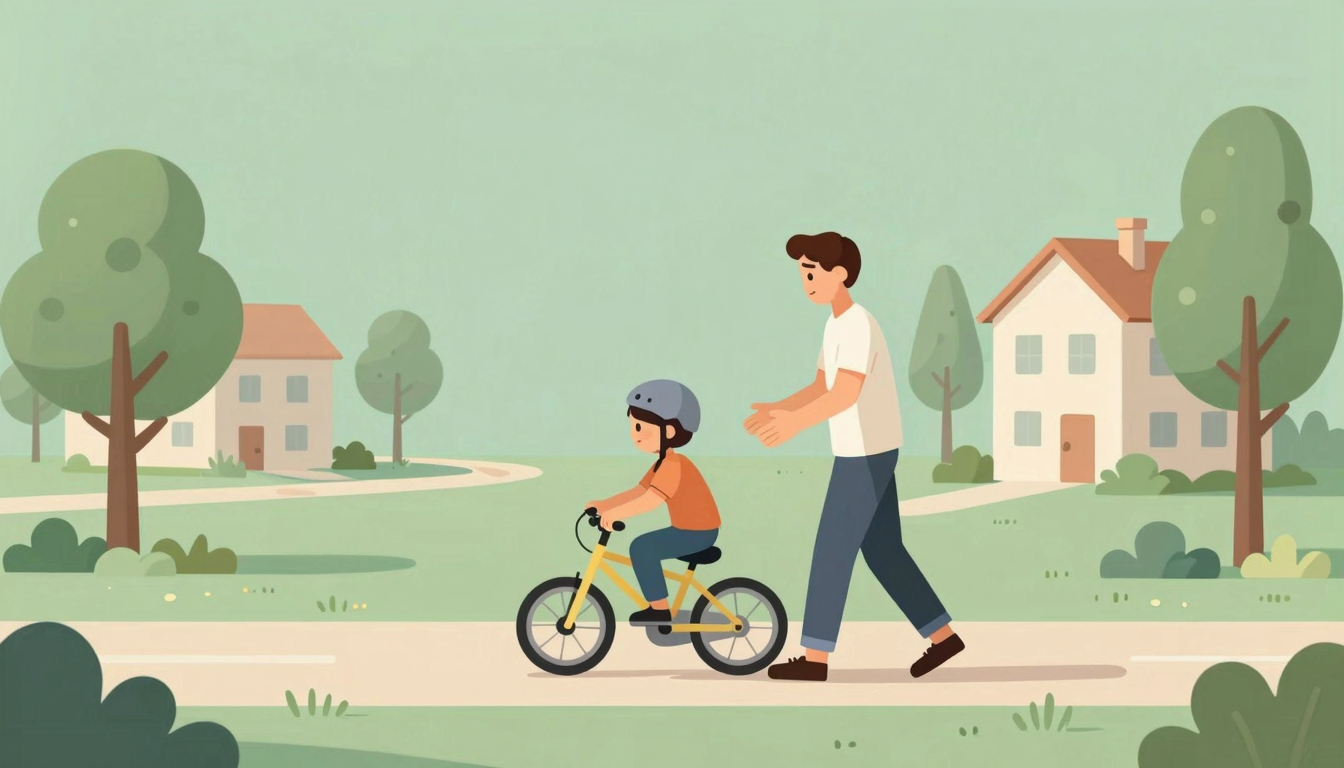
The writer offers familiar examples of how parents may respond. While teaching a child to ride a bicycle, a parent might say, “Don’t be afraid. There’s nothing to fear.” Before an exam, the reassurance might be, “Don’t be nervous. You’ll definitely do well.” When a child’s palms are sweating or they ask for help in a frightened voice, a parent may keep offering encouragement without easing demands that can sometimes be too strict.
Rather than settling how people should parent, the writer asks why parents can be so eager to prevent their children from feeling anxious. One proposed explanation is that they believe anxiety makes children fragile and less likely to succeed. Another is that preventing a child’s anxiety can become a way of avoiding their own: the fear that their child will be overwhelmed by the feeling or unable to complete a task.
Some anxiety is a normal part of facing childhood challenges, the writer argues. Parents can acknowledge what their child is feeling, express trust in them, and help them move through the anxiety rather than escape it. Supporting a child through discomfort need not mean making the feeling disappear.
Yet a deeply rooted belief that anxiety is harmful can drive strenuous efforts to prevent it. Some parents, in the writer’s image, prepare the road for their children instead of preparing their children for the road. Anxiety need not signal incapacity; it may contribute to antifragility—the capacity to grow stronger through difficulty.
The phrase “emotional immune system” is a metaphor. Manageable challenges with support may offer opportunities to learn, but forcing yourself to endure escalating distress is not a guaranteed route to strength. Adjusting demands and seeking help can be appropriate responses.
Human beings are resilient, the writer insists, and excessive protection can deny us experiences through which we grow. Meeting challenges that involve risk calls for less perfectionism and more courage. Where anxiety remains manageable, the invitation is to face it and allow ourselves to feel it, understand the information it conveys, and then use the readiness it provides to act and make progress.
The appeal takes the form of a closing image: “Wind extinguishes a candle but strengthens a fire. Be like the fire, and welcome the wind that helps it burn brighter.”
You do not need to diagnose yourself or wait until anxiety feels completely uncontrollable before seeking help. Persistent anxiety that interferes with sleep, school, work or relationships deserves professional attention. Treatment can include psychotherapy, medication or both. Helping a child through discomfort should also include responding to safety, developmental needs and sustained impairment.