Summary
Sincere concern and accurate understanding can diverge. Four experiments examine how similar experiences, perspective taking and personal distress relate to judging another person’s negative emotions.
At a glance
Shared experience does not necessarily improve accurate understanding of another person’s emotions. In the four experiments described, which focused chiefly on negative emotions, greater experience similarity was associated with lower empathic accuracy. Personal distress and empathic concern partly accounted for that relationship, with concern potentially helping while distress could interfere.
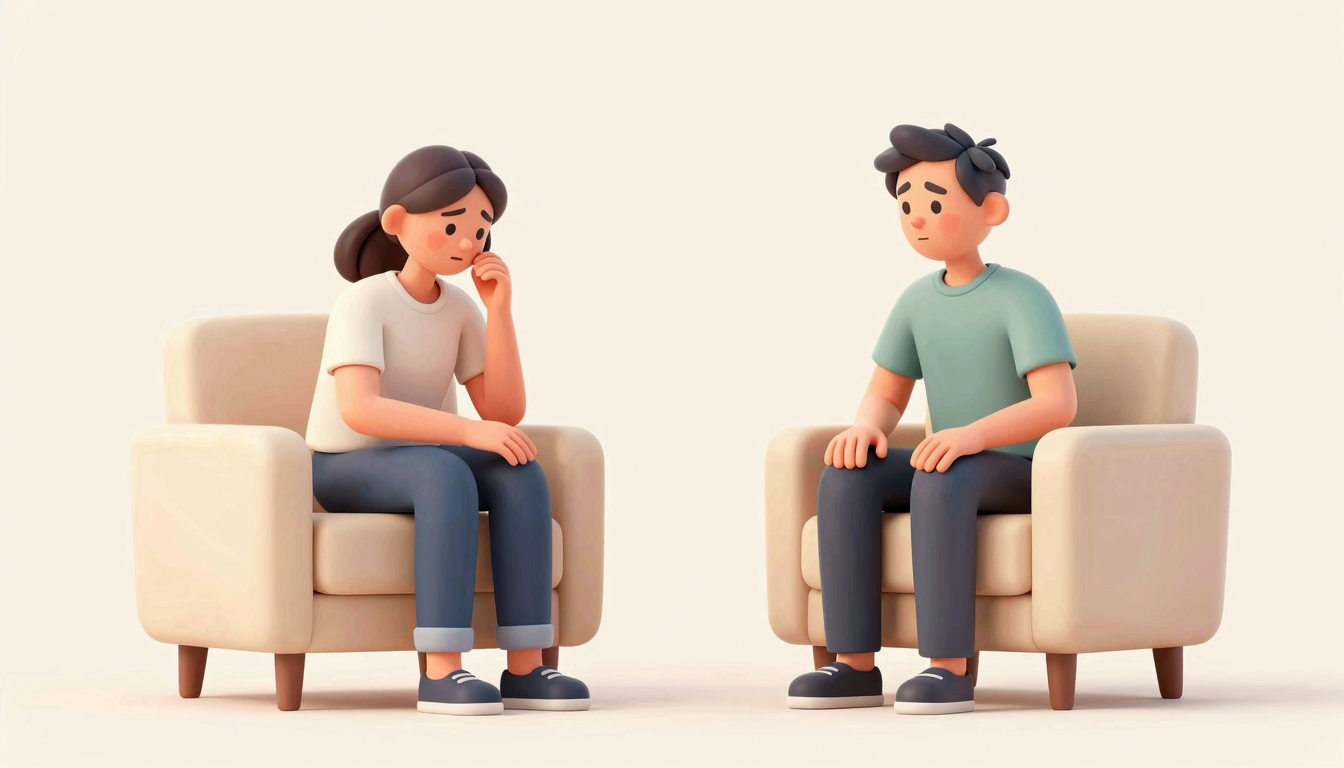
“I understand how you feel. I’ve been through something similar.” It is a familiar reassurance, and it may be entirely sincere—an expression of recognition and care. But does having a similar experience mean someone accurately understands what another person is feeling?
The wish to understand other people’s minds has a counterpart: when people are in pain, they often want the company of someone who understands them. Psychologists call the ability to accurately understand another person’s thoughts and emotions empathic accuracy. Whether shared experience helps someone achieve that accuracy is a separate question from how sincerely they care.
Accuracy depends partly on how clearly someone expresses their feelings and how much the person trying to understand them knows about the circumstances behind those feelings. Imagine someone who is sad but conceals it, or whose recent experiences are unknown to you. Either condition makes accurate understanding harder. When they express their sadness clearly, understanding becomes easier. But does knowing more about their life offer a further advantage? And if you have been through something similar—or the same kind of event—does that make their feelings easier to understand?
Researchers examined this question by studying experience similarity and perspective taking, focusing chiefly on how accurately people judged another person’s negative emotions. Earlier research had suggested that experiencing similar emotional events could help people understand someone else’s feelings. Yet little research had directly examined whether experience similarity improved empathic accuracy. The supporting evidence was largely indirect: people who knew more about what had caused another person’s emotions tended to judge those emotions more accurately. That evidence concerned knowledge of emotional causes, leaving the benefit of shared experience to be tested. On this basis, the researchers hypothesized that similar experiences would improve accuracy.
Perspective taking supplied another possible influence. Self-focused perspective taking means imagining how you would feel in the same situation. Other-focused perspective taking means imagining how the other person feels, considering the current event from their position.
The research background described in the account presented both approaches as potentially improving emotional understanding, while distinguishing their emotional consequences: imagining yourself in the situation can bring up your own negative thoughts and distress, whereas imagining the other person’s feelings was described as not evoking personal distress.
The Anchoring and Adjustment Model, attributed to Epley and colleagues (2004), offered a further reason to expect an advantage for other-focused perspective taking. As applied in this account, the model suggested that focusing on the other person would be less affected by egocentric cognitive bias than imagining one’s own response, potentially allowing more accurate understanding. The researchers therefore predicted greater empathic accuracy with other-focused perspective taking. They also considered whether its effect might depend on how similar the perceiver’s experiences were to the other person’s.
The researchers conducted four experiments with American participants whose average age was about 37. In Experiment 1, participants were assigned to either self-focused or other-focused perspective taking and watched four videos about negative emotional experiences, each lasting two to three minutes. The video material was described as showing a woman around age 20 recounting emotional events from her life.
Participants then rated the emotions expressed in the videos using ten emotion terms, each on a scale from 0 to 6. Next, they rated how closely the events resembled experiences of their own or of people close to them, again on a 0–6 scale. These ratings provided the measure of experience similarity.
To measure empathic accuracy, the researchers calculated the absolute differences between participants’ emotion ratings and the targets’ ratings of their own emotions. Larger discrepancies meant less accurate judgments. Multiplying the average absolute difference by −1 produced a final index on which higher values indicated greater accuracy.
Experiment 1 did not support the predicted benefit of similar experience. Instead, similarity interacted with perspective taking: among participants assigned to focus on the other person’s feelings, greater similarity was associated with lower empathic accuracy.
Could greater similarity have stirred up stronger negative emotions in the participants themselves, making it harder to understand the person in the video? This was a possible explanation to explore, rather than a mechanism established by the first experiment.
Experiment 2 tested whether bringing participants’ own emotions to the foreground affected their accuracy. After watching the videos, half rated their own emotions before rating the other person’s; the other half completed the ratings in the reverse order. Those who rated their own emotions first were less accurate in judging the other person’s feelings. The account interprets this finding as evidence that, in this experiment, attending first to personal negative emotions hindered accurate judgment regardless of the assigned perspective-taking approach. Greater experience similarity also predicted lower accuracy, and similarity again interacted with perspective taking.
The adverse relationship persisted when the materials and comparison groups changed. Experiment 3 used four different videos and added a perspective-taking control group. Again, greater similarity between participants’ experiences and the events described in the videos was associated with less accurate judgments of the targets’ emotions.
Experiment 4 provided further support for the preceding findings and examined the emotional pathways involved. Personal distress and empathic concern arising after participants watched the videos partially mediated the relationship between experience similarity and empathic accuracy, accounting for part of that relationship.
The account explains these pathways as pulling in different directions. Having lived through a similar negative experience may evoke sympathy and concern for the other person, helping someone understand their feelings. This beneficial pathway, however, was described as relatively small. The more prominent adverse possibility was that similarity could draw attention away from the other person and back toward oneself, reviving the pain of one’s own experience. Feeling overwhelmed in this way may consume cognitive resources and interfere with accurate understanding of the other person’s emotions.
Shared experience can therefore accompany sincere concern while leaving someone caught in their own pain, making it harder to take another person’s perspective and understand their negative emotions accurately. In the account’s closing interpretation, accurate understanding requires both greater empathic concern for the other person and the ability to interrupt interference from one’s own negative emotions. Together, these conditions make accurate perception possible; they do not guarantee it.
Frequently asked questions
What is empathic accuracy?
Empathic accuracy is the ability to accurately understand another person’s thoughts and emotions.
How do self-focused and other-focused perspective taking differ?
Self-focused perspective taking means imagining how you would feel in the same situation. Other-focused perspective taking means imagining how the other person feels, considering the current event from their position.
What happened when participants rated their own emotions first?
In Experiment 2, participants who rated their own emotions before rating the other person’s were less accurate in judging the other person’s feelings than those who completed the ratings in the reverse order.