Summary
An enlarged mahjong table, concealed family photographs and shifting reflections bring private recollection into shared space in Family Album.
At a glance
Family Album explores photography’s relationship with time through domestic space, sculpture, painting, light and participation. Drawing on the artist’s grandparents’ photographic labor, it connects private memories with shared family narratives. Its installations consider both the moment a photograph preserves and the later occasions when people return to it, extending family beyond the household to wider human connections.
An interior may itself be a family album. This possibility opens Family Album, an exhibition in which the artist explores photographs and the time people share. Space and memory, individual and collective recollection, photographs and time form its connected concerns. Here, the artist extends “family” beyond a household to include all the connections people establish with others. “Our time” is the time shared through those relationships.
Over several years of studying art through photography, the artist became increasingly absorbed in the medium’s abstract relationship with time, more than in the beauty and meaning created by an image’s visual content and symbols. Photography, as the artist understood it, could take a slice from flowing time, hold it still and make it permanent. The question was how to extract that quality intact and present it on its own, as cleanly as removing a bone from a chicken wing.
The difficulty was that no photograph could be separated from the particular moment it carried. In the artist’s reasoning, a photograph records a concrete scene in the world, and the real time belonging to that scene cannot be stripped away. Even pinhole imaging, without a shutter to release, remains continually bound to the present. To isolate photography’s temporal character, the artist proposed removing recognizable real-world imagery and giving that character form through another medium. This attempt led to the exhibition’s large installation.
A second starting point lay in the family’s considerable labor around photographs. In the 1970s, while the artist’s maternal grandfather was still alive, he set up a home darkroom to develop and enlarge photographs. With a Seagull camera, he made many black-and-white pictures of the family. Later, the artist’s maternal grandmother hung family group photographs densely in her room. In her later years, she carefully assembled 32 thick family albums for her children.
In the grandmother’s preservation of photographs and her treatment of relatives, the artist sees a way of building an identity through relationships. The group photographs helped her locate herself within those connections and, in the artist’s understanding, root the value of her life in them. Translating both grandparents’ actions into art became a way to explore their feelings and interests, and to understand what family meant to them. Time and people thus became the exhibition’s two starting points—the aspects of photography that mattered most to the artist.
The exhibition occupies the first and second floors of a four-story family villa. Its installations condense an abstract domestic space alongside rooms that retain their everyday functions: a living room, an open kitchen, a storage room and a bedroom. Orange spheres and dark-green square frames recur among the pendant lights, round chairs, tabletops and picture frames, tying the works to their architectural setting. On the first floor, abstract versions of album-making and photograph-hanging explore how memory inhabits an interior. Upstairs, attention turns to photographs themselves and the time within them.
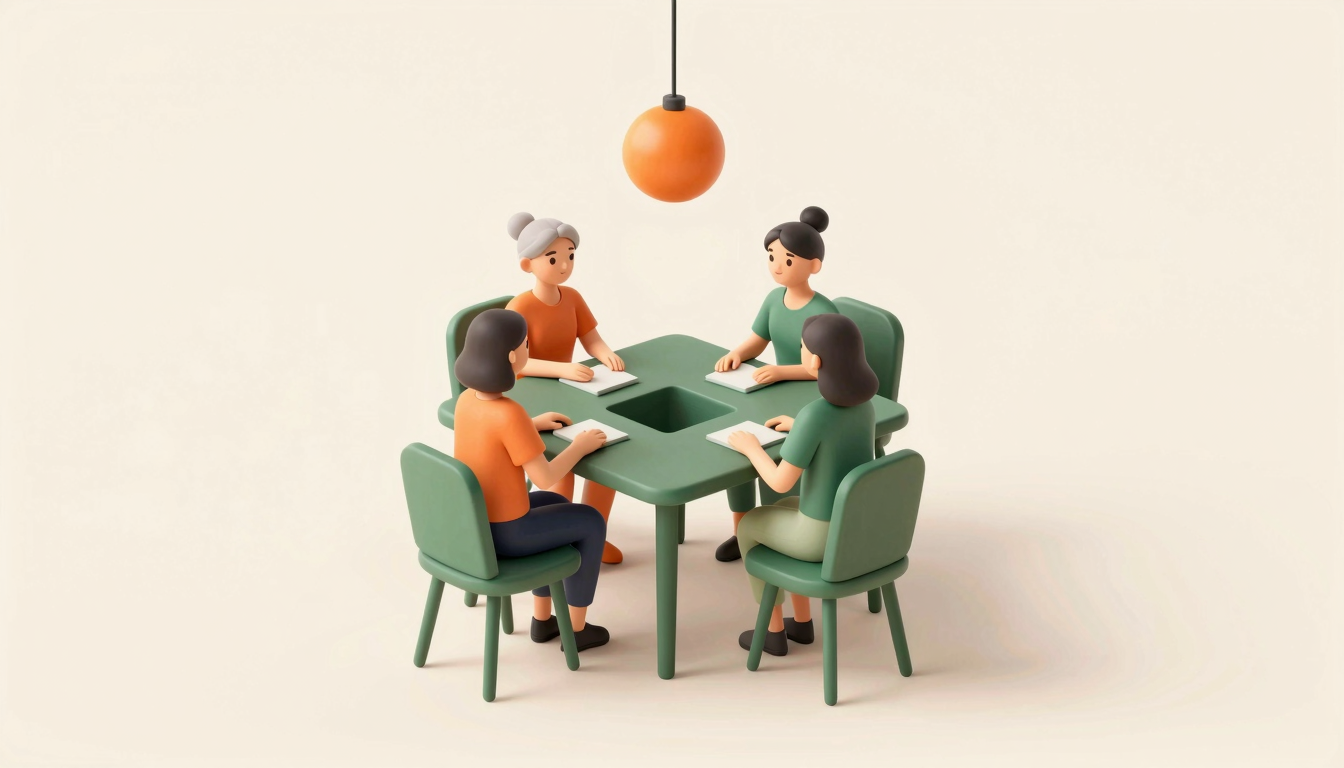
The Ritual of Reading Family Photographs takes the form of an enlarged mahjong table and chairs, exploring the interaction of individual and collective memories and the relationship between finite and enduring time. An oil painting that hung in the grandmother’s living room for roughly three decades rests in the recessed center of the tabletop. Inside four round chairs hang five old family-album photographs, showing the grandmother with her daughters and granddaughters beneath that same painting.
For the artist, the grandmother’s album-making for her children and grandchildren resembles the workings of a mahjong game. So does the family’s practice of sitting together in a cramped bedroom, studying photographs closely and recalling the past. In this analogy, a dealer determines where a narrative begins and the order in which it unfolds. Three other participants join with allotted cards, keeping their contents private. What each person sees remains undisclosed to the others: within a shared story, everyone holds a private one.
The artist plans a performance for the work’s complete version. The grandmother and her three daughters would sit around the table and follow prescribed game rules: turn the painting’s canvas over, take turns cutting up the entire painted image, and then shuffle. The proposed performance would further explore how individual and collective memories interact on the tabletop.
The installation offers three ways of looking. On entering the first-floor gallery, visitors encounter a sculptural family album whose memories sit between public and private. The photographs are concealed inside the chairs, while the table’s sheer size creates four separate viewing planes. Visitors must circle the table to inspect the small photographs in each plane separately. One face includes a photograph of the grandmother and the artist’s second maternal aunt beneath the living-room painting.
The next two modes unfold in sequence as ways of looking together. Seated around the table, viewers look into its square horizontal surface at similar oblique angles. Moving upstairs, they can then see the whole painting together. For the artist, the first-floor tabletop exists in the present, while the second-floor view offers a retrospective perspective. These perspectives coexist within the building, giving spatial form to two kinds of photographic time: the instant of shutter release held within an image, and the later time in which people return to it.
The stillness of the materials provides another approach to that temporal question. The artist imagines painting, photography and sculpture as a quiet triangle exploring enduring time, contrasting them with the movement of film, theater, animation, dance and performance. Although the installation began with photography and the family album, painting and sculpture account for most of its physical volume. The old oil painting and the heavy dark-green sculptural mahjong table approach photography’s relationship with time indirectly, through stillness and great weight.
The small family photographs supply clues. One shows the artist’s eldest maternal aunt and her family with the artist’s mother and grandmother beneath the living-room painting; another shows the artist with the grandmother in the same setting. Together with the large painting on the tabletop, these images connect the family members’ collective time. The artist extends that shared time beyond this particular family and these materials, toward the time any of us has spent with another person, and with others.
The recurring circles and squares have grammatical roles in this thinking. The circle stands for a subject and the actions that issue from it. The square offers a carrier, a place—an expansive adverbial setting, rich in possibilities for those actions. Against the span of a lifetime, gatherings around a table are brief. The artist imagines preserving them as the tabletop becomes a photograph and a square clock without hands. Within the oil painting, time spent together acquires a poetic permanence.
Yet this still structure depends on participation to come alive. Ordinarily, people gather for a photograph, becoming a still image—what the artist describes as a static, two-dimensional sculpture. Here, that sequence is reversed. The sculpture exists first; when friends sit around the table, their gathering awakens its time. Initially existing in the manner of a photograph, the table becomes a setting for another group photograph. In the artist’s formulation, the gathering itself creates a new, living photograph unfolding in the present.
At the center of that gathering is the recessed tabletop. Its shape brings familiar occasions to the artist’s mind: a hollow holding hot-pot oil, or the green felt at the center of a mahjong table. Here, an oil painting occupies the space where gazes meet in the present and memories are held afterward. The artist suggests that the recess stitches otherwise unrelated meanings around the painting. A remembered scene inviting viewers to read and interpret it is one such association, leaving room for others.
Seven spherical pendant lights carry these spatial connections through the exhibition, evoking what the artist describes as clock markings being completed. After sunset, their projections onto the second-floor curtain form seven luminous points. The configuration changes with the angle from which a visitor looks.
In film, the second work, the inquiry turns to memory’s material presence in an interior. The artist’s longstanding interest in hanging photographs on walls extends to what happens afterward: subtle changes in the surrounding living space alter how memory resides there.
The artist calls the places where photographs hang “white areas.” These are carriers of memory that people impose on their surroundings, investing them with time and emotion until, through accumulation, the rectangles become metaphorically overexposed. “Black areas” are the indoor surfaces left uncovered by photographs. The terms name roles in this imagined scheme rather than necessarily describing actual colors. Memory is imagined as diffusing from white to black along a concentration gradient. Window screens, glass, mirrors, clothing surfaces and other materials acquire an agency of their own, actively absorbing saturated memories and feelings.
The artist photographed these “black areas” in the home where the grandmother had lived alone for more than thirty years. Several photographs with the most intense colors were selected, enlarged to several times the pictured surfaces’ real-world size and pasted directly onto the gallery walls.
The Time a Photograph Holds, the third work, examines photography’s reshaping of time in two parts. The first presents an original group photograph from 1984, identified in the artist’s account as a portrait from an engineering-mechanics institute whose designation also names the Chinese Academy of Sciences and the State Seismological Bureau. The artist’s maternal grandfather handmade its wooden frame, and the framed photograph remained hanging in the grandmother’s home. Both maternal grandparents appear in the image.
As the artist describes it, the photograph was made by rotating the camera from left to right and releasing the shutter multiple times. Visitors read it by moving slowly in the opposite direction, from right to left. As they move, the reflection of an orange light on the glass gently sweeps across the faces in the black-and-white image.
The second part consists of five dark-green frames arranged side by side in front of pendant lights. Painted with the same paint as the table downstairs, their centers appear almost blank. As visitors walk back and forth along the passage, their reflections in the glass shift subtly in relation to four circular lights.
The faint patterns within the frames are high-resolution scans of the backs of old photographs. The central image carries a Christmas greeting that the artist’s grandfather wrote in Russian to the grandmother on Christmas Eve, 1964. In the other four, marks in the lower-right corners remain where paper was pasted down and later torn away. The artist identifies these as traces of the grandmother’s labor in remaking the family albums.
The fourth work is titled when you finally see skeletal debris in kinships.
The fifth, little orange blossom, consists of medium-format film photographs the artist took at the grandmother’s home, displayed in the small gallery at the rear of the second floor. The cramped setting recreates the artist’s childhood memory of staying there: each winter, an old electric heater cast an orange-red glow over every surface in the room. The artist describes this setting as the exhibition’s only area that recreates a remembered place realistically.
On the exhibition poster, the recurring green square is simultaneously a photograph’s frame, a square mahjong table and a clock without hands. Its clock markings run counterclockwise—a direction the artist connects to loosening a bottle cap. A photograph can be imagined as a container of time, like a bottle of water. Several works attempt, metaphorically, to open it, pour out the time held inside and see what it might be like.
In the artist’s further metaphor, the viewer’s gaze unscrews the cap while reading the poster’s text. The invitation is to look at the works and try to understand the time within photographs. What that time might look like once released remains an open question.
Frequently asked questions
What does family mean in Family Album?
The artist extends family beyond a household to include all the connections people establish with others. The exhibition’s “our time” refers to time shared through those relationships.
What two kinds of photographic time does the installation explore?
For the artist, the installation connects the instant of shutter release held within an image with the later time in which people return to it. The downstairs tabletop and upstairs view give these perspectives spatial form.
Did the planned performance with the grandmother take place?
The artist describes it as a performance planned for the work’s complete version. The grandmother and her three daughters would turn the canvas over, take turns cutting up its painted image and then shuffle.