Summary
The triune-brain story misrepresents evolution and divides emotion from reason too neatly. Integrated systems, development, neurons, networks and body regulation offer a more accurate and less moralizing perspective.
At a glance
The human brain did not evolve by stacking rational and emotional brains over a reptile. Its interacting systems reflect shared ancestry and specialization; emotions and reasoning both require context, and body budgeting is one interpretive lens rather than a diagnosis.
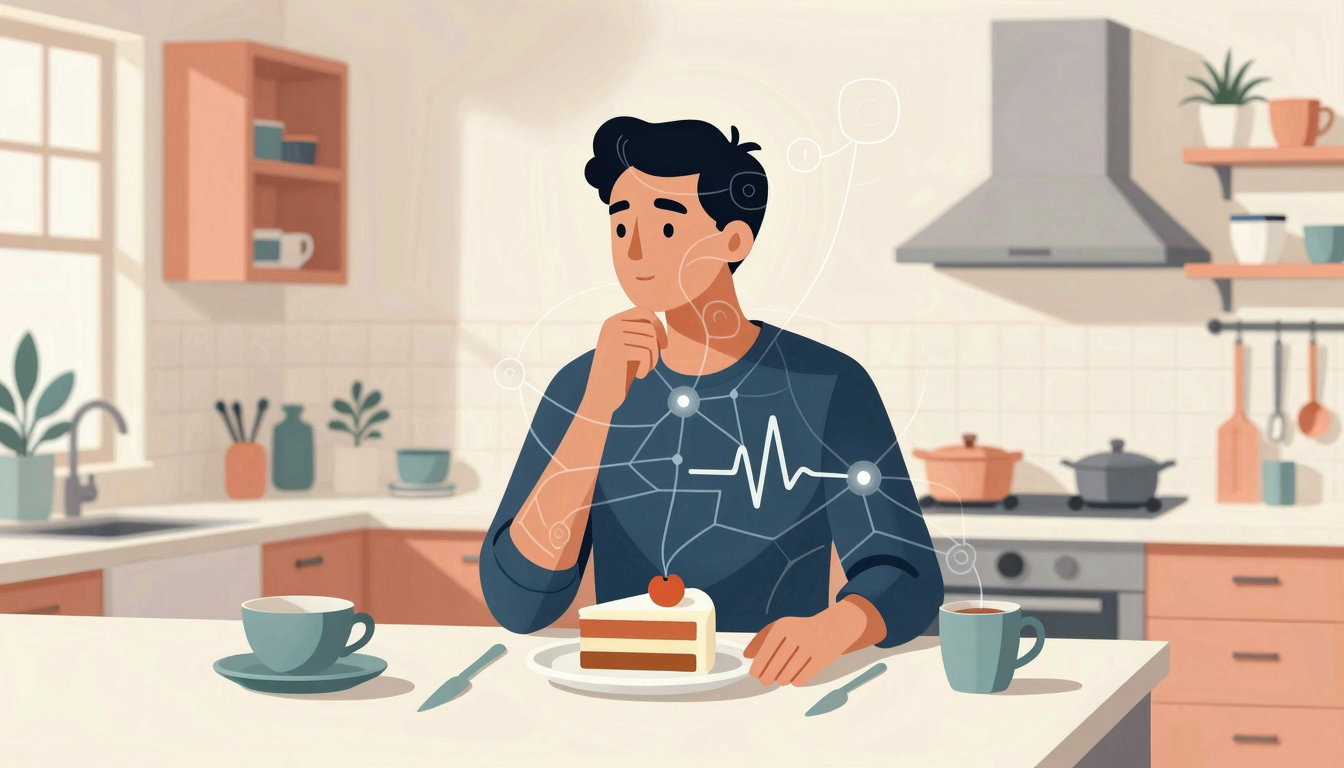
A slice of rich, smooth cake is placed in front of you. You want it, but you have just eaten lunch and decide to leave it. A familiar explanation says that your rational brain has defeated your emotional brain and the primitive creature lurking underneath.
It is a vivid story. It is also a misleading account of what is inside your skull. You do not have a reptile brain, a mammalian feeling brain, and a uniquely human reasoning brain stacked together as three competing occupants.
You have one brain with many interacting systems. That distinction changes more than a diagram. It challenges the habit of treating every emotion as an animal impulse and every act of restraint as the victory of a civilized self over a beast.
Why the three-brain story is so persuasive
The triune-brain model associates basic survival with a “reptilian” core, emotion with a supposedly later mammalian limbic system, and reason with an outer neocortex. In its popular form, the prefrontal cortex becomes a supervisor keeping the older, unruly parts under control.
This resembles older philosophical stories about inner conflict, including Plato's account of a divided soul. But Plato did not identify lizard brains, limbic systems, or cortical mechanisms. A resemblance between a philosophical metaphor and a modern diagram does not make either one anatomical evidence for the other.
The model feels plausible because internal conflict is real. People do experience a desire and a competing intention. They can feel overwhelmed and later regret an action. What does not follow is that those experiences reveal three brains with different evolutionary birthdays.
Cesario, Johnson, and Eisthen's review, “Your Brain Is Not an Onion With a Tiny Reptile Inside,” explains why the layered evolutionary account conflicts with comparative neuroscience. A memorable metaphor can persist because it fits experience while still getting the biology wrong.
Evolution did not build a reasoning layer over a reptile
Humans and other vertebrates share evolutionary history. Existing structures changed in size, organization, and connections across lineages. Evolution did not preserve an intact reptile brain and then add separate emotional and rational brains on top of it.
This does not mean that all species have identical brains, or that no specializations evolved. The important distinction is between modifying inherited systems and adding whole independent psychological layers. Shared ancestry can coexist with substantial differences in development and function.
Nor should a list of brain regions become a list of isolated mental jobs. Perception, action, memory, and emotion depend on interactions across regions. A cortical contribution to a process does not imply that the process happens entirely in the cortex, and an older evolutionary structure is not limited to a crude instinct.
Development helps explain differences in form
Related species share broad features of brain development, including patterns in the generation and organization of cells. Changing the timing and duration of developmental processes can alter how much a region expands and how it connects with the rest of the nervous system.
This provides an alternative to imagining a new layer appearing whenever a species acquires a new ability. Differences in developmental schedules can reshape a shared plan. The result may look dramatically different without containing a second or third brain.
The comparison should not be reduced to a single timetable that explains every feature of every vertebrate. Brain evolution involves multiple interacting changes. Developmental timing is one route into understanding that complexity, not a complete replacement formula.
A bigger cortex is only part of the explanation
The cerebral cortex is the folded outer gray matter of the cerebrum. It contributes to perception, language, planning, and many other functions in cooperation with other systems. Its folds allow a large surface to fit within the skull, though folding itself is not a simple measure of intelligence.
The source offers a kitchen analogy. Seeing an enormous kitchen might make you think a family particularly values cooking. Yet its meaning depends partly on the size of the house. A large kitchen in an enormous building is different from a kitchen occupying nearly all of a small home.
Brain comparisons likewise need more than absolute size. Relative size, cellular composition, regional organization, and connections matter. Humans have a large cortex, but sweeping claims that its proportion or density is uniquely greater than every other species oversimplify the comparison.
The analogy also has limits. A brain is not a house of separate rooms operating independently. Relative measures help ask better questions; they do not identify a single structure that contains all human capacities.
Neurons and cooperation matter alongside size
A kitchen's ability to prepare a complex meal also depends on the cooks and how they coordinate. In the analogy, neurons are the cooks. Expanding the room does not necessarily increase their number in the same proportion, because cellular scaling differs across groups of animals.
The human cerebral cortex contains roughly 16 billion neurons, an estimate consistent with clinical descriptions of cortical structure. That number concerns the cortex, not the whole brain, and should not be treated as a complete score for intelligence.
Association regions help integrate information across sensory experience, memory, goals, and social context. Their organization contributes to capacities such as planning, abstract reasoning, understanding others, and creating tools or art. Those abilities depend on distributed cooperation rather than a single executive defeating emotional subordinates.
It is therefore more accurate to ask how systems coordinate than to ask which of three brains won. The kitchen metaphor remains useful only while we remember that real neurons participate in flexible networks, not a fixed workforce assigned one mental task each.
Emotion and reason are not opposite moral teams
Worry before an important deadline may draw attention to work that needs doing. An elaborate justification for several more hours of scrolling may protect a distraction. Emotion is not automatically foolish, and having a thought does not make the thought rational.
Likewise, an action's moral worth cannot be read from whether it felt deliberate or emotional. People can reason carefully toward harmful ends, and caring reactions can motivate useful action. Describing behavior requires its context and consequences, not just a contest between feeling and thought.
Lisa Feldman Barrett's “body budget” provides one lens for reconsidering the distinction. The phrase refers to anticipating and regulating bodily needs, including energy, water, salt, and other resources. In this account, what looks like emotion or reasoning is connected with the brain's work of keeping a body functioning in its environment.
Calling this a lens matters. It is a theoretical way to interpret aspects of behavior, not the sole accepted definition of rationality or proof that every distressing response is beneficial.
A response can fit yesterday's danger better than today's life
Imagine a soldier in a dangerous setting. Preparing for threat can be costly, but missing a real threat could be far more costly. A false alarm may therefore be understandable in that environment even though it uses resources unnecessarily on that occasion.
After a return to safer circumstances, persistent threat preparation may become exhausting and disruptive. The protective logic learned in one context may fit another poorly. Understanding that mismatch can reduce shame without denying its costs.
The example does not establish a diagnosis. PTSD involves a pattern of symptoms, duration, and impairment assessed by a qualified professional; it is not simply another name for being on guard when no threat is present. NIMH's PTSD guidance describes the broader condition and available treatment.
Nor can a reader assume that every environment is safe merely because a reaction appears excessive to someone else. Some people remain exposed to danger. Good support considers both the situation and the symptoms, instead of telling a person that their brain has simply guessed wrong.
Return to the cake with a different story
Declining the cake may involve fullness after lunch, a long-term preference, a social situation, a memory, or a plan. Eating it on another occasion may also fit your circumstances. Neither choice reveals a little reptile winning or losing a battle.
The practical invitation is to become more curious about the whole situation. Are you tired, hungry, overloaded, or responding to an old expectation? What information and resources would make the next choice easier? Those questions leave room for responsibility without turning a difficult emotion into evidence of personal inferiority.
Having one integrated brain does not make all reactions wise. It does mean that understanding and changing them requires more than demanding that reason defeat an inner animal. You can recognize a response, examine how well it fits your life, and seek support when it causes persistent distress.
Frequently asked questions
Did Plato propose the triune brain?
No. His divided-soul account is a philosophical precursor in theme, not modern neuroscience.
Does one brain mean every region does the same thing?
No. Specialized regions work in interacting systems.
Are emotions always irrational?
No. Their usefulness depends on context, as does the usefulness of deliberate thought.
Does persistent threat sensitivity equal PTSD?
No. Diagnosis requires assessment of a broader symptom pattern, duration and impairment.