Summary
A stage dream can make private pressure feel public. Use the scene to identify a practical next step.
At a glance
A stage dream may reflect feeling visible or evaluated; identify the real pressure and take one practical step.
Query-by-query explanations and a four-question reflection process.
Describe the scene, name the waking pressure, separate controllable steps, and take one reversible action.
Direct answer: A dream about standing on a stage can show that you feel visible, evaluated, or responsible for expressing something important. Its lesson is practical: identify what you are being asked to perform or explain, separate real expectations from imagined judgment, and take one manageable step. The dream alone does not predict success, embarrassment, spiritual approval, or a future event.
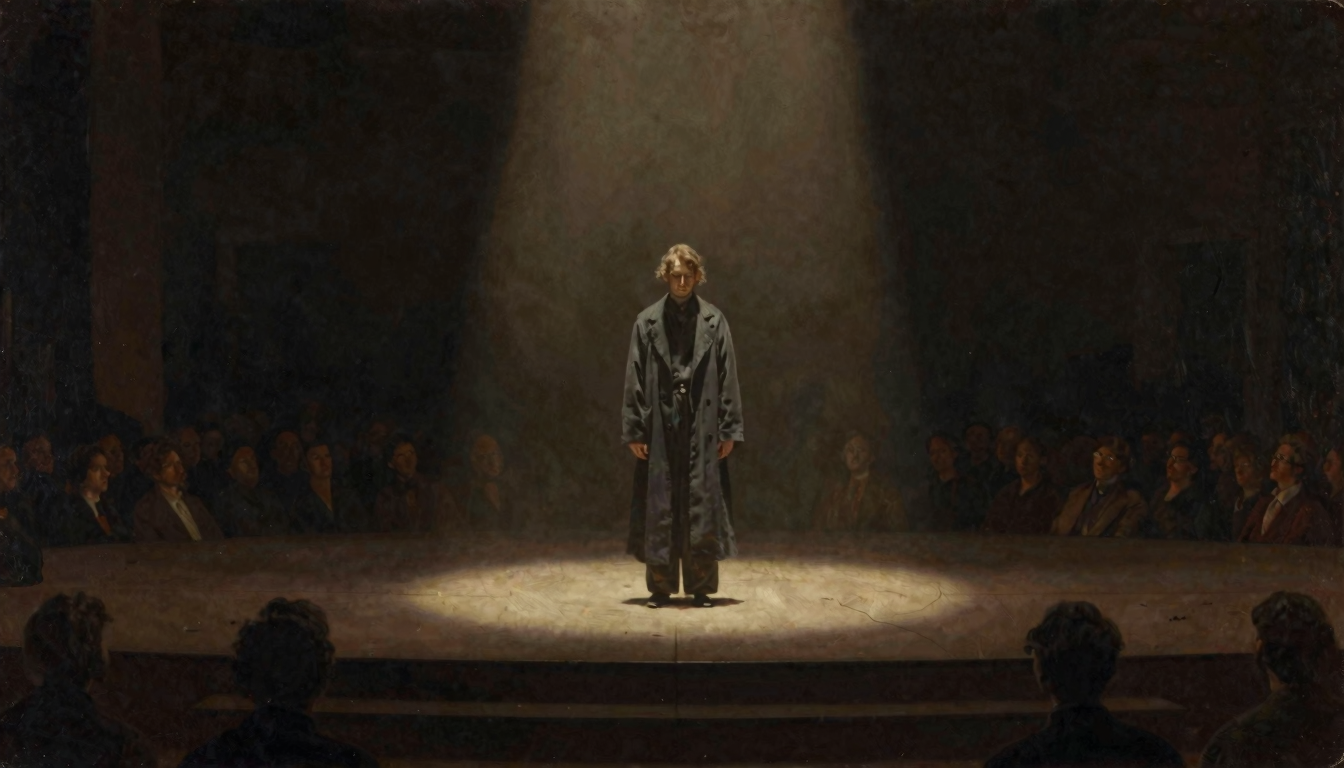
The stage turns a private concern into a public moment
If you dreamed of being on a stage, notice whether you felt ready, proud, frozen, or irritated. If you dreamed of standing on a stage, the stillness may point to a demand to take a position before you have chosen your words. A calm stage can represent willingness to be seen; an empty stage can show uncertainty about who is evaluating you. None of these details establishes a prophecy.
When the lines disappear
A dream about being on stage and forgetting lines often resembles a waking fear of being unprepared. You might have a presentation tomorrow, a difficult conversation, or a role whose rules are unclear. Write the first sentence you need to say, list the facts you actually know, and decide what question you will ask if you need help. Preparation gives the image a useful next step without treating it as a warning from outside you.
Standing up, standing your ground, and the bridge
The query dream about standing is broad, so use the surrounding action. Dream meaning of standing up for yourself and dream about standing up to someone may connect the stage to a boundary or a need to speak plainly. The dream cannot decide whether confrontation is wise. Identify the behavior, state your limit, and choose a safe setting or support.
Dream about standing on a bridge adds a transition. You are between places, roles, or decisions. Check what is on each side, what information is missing, and whether you can cross in stages rather than forcing one dramatic choice.
Ordinary-life lessons
At work, work: A stage can resemble a review, interview, meeting, or launch. Ask for the success criteria and rehearse the one action visible to others.
With money and business, money: Public pressure can make a financial choice feel like a performance. Write the cost, downside, and deadline; do not invest or sign because the dream felt urgent.
In relationships, relationships and family/home: Being watched may echo a need for approval or a conversation about roles at home. Say what you need in one concrete sentence and listen for the other person's actual answer.
For health and energy, health and energy: A frozen performer may simply be overtired or overstimulated. Rest, hydrate, and seek appropriate care for persistent symptoms; the dream is not a diagnosis.
At home and in daily decisions, daily decisions: The lesson can be to distinguish an audience you can consult from an audience you are imagining. Choose the smallest reversible step that produces real information.
Related travel and movement scenes
Autocomplete also surfaced neighboring questions. They are not hidden branches of the stage dream, so each one needs its own modest, non-predictive explanation:
- Being on a train with someone: shared direction, schedules, and the influence of another person's choices may be the practical focus. Clarify who decides the next stop.
- Being on a train: the image can prompt reflection on a route already in motion. Check whether you have accepted a plan without reviewing its destination.
- Being on a boat: notice how much control you feel over the emotional or practical conditions around you. Identify what support would make the situation steadier.
- Being on a boat in rough seas: instability may feel especially vivid. Check real safety, health, or financial facts instead of predicting disaster.
- Being on a ship: a larger system, institution, or long project may feel responsible for the direction. Find the part of the route you can influence.
- Being on a ship in rough seas: pressure from changing conditions may be the useful question. Separate an actual risk from the fear created by uncertainty.
- Being on a sinking ship: urgency can dominate the dream, but it is not a forecast of catastrophe. Make a safety plan and ask for help where a real danger exists.
- Being on a cruise ship: a planned route with limited control over stops may mirror a commitment you entered before checking its flexibility. Review the terms and exit points.
- Being on a cruise: comfort and movement can coexist with dependence on a schedule. Ask which part of the plan still belongs to you.
- Being on a plane: distance, ambition, or a high-stakes transition may feel amplified. Verify the next requirement before making a large decision.
- Being on a bus: other passengers and a shared timetable can highlight group expectations. Confirm the meeting point, role, or deadline rather than guessing.
- Being on a bus with someone: the relationship and shared responsibility become more visible. State what you need from the other person before continuing.
- Being on a roller coaster: rapid emotional changes may be the main feature. Slow down and avoid making an irreversible choice while highly activated.
- Being on a beach: the boundary between familiar ground and the unknown can invite reflection on readiness. Choose what information you need before crossing into a new phase.
- Being on an elevator: rapid changes in status, direction, or access may feel compressed. Check what is actually changing and who controls the timing.
For every scene, describe the conditions, name the waking concern, and choose an evidence-based next action. None of these images supplies a fixed spiritual verdict.
A four-question reflection
Write: “I was standing on a stage and ____.” Fill in the feeling, the audience, and what you were expected to do. Then ask: What real situation feels public? What part is under my control? What support or information is missing? What one action can I take today?
The lesson is modest but useful. Visibility is not the same as danger, and uncertainty is not a verdict. Let the dream identify the pressure; let real evidence, consent, safety, and careful planning guide the decision.
Frequently asked questions
What does a dream about being on a stage mean?
It can reflect feeling visible, evaluated, or responsible for a message. The dream does not prove a prediction; use the emotion and the real situation to identify the pressure.
What if I am on stage and forgetting lines?
Forgetting lines can mirror fear of being unprepared or unable to say what matters. Choose one small preparation step, such as writing your opening sentence or asking what is actually expected.
What does standing on a stage say about work?
It may echo a presentation, interview, review, or leadership decision where attention is on you. Check the practical standard and rehearse the next observable action rather than guessing how everyone will judge you.
Does standing on a stage mean I should stand up for myself?
It can prompt that question, but it is not an instruction. If a boundary is needed, name the specific behavior, request, or consequence you can address safely.
How is standing on a bridge different?
A bridge adds a transition or choice between two places. Ask which decision you are crossing and what information would make the next step safer.
What about dreams of being on a train, boat, ship, plane, bus, cruise, beach, elevator, or roller coaster?
Those scenes shift the practical focus: a train or bus can suggest a shared route, a boat or ship can foreground emotional conditions, a plane can heighten distance or ambition, a cruise can show a planned journey, a beach can mark a boundary, an elevator can show rapid status change, and a roller coaster can reflect volatility. These are prompts for reflection, not fixed meanings.
What does a sinking ship or rough sea add?
It can make instability or urgency more vivid. Attend to real safety, finances, health, or relationship facts before making a decision; the dream cannot forecast disaster.
What lesson should I take from this dream?
Separate visibility from danger, identify the exact situation that feels like a stage, and take one grounded step: prepare, ask for clarity, set a boundary, or pause until evidence improves.
Is there a fixed spiritual or traditional verdict?
No fixed verdict is supported by this search-intent-only topic. The most honest reading is reflective and conditional, without claiming supernatural certainty or a future event.