Summary
The building gives the dream an address, while the lack of pain may show adaptation, numbness, or delayed recognition.
At a glance
The dream may show an unnoticed emotional injury tied to a particular setting. Identify the building, who saw the wound, and what you have normalized there.
Uses building type, wound visibility, and absent pain to distinguish numbness, normalization, and delayed recognition.
Record the building, injury detail, witnesses, emotional response, and tolerated real-life condition; then verify one boundary or support need.
Why the setting and missing pain matter
A building gives an emotional issue an address. An office can point to workload, status, or treatment by colleagues. A home can point to family roles, privacy, or safety. A school or public building can reflect evaluation and belonging. The dream does not make the setting universally symbolic; it connects the wound to the place where the pressure feels contained.
A painless wound may suggest numbness, competence under strain, delayed recognition, or a problem that has not yet become visibly disruptive. It can also reflect a real bodily sensation or recent image. Look at what happened to the wound: was it hidden, visible, treated, ignored, or examined by someone else?
A modern case walkthrough
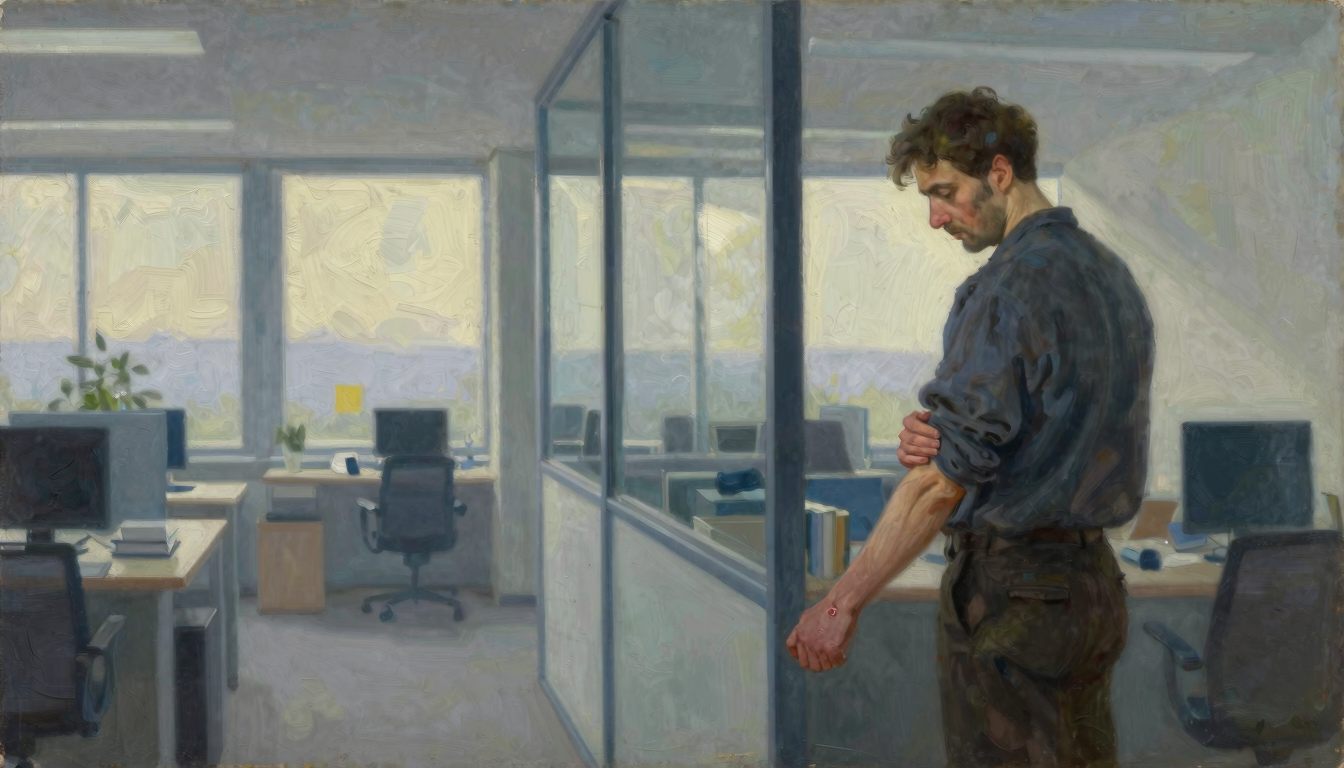
Marcus worked in a busy design office where his manager kept adding urgent revisions late in the day. He told himself the schedule was temporary and stopped mentioning the headaches and missed dinners. He dreamed that a glass panel in the office lobby cut his forearm. The cut was open and clearly visible, but he felt no pain. Colleagues walked past while he continued answering messages.
His first reaction was to assume the dream meant he was physically safe because it did not hurt. A more precise reading noticed the office location, public wound, and automatic return to work. The painless cut could reflect how normal overextension had become.
The next morning Marcus listed the late requests from the previous month and asked his manager to agree on a cutoff time and revision priority. The manager moved one deadline and assigned another designer to the overflow. Marcus still had busy weeks, but he stopped treating every request as an emergency and resumed two evenings with his family. The result was not proof that the dream predicted a workplace event. It helped him recognize a boundary problem before it became impossible to ignore.
How to read the building
Use one exact sentence: "I found a painless cut on my hand in my childhood home while my current partner waited in the hallway." Ask four questions.
- What does this building represent in your current life?
- Who could see the wound, and who ignored it?
- Did the lack of pain feel reassuring, strange, or frightening?
- What condition have you adapted to so thoroughly that you no longer call it a problem?
For the example sentence, the childhood home may connect a current relationship concern to old family rules about silence or self-reliance. The useful response is to name the present boundary and discuss it, not to assume the dream diagnoses the relationship.
Notice before you normalize
Write down the wound's location, size, cause, visibility, and your first action. Then compare the dream with one real setting. Are you accepting disrespect because it is routine? Are you working through exhaustion? Are you avoiding a conversation because the conflict feels easier than change?
Choose a proportionate next step: document an incident, ask for help, schedule a medical check for a real symptom, clarify a household rule, or tell a trusted person what you have been minimizing. A dream is a prompt for attention, not medical evidence or proof of another person's intent.
When the dream may be physical or incidental
A painless wound image can follow a small scrape, skin irritation, medical appointment, film scene, or worry about injury. If you wake with an actual wound, persistent numbness, swelling, or other symptoms, use ordinary medical care. If no physical cue exists, the building and your response usually offer the stronger emotional context.
Frequently asked questions
Does a painless wound dream mean I am emotionally numb?
It can reflect numbness or adaptation, but it is not a diagnosis. Notice what you have normalized and whether you can still identify a need or boundary.
Does the building change the meaning?
Often. It locates the concern in a setting such as work, home, school, or a public place. Use the building's current role in your life rather than a fixed symbol dictionary.
What if other people ignored the wound?
That may highlight feeling unseen or learning to hide distress. Check whether people truly lack information or whether you have not asked for support.
Should I worry that the dream predicts an injury?
No. A dream is not reliable evidence of a future accident. Follow normal safety and medical practices if there is a real-world concern.
What should I do after this dream?
Record the setting and your reaction, identify one condition you have been tolerating, and take a concrete support or boundary step.