What this article is really about
Dreaming about a cathedral may symbolize encountering a tradition, community, or sense of meaning larger than your individual role. Its height and scale can suggest awe, continuity, or the weight of shared expectations. Entering comfortably differs from feeling too small to participate, and quiet space differs from a ceremony whose terms you do not understand. The dream does not establish a divine command, predict a religious event, or judge your worth. Its meaning depends on whether the grandeur gave you perspective and room to belong or made an ordinary contribution feel inadequate.
Direct answer
Dreaming about a cathedral may symbolize encountering a tradition, community, or sense of meaning larger than your individual role. Its height and scale can suggest awe, continuity, or the weight of shared expectations. Entering comfortably differs from feeling too small to participate, and quiet space differs from a ceremony whose terms you do not understand. The dream does not establish a divine command, predict a religious event, or judge your worth. Its meaning depends on whether the grandeur gave you perspective and room to belong or made an ordinary contribution feel inadequate.
Monumental shared meaning scale and individual participation distinguish cathedral from offering focus.
Recall scale role action available place and one clarified contribution.
A cathedral holds individual experience within a larger structure. Its question may concern how to participate in something meaningful without expecting yourself to match the scale of the whole building.
What a cathedral can symbolize
A cathedral can represent an established framework of shared meaning. In a dream, that may concern faith, inherited values, community, or an institution whose history gives it emotional weight. The building's scale can make that framework feel both sustaining and difficult to approach.
The favorable possibility is perspective: your own experience finds a place within something that does not depend entirely on you. The difficult possibility is comparison: the grandeur becomes a standard against which ordinary participation seems too small.
Notice whether the space contained people and usable places to sit, speak, or listen. An impressive structure that allows participation differs from one you can only admire from a distance. The symbolic value may lie in how the building accommodates life, not in its magnificence alone.
These associations are conditional. A cathedral dream cannot reveal another person's beliefs or establish a religious ruling. It can help you consider how a larger source of meaning relates to your present role.
Awe that gives perspective
Looking upward may symbolize recognition that your immediate concern is part of a wider story. If the feeling was spacious, the scale may suggest relief from having to carry every part yourself.
Awe can be meaningful without requiring certainty. You may encounter beauty or a valued tradition and still have questions about how you belong within it. The dream does not demand that admiration become unquestioning agreement.
Grandeur that becomes a test
If you felt unable to speak, sit, or enter because the place seemed too important, the image may concern a standard of participation that you have imagined. You may be comparing an ordinary act with the scale or reputation of the whole setting.
Ask whether anyone actually required that comparison in the scene. Your own hesitation may matter more than an external demand. The dream does not prove that a real institution expects perfection from you.
Seeing the cathedral from outside
Seeing a cathedral from outside may symbolize recognizing a significant tradition or community before deciding how to approach it. The view can suggest curiosity, respect, aspiration, or distance.
A visible entrance may emphasize a possible route to participation. Circling the building without entering may emphasize uncertainty about what the first step involves. Admiring it from a distance may be satisfying in itself; you do not have to inhabit every meaningful place you encounter.
Notice whether the building was familiar. A known cathedral may carry memories of visits, ceremonies, photographs, or family experiences. An unfamiliar one may make a question about scale and belonging more general.
The dream does not verify a real location or predict travel. A remembered exterior can give an ordinary concern a monumental form without requiring a literal journey.
If other people entered easily, consider whether you were comparing your uncertainty with their apparent familiarity. Their movement in the dream does not establish that real people understand everything you do not. Participation often begins before complete familiarity is available.
Entering and finding a place
Entering may symbolize moving from admiration toward experience. Finding a seat, joining a gathering, or listening can suggest that participation has a particular form you can actually take.
If you wandered without knowing where to stand, the image may emphasize unclear expectations. A place can feel welcoming in principle while its practical terms remain unknown. The useful question may be what your role involves, rather than whether you deserve to be there.
If someone showed you a place, the scene may suggest guidance or a willingness to receive help. If you refused because the seat seemed too ordinary, it may suggest that you expected participation to match the building's grandeur.
Being near the entrance can symbolize a modest but real form of involvement. A small place does not necessarily mean exclusion or lesser worth. Consider what you could see, hear, or contribute from where you were.
If you chose to leave, notice whether you had completed an encounter or felt unable to remain. Leaving after reflection differs from leaving because you assumed an impossible standard. Neither action dictates a real decision about faith or community.
High ceilings, columns, and light
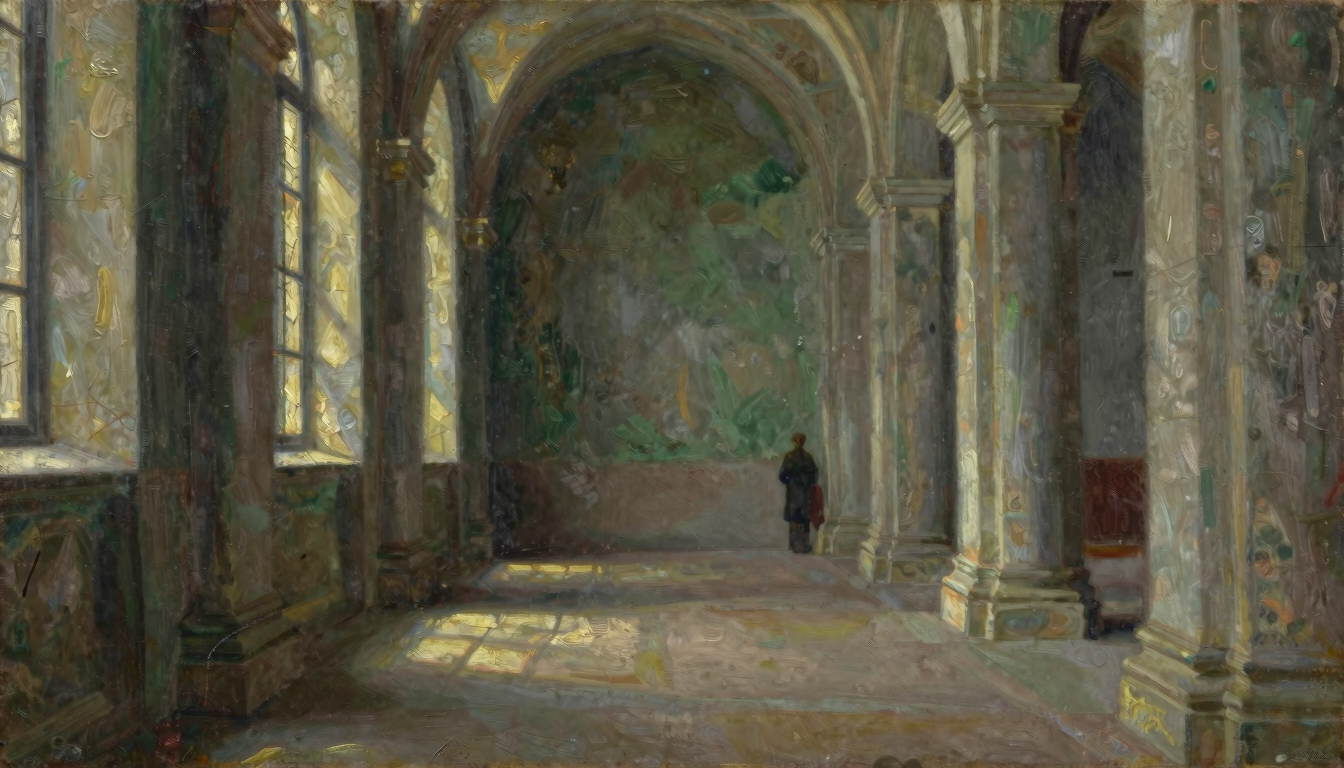
A high ceiling may symbolize breadth, aspiration, or a meaning that exceeds the immediate task. Looking upward can feel encouraging when it gives room to think. It can feel distancing when you cannot return attention to the life around you.
Columns may suggest a framework that holds a shared space. If you noticed their arrangement, the image may emphasize the many supports beneath an established tradition or institution. The building does not depend on a single person standing in the center.
Light through windows may symbolize a particular view within a larger setting. Colored light can add personal associations with beauty, memory, or difference. It does not provide a fixed coded message about your future.
A dim interior may emphasize uncertainty or quiet attention, depending on your experience. Darkness alone does not establish evil, punishment, or absence of meaning. Notice whether you could move and whether the space felt suitable for what you wanted to do.
Do not turn every architectural detail into a separate judgment about yourself. Choose the feature that affected your action most. A useful interpretation can remain focused on one relationship between scale and participation.
Silence, music, and a gathered community
Silence may symbolize a pause within a larger pattern of activity. If it felt restful, the cathedral may suggest a space where you did not have to produce an immediate response. If it felt forbidding, it may emphasize uncertainty about whether speaking was allowed.
Music may symbolize coordinated participation or an experience that reaches you before you can explain it. Singing with others differs from listening, and either can have value. The dream does not require you to take the most visible role.
A gathered community may emphasize belonging through a shared practice. Notice whether the people made room for one another or seemed absorbed in an expectation you could not understand. Their dream behavior does not prove the character of a real group.
If you missed a cue, the scene may concern the difference between learning and already knowing the pattern. An unfamiliar practice can require explanation without making you unsuitable. The symbolic question may be whether there is room to learn within the shared structure.
If the ceremony continued without you, consider whether that felt relieving or excluding. A larger activity can survive your absence, which may reduce an assumed burden. It can also prompt a question about the particular connection you want to have with it.
Empty, crowded, or damaged cathedrals
An empty cathedral may symbolize encountering the framework apart from the people who usually give it life. It can feel peaceful, spacious, or abandoned. The feeling and your action help distinguish private reflection from concern about a tradition's current use.
A crowded cathedral may emphasize shared significance as well as difficulty finding a place. The question may concern access, expectations, or how individual participation fits within a collective event.
A damaged cathedral may suggest that a familiar expression of meaning has changed. It does not establish that faith or a valued principle has been destroyed. The form may need attention while the meaning remains important.
If you tried to repair everything yourself, the image may emphasize an assumed responsibility for a structure larger than your role. If you helped with one defined part, it may suggest participation that respects both the whole and your actual capacity.
A cathedral is not the same as an altar. The cathedral may emphasize the larger shared framework; an altar may focus attention on an offering or commitment within it. If both appeared, notice which one shaped the action you remembered.
Four ordinary-life connections
Faith and inherited meaning
You may value a religious tradition while wondering how your own experience fits its established forms. A cathedral can symbolize the scale of the inheritance without determining whether you belong within it.
Check which question concerns personal reflection and which needs knowledgeable guidance within your tradition. Choose one suitable conversation or practice with understood terms. The symbolic possibility is participation that allows questions, rather than treating uncertainty as proof of insincerity.
Community and institutions
You may join an established group whose history or reputation makes your contribution seem small. A cathedral can symbolize the difference between appreciating the whole and finding a particular place within it.
Check the actual role available to you. Ask what one useful contribution involves instead of comparing yourself with the entire institution. A modest task can support a meaningful shared activity without representing everything the group has ever accomplished.
Work and collective standards
A project may have a strong reputation, and you may assume that every task must reflect its full importance. The grand interior can symbolize a standard that overwhelms the practical work beneath it.
Check what the current task needs and whose expectations are explicit. Confirm one concrete result with the people involved. The favorable movement is toward work that serves the shared purpose; the difficult movement is delaying participation until your contribution feels monumental.
Personal perspective and ordinary life
You may seek a larger sense of meaning while dismissing the small routines through which it could be expressed. A cathedral can symbolize breadth that enriches ordinary life, or breadth that makes ordinary life seem insufficient.
Check what value the grand image points toward: care, curiosity, belonging, or attention. Give it one modest present expression. The symbolic question is how a large meaning makes room for daily conduct, not whether every day can reproduce an extraordinary feeling.
A modern example
Thomas joined a local choral group that had performed in important venues for many years. He admired its history and began imagining that his first contribution needed to demonstrate complete confidence. Before the first rehearsal, he repeatedly practiced an entire program rather than asking which piece the group would actually begin with.
In a dream, Thomas entered a cathedral with a high vaulted ceiling. He saw a small seat among the singers but kept looking upward, convinced that his voice would have to fill the whole building before he could sit down. The detail he remembered was that a place was available while his comparison with the space prevented him from using it.
Thomas did not interpret the dream as a religious promise or evidence that he was destined to perform there. He recognized a question about scale. He asked the conductor what preparation was useful for the first rehearsal and learned that the group would work through one section together.
At rehearsal, he missed a note and followed the next phrase with the others. He asked one question during the break and returned the following week. His contribution remained ordinary, but it became part of an activity he valued. He no longer treated the group's whole history as a test he had to pass in advance.
The cathedral image helped him distinguish shared significance from a demand for individual grandeur. Finding a place within the structure became more useful than trying to match its scale.
Spiritual meaning and favorable tendencies
In a personal spiritual reading, a cathedral may invite attention to continuity, humility, beauty, and belonging within a wider framework. These are conditional reflections, not a verified universal interpretation or proof of a divine encounter.
A favorable tendency may emphasize perspective that gives your experience room. A difficult tendency may emphasize awe becoming an impossible standard, or inherited authority replacing questions about actual participation.
The building does not guarantee blessing or establish judgment. If religious associations matter to you, consider them within your own practice and knowledgeable guidance. Keep that reflection separate from predictions about events or assumptions about another person's beliefs.
A striking dream can be meaningful without requiring a major decision. The useful result may be a clearer question about how a valued tradition or community is expressed in ordinary life.
Reading your own cathedral dream
Recall your position, the scale, and the action that mattered. Distinguish admiring from entering, listening from being silenced, and a usable place from an imagined demand to fill the whole space. Notice whether the grandeur supported participation or displaced it.
If a waking connection fits, identify the larger purpose and your actual role within it. One clarified expectation, suitable conversation, or modest contribution can make that relationship more concrete. If none fits, the cathedral can remain a vivid place of wonder without becoming an instruction.
Frequently asked questions
What does dreaming about a cathedral mean?
It may symbolize a tradition community or framework of meaning larger than your individual role. Notice whether its scale offered perspective or made ordinary participation feel inadequate.
What does seeing a cathedral from outside mean?
It may emphasize recognizing significance before choosing how to approach. Admiration does not require entry and distance does not prove exclusion.
What does entering and finding a seat symbolize?
It may suggest moving from admiration into a specific form of participation. A modest usable place can matter without matching the grandeur of the whole setting.
What do high ceilings columns and light mean?
They may emphasize breadth shared support and a particular view. Their action and personal associations matter more than a fixed architectural code.
What do silence and music in a cathedral mean?
Silence may suggest rest or uncertainty about speaking; music may suggest coordinated participation. Listening and singing can each have value.
What do empty crowded or damaged cathedrals mean?
They may emphasize private reflection shared expectations or a changed expression of meaning. Damage does not prove that an underlying value or faith is destroyed.
Is a cathedral dream a divine message?
This article offers conditional spiritual reflection without a verified religious ruling. The image does not establish a divine command blessing judgment or prediction.
How is a cathedral different from an altar dream?
A cathedral may emphasize the larger shared framework and your place within it. An altar may focus on a particular offering or commitment inside that setting.