Summary
Dreaming about a cage may symbolize restricted movement, protection that has become limiting, or a boundary around something you fear or value. The meaning depends on who is inside, who controls the door, and whether enclosure feels chosen or imposed. An open or empty cage can shift the emphasis toward release, absence, or a boundary no longer needed. The dream does not prove that you are trapped or predict danger.
At a glance
Dreaming about a cage may symbolize restricted movement, protection that has become limiting, or a boundary around something you fear or value. The meaning depends on who is inside, who controls the door, and whether enclosure feels chosen or imposed. An open or empty cage can shift the emphasis toward release, absence, or a boundary no longer needed. The dream does not prove that you are trapped or predict danger.
Visible containment door access and voluntary release distinct from bird at window.
Recall occupant door choice; review one boundary.
A cage separates what is inside from what is outside while often leaving both visible. That makes access and movement central to its symbolism. Something can be seen without being reachable, and something protected can still need room to move.
Containment protection and choice
A cage may evoke keeping something within limits. Its bars make the boundary visible, unlike a room whose walls hide what lies beyond. You may feel watched, kept safe, prevented from acting, or responsible for what is enclosed.
An encouraging reading may concern a temporary boundary that serves a purpose. A cautionary reading may concern continuing the same enclosure after that purpose has changed. Neither reading establishes that a waking arrangement is good or harmful without looking at its actual conditions.
Consider whether entry was voluntary, whether the door can open, and whether staying feels useful. A chosen pause differs from an imposed restriction. A protective boundary differs from a demand that another person surrender their choices.
The symbolic question is not simply whether boundaries exist. It is what the boundary serves, who can change it, and whether those affected have a say. A dream can make that question vivid without supplying the answer.
Being inside and seeing the way out
Being inside a cage may evoke a limited role, a narrow expectation, or difficulty expressing a wish. The feeling matters: a peaceful enclosure differs from one you struggle against.
Seeing an open door but remaining inside may emphasize hesitation, familiarity, or a reason to wait. It does not prove that you secretly want restriction. The dream may simply hold freedom and uncertainty in the same scene.
Finding a key may evoke access or permission becoming imaginable. Someone else holding it may emphasize dependence within the dream, but cannot establish that a real person controls your future.
If you leave, notice what happens afterward. Moving into a calm space may emphasize room to act; leaving into unfamiliar surroundings may emphasize the uncertainty of a new choice. Escape alone does not guarantee a favorable outcome in waking life.
Birds parrots and the space to move
A bird in a cage may evoke a contrast between the capacity to fly and a limited space. The bird's condition and action matter more than assigning every bird the same message.
A parrot may add an association with voice or repetition if that is how you experience it in the scene. A silent parrot, a calling bird, and one resting comfortably are different images. None reveals what another person thinks about you.
A bird escaping a cage may evoke movement becoming possible or a change in how something is held. If you feel relieved, release may be prominent. If you chase it anxiously, responsibility or loss of control may be more prominent.
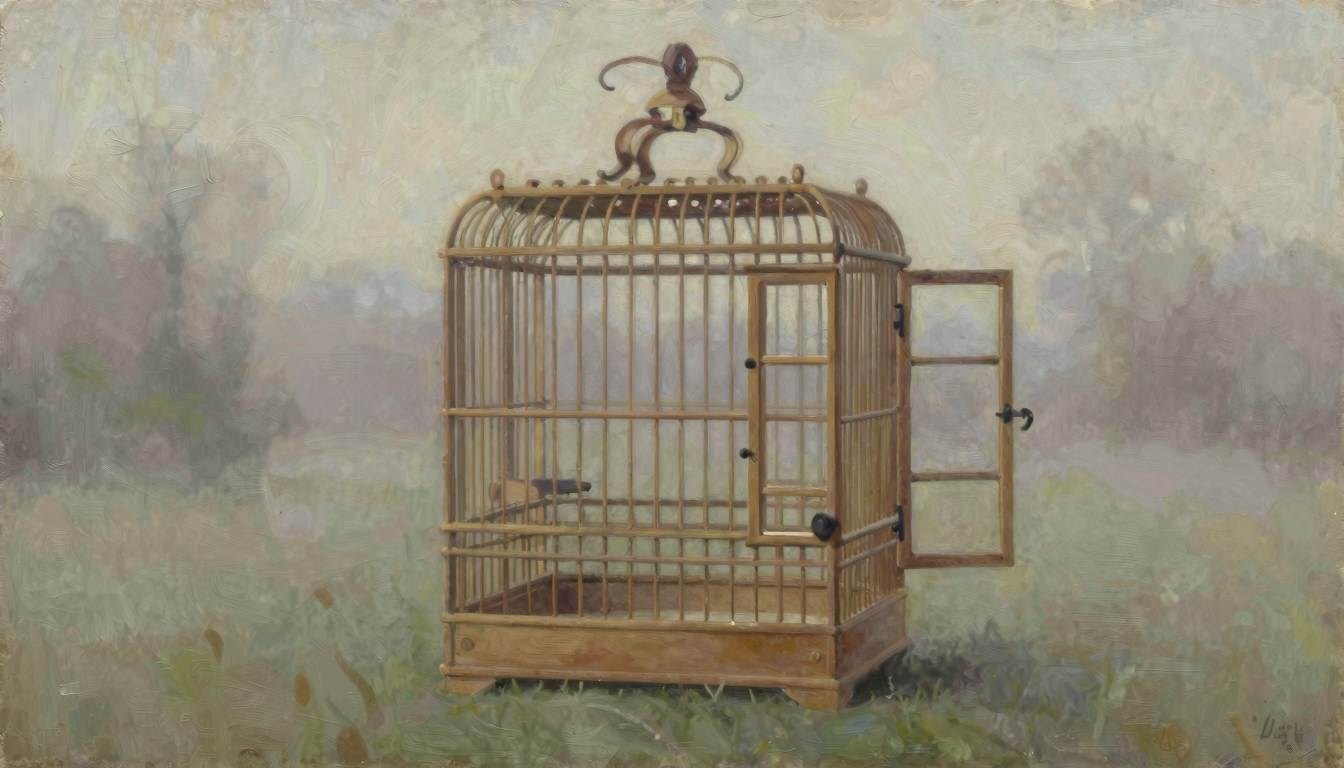
An empty bird cage may evoke absence, completed release, or a prepared space awaiting an occupant. A dead bird in a cage may evoke grief or the end of something cherished within the dream. It is not a prediction of death or proof that someone has been harmed.
Before drawing a conclusion, distinguish the enclosure from its occupant. The dream may concern the way freedom is managed, rather than the bird alone. Your remembered action toward the door helps keep the interpretation specific.
Lions tigers and snakes behind bars
A lion or tiger in a cage may evoke powerful energy, fear held at a distance, or admiration under controlled conditions. A resting animal differs from one pressing against the bars. The dream cannot identify a dangerous person or prove that a threat exists.
Dreaming about a lion in a cage may place strength and restriction together. Whether you approach, retreat, feed it, or open the door changes the emphasis. Admiring strength is different from wanting to release everything without considering consequences.
A snake in a cage may evoke something unsettling contained where it remains visible. It can also concern curiosity if you watch calmly. The image does not establish betrayal, a hidden enemy, or a fixed spiritual warning.
These animals should not become labels for people in your life. A more useful reflection is whether a strong feeling or demanding situation needs an appropriate boundary, and what ordinary evidence would help you judge that boundary.
Dogs cats rats and rabbits
A dog in a cage may evoke companionship separated from access, especially if you want to reach it. A cat may emphasize independence if its attempts to move freely stand out. A rat may evoke unease or resourcefulness, while a rabbit may evoke vulnerability or a wish for shelter.
Those associations are possibilities, not a code. Your own experience of the animal and the way it acts can reverse the emphasis. A calm rabbit in a spacious enclosure differs from a frightened one in a cramped space.
Feeding an animal may evoke care within an existing limit. Opening its door may evoke adjusting that limit. Ignoring it may evoke distance within the scene, but cannot prove that you neglect a waking responsibility.
Ask what the animal appears to need and whether you can respond. Keep care, control, and release distinct instead of treating every enclosed animal as the same symbol of captivity.
Rib cage and other uses of the word
A rib cage is a part of the body, so a dream about it is different from dreaming about a barred enclosure. Symbolically, it may evoke protection, vulnerability, or awareness of what is held close. A dream image cannot diagnose an illness or injury.
The phrases Nicolas Cage dream scenario meaning and Nicolas Cage dream movie meaning concern a name and potentially an entertainment work. They do not by themselves describe a cage in a sleep experience. A remembered actor or film may be personally meaningful, but its name is insufficient to establish a symbolic message or explain a plot.
Likewise, Dream Cage game, Steam, PS5, walkthrough, endings, story, horror game, all anomalies, and escape phrases may concern a named game. This dream interpretation cannot establish its platforms, solutions, story, or ending. If a game appears in your sleep, describe your actual scene and feelings rather than borrowing an unverified explanation from its name.
For personal spiritual reflection, an enclosure may invite consideration of freedom and responsibility. That remains a conditional reflection, not a fixed religious ruling or a prediction that release is destined.
Where a boundary may need review
Work and a role with limited choices
A cage may resemble a role whose responsibilities are clear but whose choices are narrow. Check which decisions actually belong to you, then ask for one specific change. The dream cannot prove that an employer intends to hold you back.
Relationships and protection that limits participation
A protective enclosure may resemble making decisions for someone while intending to help. Check what that person wants, then agree on one boundary together. Care becomes easier to assess when participation is visible.
Home and temporary arrangements
An empty cage may resemble a household arrangement that continues after its purpose ends. Check whether it is still needed, then remove or adjust one part. A previous need does not automatically justify a permanent limit.
Creativity and room for an unfinished idea
A caged bird may resemble keeping an idea private until it feels perfectly safe. Check what a small audience could actually offer, then share one limited version. Exposure can be chosen in stages without treating secrecy as failure.
A modern example of reviewing a limit
Jonah coordinated a community drawing afternoon. He prepared every activity himself because he wanted new volunteers to feel comfortable. They had little chance to choose tasks, and he struggled to finish the setup. He dreamed of a bird waiting beside an unlocked cage door while he kept arranging its perches.
He connected the scene with continuing to organize a protected space while overlooking the choice to participate. His judgment was that comfort did not require him to make every decision.
He asked each volunteer to choose one activity and state what materials they needed. One prepared a still life table, another arranged a shared sketch wall, and Jonah handled the remaining supplies. The room was ready when participants arrived. The ordinary result came from asking, assigning, and preparing; the dream did not prove anyone was trapped or guarantee cooperation.
Read the door alongside the occupant
Recall who was inside, the condition of the enclosure, and your action toward the door. Distinguish protection from restriction, chosen waiting from imposed confinement, and release from an assured result.
Choose one real boundary to review using actual needs and choices. A cage dream may support that reflection without declaring your life imprisoned or requiring you to remove every limit.
Frequently asked questions
What does dreaming about a cage mean?
It may evoke restriction protection or a boundary around something valued or feared. Who is inside and who controls the door shape the reading.
What does a bird cage dream mean?
It may contrast the capacity to move freely with a limited space. A parrot can add a personal association with voice; neither image has a fixed message.
What does a bird escaping a cage mean?
It may evoke release or changed responsibility. Relief and anxiety lead to different readings; escape does not predict a waking result.
What does an empty or dead bird cage scene mean?
An empty cage may evoke absence or release. A dead bird may evoke grief within the scene and is not a prediction of death.
What do lions tigers or snakes in cages mean?
They may evoke strength fear or curiosity held within a visible boundary. They cannot identify dangerous or deceitful people.
What about a dog cat rat or rabbit in a cage?
Personal associations and the animal’s condition matter. Distinguish care control and access rather than using one fixed meaning for every occupant.
What does dreaming about the rib cage mean?
It may evoke bodily protection or vulnerability as a symbolic reflection. A dream cannot diagnose injury or illness.
Does this explain Nicolas Cage films or Dream Cage games?
No plot platforms walkthrough endings story anomalies or game solutions can be established from those phrases alone. A named entertainment query differs from a described sleep scene.