Summary
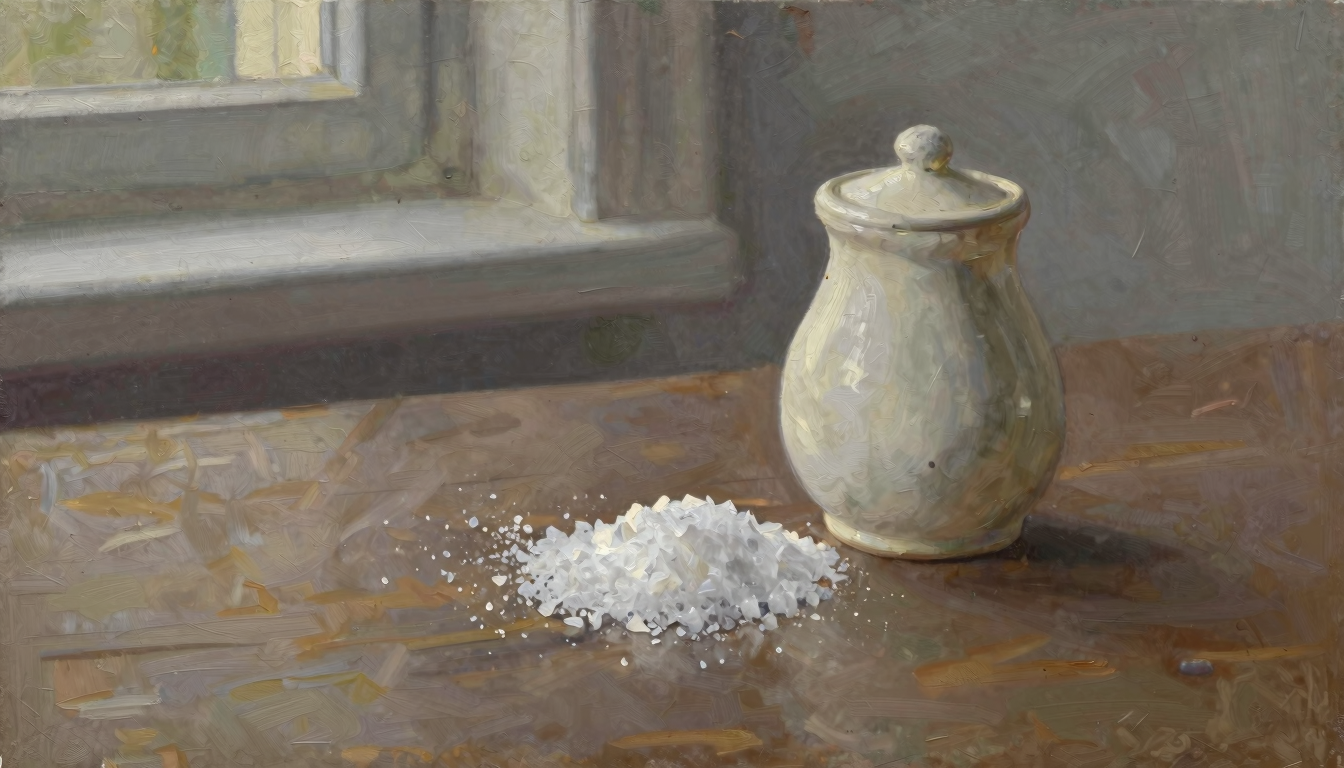
Your action changes the meaning of spilled salt by showing whether the scene concerns accident, deliberate release, careful distribution, or repair. Knocking over a salt container may symbolize an unintended disturbance; scattering salt intentionally may symbolize marking a boundary or letting something go. Cleaning it up may emphasize restoring an ordinary arrangement. The spill itself does not establish good luck, bad luck, or a spiritual consequence. Read what you meant to do, where the salt landed, and how you responded before treating every scattered grain as the same sign.
At a glance
Your action changes the meaning of spilled salt by showing whether the scene concerns accident, deliberate release, careful distribution, or repair. Knocking over a salt container may symbolize an unintended disturbance; scattering salt intentionally may symbolize marking a boundary or letting something go. Cleaning it up may emphasize restoring an ordinary arrangement. The spill itself does not establish good luck, bad luck, or a spiritual consequence. Read what you meant to do, where the salt landed, and how you responded before treating every scattered grain as the same sign.
Separates intention and outcome, controlled distribution and spill, perfect reversal and repair.
Record exact action and scale; compare known event; make proportionate correction.
Salt and the spill are different parts of the image
Salt can carry personal associations with seasoning, preservation, value, or a household routine. A symbolic reading may consider how a small amount changes a larger mixture. Seeing salt neatly contained differs from seeing it dispersed where you did not intend it to go.
The spill adds movement and a change in arrangement. Something previously measured or held together becomes scattered. That can symbolize a small disruption, a loss of control over a detail, or an ordinary mistake made unusually visible. It does not mean that the whole situation has become spoiled.
Notice the amount. A few grains on a table differ from a broken container covering a floor. A small spill with a strong reaction may emphasize what the mistake seems to mean to you rather than its actual scale. The dream can stage a disproportionate concern without proving that the concern is justified.
An accident leaves intention separate from outcome
Accidentally spilling salt may symbolize the gap between what you intended and what happened. You may have been trying to prepare a meal, pass a container, or make room on a table. The disturbance occurs within an otherwise ordinary act.
If you immediately apologize, the scene may concern responsibility for a small mistake. If you hide it, it may concern the fear of being judged for an imperfect action. If nobody minds, it may suggest room for an error that does not determine the whole exchange. Each response changes the symbolic emphasis.
A mistake is different from a deliberate insult. Do not assign hostility to an accidental spill unless the dream includes an intentional act. Equally, feeling guilty does not establish that you have caused serious harm. Read what actually happened before deciding how large a response it requires.
Sprinkling salt is controlled distribution
Sprinkling salt differs from spilling because it usually involves directing an amount toward a purpose. In a dream meal, it may symbolize adding a small contribution or trying to improve what is already present. Too much can symbolize an adjustment that overshoots its intended effect.
If you sprinkle it around a doorway rather than over food, the image may invite a personal association with boundaries or protection. That is a symbolic reading, not evidence that the action has supernatural power. The purpose within the dream should remain distinct from any claim about what a waking ritual can accomplish.
If another person asks you to stop, the scene adds disagreement about the contribution. If they welcome it, the scene adds cooperation. A shared action deserves attention to the exchange around it, not just the substance being used.
Deliberate scattering adds choice
Deliberately scattering salt can symbolize releasing a measured resource, marking a space, or acting against the arrangement that held it. The meaning depends on what you intend. A calm gesture differs from an angry one; a playful action differs from a forced act.
If you throw it away because it is unsuitable, the scene may concern discarding what you do not want to use. If you scatter it to upset someone, the emphasis may be on conflict. Neither should be confused with a container falling from your hand.
A symbolic interpretation can therefore ask what the action changes: the meal, the boundary, the shared table, or your own relationship to the material. It does not need to declare the act universally auspicious or unfavorable.
The floor and the table create different tasks
Salt on a table may symbolize disruption inside a shared exchange. Salt on a floor can emphasize a mess that extends into movement or the practical space around you. Its location changes what must be restored and who is affected.
A spill beside a doorway may invite reflection on a threshold, but the placement alone does not establish a spiritual warning. A spill in a kitchen may concern preparation; a spill at a formal dinner may concern appearance or manners. The setting gives the same action different social weight.
If you cannot tell where it lands, leave that detail open. A vague scattering should not become a precise prediction about a particular room, relationship, or event. The dream’s uncertainty is part of its limits.
Cleaning up emphasizes what happens after the mistake
Gathering the grains may symbolize restoring order, accepting a bounded responsibility, or making space for an activity to continue. Asking someone to help adds a shared response. Being left to clean alone may symbolize an imbalance if that fits a known arrangement.
Trying to recover every grain can suggest a wish to undo an event perfectly. The scene may invite the question of whether repair requires exact reversal or simply a workable next state. Sweeping away a small spill can symbolize moving on after attending to what matters.
Leaving the spill untouched can have several meanings. It may symbolize avoidance, but it may also represent recognizing that a trivial detail does not need immediate attention. What else is happening in the scene helps distinguish neglect from proportionate choice.
Spiritual symbolism does not establish luck
A personal spiritual reading may connect salt with preservation, cleansing, or protection. Those associations can be used to reflect on what you value or want to safeguard. They do not establish that an accidental spill changes your fortune or exposes you to an unseen force.
Questions about whether spilling salt is good luck or bad luck cannot be answered as reliable predictions. The act may carry a superstition for a particular person, but the spill itself supplies no evidence of a coming result. You do not need a corrective ritual to cancel a consequence established by this dream.
If the dream makes you fear a mistake, a useful reflection may concern how readily a small accident becomes a large story. Notice whether your response protects a real need or serves only an imagined verdict. A spiritual interpretation can retain choice and uncertainty rather than making fear compulsory.
Four ordinary exchanges to examine
At work, a spill may symbolize a small error during a shared task. Check what actually needs correcting, tell the relevant person, and make the correction. Avoid turning one detail into proof that your whole role is compromised.
In relationships, passing the container and spilling it may symbolize a misstep in an exchange. If there is a known misunderstanding, clarify the intended meaning and listen to the response. A dream does not establish that another person is angry or that conflict is inevitable.
At home, salt on the floor may symbolize a recurring practical task or an uneven share of cleanup. Name the actual routine and agree on who handles it. The image can help describe irritation without proving that someone intended to create it.
With money, scattered grains may symbolize concern about many small costs or an avoidable mistake. Use actual amounts and obligations to decide what to address. The dream does not predict loss or make a superstition a financial guide.
A small error at a shared table
Consider Lucia, who is arranging a dinner after a busy week. She dreams of passing salt to her brother, dropping the container, and trying to collect every grain before anyone can see. The meal grows cold while she keeps searching under the table.
Lucia notices that she has been delaying a simple apology for mixing up a family booking because she wants to fix every detail first. She reads the scattered salt as a symbol of an ordinary mistake and the prolonged cleanup as a wish for perfect reversal. She tells her brother what happened and offers a practical alternative date.
They agree on the new date, and the booking is changed. The result is a usable repair rather than erasing the original error. The dream helps Lucia notice the scale of her response; the conversation establishes what the real situation needs.
Keep intention and repair in view
Record whether you spilled, sprinkled, scattered, or cleaned the salt. Note the amount, location, and other people’s actual responses. These details prevent one broad symbol from replacing several different actions.
Compare the scene with one known event. Ask what you intended, what changed, and what a proportionate response would be. If nothing fits, leave the dream unresolved instead of searching for a future misfortune.
Your action gives spilled salt its direction. A small accident, a chosen boundary, and a careful repair can involve the same grains while telling different stories about participation and responsibility.
Frequently asked questions
What does salt symbolize in a dream?
Salt may symbolize seasoning, preservation, value, or a personal association with protection. Its use and setting shape the reading, rather than a fixed spiritual result.
What does seeing spilled salt in a dream mean?
It may symbolize a scattered arrangement or small disturbance. Notice whether the spill is accidental, deliberate, or followed by repair.
What does accidentally spilling salt mean spiritually?
An optional reading may concern imperfection or the gap between intention and outcome. The accident does not establish bad luck or a spiritual consequence.
What does spilling salt on the floor mean?
The floor may emphasize a practical space affected by the spill and the task of restoring it. Its placement does not prove a spiritual warning.
What does dreaming about sprinkling salt mean?
Sprinkling usually emphasizes controlled distribution toward a purpose. It differs from an unintended spill or angry scattering.
Is spilling salt good luck?
A spill does not reliably establish good or bad fortune. Any personal superstition should remain separate from predictions about what will happen.
What does it mean when you spill salt while awake?
At the observable level, salt has been displaced and may need cleaning. A symbolic association is optional; the accident itself does not determine your future.
What does salt represent spiritually?
A personal reflection may associate it with preservation, cleansing, or protection. These associations do not prove supernatural effects or require a ritual.
Does cleaning up the salt change the dream’s meaning?
It adds a response to the event and may symbolize bounded responsibility or restoring a workable arrangement. Trying to recover every grain can instead emphasize a wish for perfect reversal.