Summary
One piece, a missing piece, or an overwhelming pile can point to different levels of value, planning, secrecy, and responsibility.
At a glance
Yes, but not as a universal number code. Read the quantity together with ownership, why the gold was hidden, whether anything was missing, and what action the dreamer took.
Distinguishes one piece, a countable set, an overwhelming pile, and an exact repeated number by their decision function rather than invented numerology.
Record the quantity, ownership, hiding action, emotion, and real-life item being counted; then verify one fact and decide whether disclosure or protection is needed.
What quantity changes in the dream
Gold concentrates value. A drawer places that value inside an ordinary private compartment: close at hand, organized, but out of public view. Quantity changes how much attention the hidden value demands.
A single piece can make the dream precise. It may connect to one decision, one possession, or one fact you have not disclosed. Several pieces that you carefully count can fit budgeting, dividing responsibility, or checking whether enough remains. Gold that spills beyond the drawer can make value feel unmanageable. If you cannot count it, the issue may be less about an exact total and more about being overwhelmed by what must be protected or explained.
Specific numbers do not automatically carry universal meanings. A number matters most when it already belongs to your life: the amount of a bill, the number of payments remaining, a household goal, an age, a room number, or a quantity you recently handled. Without that connection, it is safer to read the amount as small, sufficient, missing, excessive, or uncertain rather than force a prediction.
A modern case walkthrough
Priya and her husband were preparing to replace their aging car. She had received a work bonus and moved part of it into a separate savings account, intending to compare loan offers before discussing the final budget. She was not hiding a purchase, but she had delayed the conversation because she worried that the money would immediately be assigned to other household expenses.
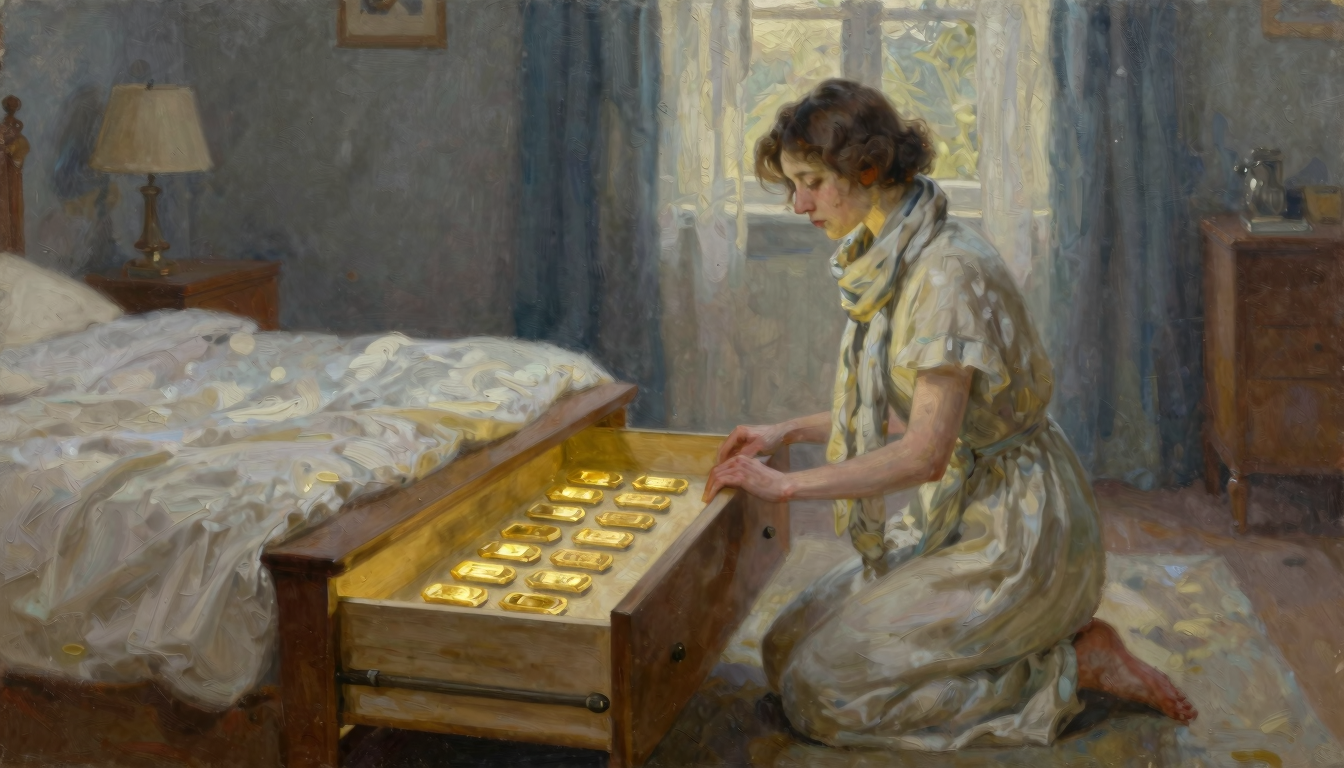
She dreamed that she opened the bottom drawer of her bedroom dresser and found twelve small gold pieces wrapped in a scarf. She counted them twice, noticed that one space in the row was empty, and locked the drawer when she heard her husband enter the room. She woke focused on the missing piece and wondered whether twelve predicted a loss.
A more grounded reading used the number as a counting signal, not a prophecy. The organized row matched her attempt to reserve a defined amount. The empty space matched her uncertainty about whether the budget was complete. Locking the drawer showed that privacy had become part of the pressure. The dream could be read as a prompt to check the plan and disclose it, not as proof that money would disappear.
That evening Priya reopened the car spreadsheet and discovered that she had omitted the first year's higher insurance premium. She added it, showed her husband the bonus and revised budget, and explained why she wanted to protect a minimum emergency balance. They chose a less expensive model and kept the reserve intact. The clear outcome was a corrected budget and shared decision. The dream did not cause or predict the missing cost; its counting pattern helped her notice where secrecy and incomplete planning were interacting.
How to read different amounts
Use broad quantity first.
- One piece: Look for one concentrated choice, possession, promise, or private fact.
- A small countable set: Ask what you are allocating, tracking, dividing, or checking.
- A missing piece: Check for an overlooked obligation, incomplete information, or fear that something is insufficient.
- A large pile: Consider whether responsibility, temptation, security, or secrecy feels bigger than you can manage.
- An exact repeated number: Ask where that number already appears in your current life before considering any symbolic association.
Carry one exact sentence through the process: "I found three gold bars in my father's desk drawer and put two back." The key questions are not whether three or two is lucky. They are why the gold was in someone else's private space, why one bar was removed, and what responsibility or boundary the action resembles. The useful final judgment may concern permission, inheritance expectations, shared property, or the temptation to claim value before ownership is clear.
A five-question check
- Was the gold yours, shared, found, or taken?
- Was the amount exact, approximate, missing, or impossible to count?
- Why was it in the drawer: protection, organization, concealment, or neglect?
- What emotion appeared when someone approached?
- What real-life value are you currently counting or withholding?
Then take one proportionate action. Verify a balance, include a forgotten cost, clarify ownership, document an agreement, or have the conversation you have postponed. Do not make an investment or accuse another person because of the dream.
When the number may be incidental
The quantity may simply reflect something recently seen: jewelry in a shop window, game tokens, a savings screen, inventory at work, or a scene from entertainment. If the amount changed during the dream or could not be remembered after waking, the stronger themes may be hidden value and privacy rather than number.
The number deserves more attention when counting was the central action, when a piece was missing, when the amount matched a current obligation, or when your decision changed because of the total. Even then, treat it as a prompt to inspect present circumstances, not a guarantee of gain or loss.
Frequently asked questions
Does a specific number of gold pieces predict money?
No. A precise count can reflect planning, sufficiency, or a real-life amount, but it does not establish future income. Check whether the number connects to an actual budget, payment, or responsibility.
What does one hidden gold piece suggest?
One piece can concentrate attention on a single opportunity, promise, possession, or private concern. The meaning depends on ownership, emotion, and what you did with it.
What if one piece was missing?
A missing piece may fit concern about incomplete information, an overlooked cost, or something that feels insufficient. Verify the relevant facts before assuming a loss will occur.
Does a large pile of gold have a stronger meaning?
It may increase the emotional scale. A large pile can make security, temptation, responsibility, or secrecy feel overwhelming, but it is not automatically more fortunate or more dangerous.
Should I use the number for gambling or investment decisions?
No. The dream is not reliable evidence for gambling, prices, returns, or market timing. Use the number to identify what you are counting emotionally, then make financial decisions from verified information.