Summary
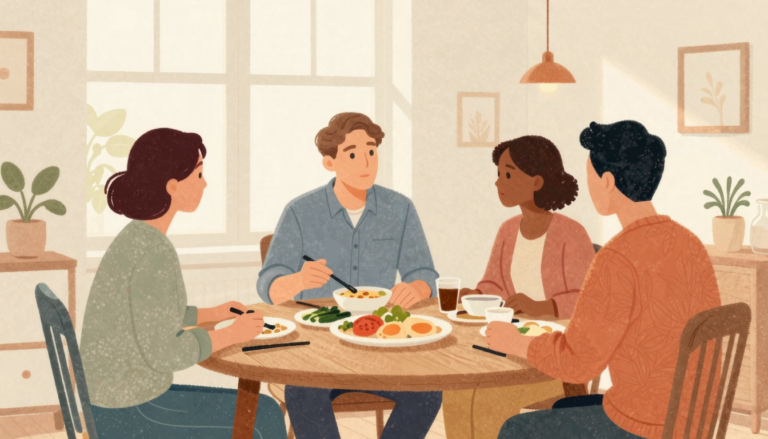
Being constantly reassuring can leave others struggling to reach the person behind the smile. Emotional openness begins with genuine feelings, a clear purpose and attention to the situation.
At a glance
Begin by acknowledging what you genuinely feel and considering what expressing it should accomplish. Positive and negative emotions can both be useful when they fit the situation, while forced positivity may create inauthenticity and anxiety. Expressing sadness to a friend can invite support, but emotional honesty still requires judgment about circumstances, consequences and the relationships you hope to sustain.
If you are always the agreeable one, learning to express negative feelings may begin with reconsidering what those feelings can do. Emotions can serve as tools for responding to particular situations, including emotions we would usually rather avoid.
Expressing anger during a negotiation can prompt the other person to make greater concessions. Showing gratitude to a romantic partner can deepen your love for each other. Envy can spur immediate action toward getting something you want, while pride can help you hold to your beliefs and follow through on your plans. These are only a few examples. Each emotion may be particularly useful in its respective circumstances; whether we call it positive or negative tells us little about how well it fits the problem.
Yet the approval we give emotions rarely reflects that flexibility. Helpfulness, understanding and other qualities that make us considerate toward others receive far more praise. It can seem as though being liked depends on showing only this agreeable side of ourselves. That expectation may encourage us to hide what we feel behind a positive display. But does the cheerful atmosphere we create actually make us happier or help us cope with life's difficulties?
Research by University of Michigan scholar Weidman and colleagues, as reported in the original essay, challenges that assumption. They found that people preferred positive emotions as tools for everyday difficulties, while those skilled at using negative emotions to regulate their responses gained greater benefits. Skillful use matters here: the finding does not mean that every expression of a negative feeling will help.
In one experiment, University of Michigan researchers used ten emotions. Five were classified as positive: pride, compassion, gratitude, confidence and love. The other five were anger, anxiety, envy, guilt and shame. Drawing on scenarios used in earlier research, they constructed two controllable and two uncontrollable situations for each emotion. In a controllable situation, using a particular emotion could produce the intended effect. In an uncontrollable situation, nothing the participant tried could improve the circumstances.
The anger scenarios illustrate the distinction. Imagine arguing with a colleague during a workplace discussion in a company that encourages communication. Expressing anger could convey that you do not understand the other person's position, making this a controllable situation. But if you are attending an online meeting and your microphone is broken, getting angry cannot overcome that obstacle. That situation was classified as uncontrollable.
After reading each hypothetical scenario, participants chose the single emotion from the ten-item list that they thought would best solve the problem. In controllable scenarios with a positive target emotion, 55% selected that emotion. When the target emotion was negative and the situation was controllable, only 13% selected it. A preference for positive emotions also appeared across both controllability conditions in scenarios associated with negative emotional tools, including anger as a way to express a viewpoint.
The essay's author describes the broader pattern as positive emotional tools being used almost twice as often as negative ones in everyday life—as though everyone were an angel of optimism. The author's practical inference is conditional: when a situation calls for negative emotional expression, substituting positivity can lead to worse results than expressing the negative feeling directly.
There can also be a personal cost to displaying feelings you do not have. Forcing yourself to act upbeat when you feel no corresponding positivity can leave you feeling inauthentic. Here, inauthenticity means performing, or being required to display, emotions that differ from your inner experience. Prior research cited in the essay found that this mismatch can cause anxiety and stress, and that prolonged inauthenticity can reduce the quality of social relationships.
The author acknowledges that a more positive approach to life is associated with greater happiness, while emphasizing a crucial condition: the positive feelings must be genuine. Displaying happiness or gratitude you do not feel may instead deepen your anxiety. Blind faith in positivity can produce the very distress it promises to ease.
Drawing on Weidman and colleagues' research, the author recommends using negative emotional tools more often to bring greater balance to our emotional repertoire and our lives. That can begin with a small admission. When you are genuinely sad, instead of telling friends, “I'm fine,” try saying, “I'm having such a hard time. I could use a hug.” That invitation includes anyone expected to be tough or masculine.
Being more emotionally open may also make it easier for others to understand us. The author draws a comparison with film characters: moments when their real personalities emerge can be more compelling than scenes in which they hide themselves to preserve surface harmony. They become more vivid, and their intentions become easier to understand. Even a character with malicious intentions can be a charming, appealing villain.
That comparison leads to the author's recollection of a friend, referred to anonymously as Little A. He freely offers reassurance: “Don't overthink it,” “Drink some warm water,” “You're doing great.” Even when someone is dissatisfied with him, he greets them with a smile. At first, everyone gets along comfortably. Over time, though, the author begins to feel a barrier in the friendship. Beneath all that constant positivity, the person himself seems difficult to reach. Perhaps, the author suggests, expressing genuine thoughts through negative feelings too might help his friends get a clearer sense of who he is.
Emotional honesty still requires judgment about circumstances, external constraints and possible consequences. As the author cautions, shouting angrily at work because you are dissatisfied with your boss might leave you out of a job the next day. Within families, the difficulty can take another form: we may direct negative feelings more often toward relatives, leaving our worst temper for the people who love us most.
An extreme form of family conflict appears in the research of a scholar, identified in the essay as an associate professor in Peking University's philosophy department. Studying suicide among peasants in North China, he found that aggrieved members of rural households often used suicide to express anger. His account describes household members as individual centers of power, with contests playing out between spouses and between fathers and sons.
The essay's author illustrates this dynamic with a hypothetical daughter-in-law blamed by a son in the household for not caring adequately for the elders. Losing ground in the family's power struggle, she might drink a bottle of pesticide instead of seeking understanding and constructive communication, intending to make her position clear, save face and resolve the dispute.
The author suggests that such extreme expressions may arise partly from the politics of kinship, where conflicts carry accumulated grievances between relatives. Someone consumed by resentment may stake their life on a dispute, hoping to make the other person feel remorse or give in and thereby win the power struggle. Yet these tactics, the author argues, often cause harm and defeat their own purpose. Why does expressing negative emotion in this way make matters worse, when the earlier research suggests that negative emotions can help people solve problems?
The Peking University researcher offers two explanations. First, those caught in these struggles have lost sight of the family as a whole. In his view, the ultimate aim of working through household conflicts should be better intimate relationships rather than victory for one person.
His second explanation concerns even the individual's own interests: being vindicated in a power struggle is different from realizing one's personal worth. He understands that worth as each person finding a fitting place and living peacefully and with dignity. In his account, a harmonious family makes that possible; winning a dispute does not. He sees the failure to grasp this distinction as part of what leaves the people he describes trapped in a desperate impasse.
For the essay's author, the practical question is what emotional expression is meant to accomplish. Negative emotions can be useful when they fit the problem; habitual positive displays may leave the difficulty unresolved while adding inauthenticity and anxiety. But choosing an expression requires judging the whole situation. Excessive negative expression may lead people who do not know you well to see you as unfriendly. If the aim is better communication in the future, how you express yourself should help the other person understand what you genuinely feel.
How would you spot a finely made artificial flower among real ones? Look for the one without a blemish, a trace of decay or a mark left by an insect. Its flawlessness gives it away: only the artificial flower bears no scars.
Joy and sadness, the pleasant and unpleasant parts of our lives, belong together in a whole, authentic person. Yet some people hold back negative feelings because expressing them seems wrong, immature or melodramatic. Feelings themselves have no moral division into good and bad; they arise for reasons. What we do with them still calls for judgment, but keeping them unspoken does not make them disappear. Deliberately ignoring or suppressing them may create problems later.
With care for the circumstances and what you hope to communicate, let yourself express sadness as courageously and sincerely as you express love and joy.