Summary
A floating gourd dipper, clacking bellows and water warmed inside a stove carry a teacher back to childhood, household ingenuity and a mother’s care in rural Haian.
At a glance
A teacher’s memories of rural Haian center on a gourd dipper, a water vat, a stove’s hot-water reservoir, bellows and an earthen stove. These objects recall family care, practical ingenuity, childhood pleasures and demanding household chores. Their emotional associations endure as modern conveniences gradually replace them, while the teacher also welcomes relief from older forms of labor.
During a lesson on a literary episode involving the theft of birthday gifts by a ruse, a teacher asked the students whether they had ever seen a dipper. In the episode they were studying, one man wants half a dipper of wine, but another snatches it and pours the wine into a bucket. Only a few hands went up. The teacher was surprised: as a primary-school child in rural Haian, the teacher had used one regularly.
That classroom moment opens a set of memories gathered around five old kitchen objects: a gourd dipper, a water vat, a hot-water reservoir built into the stove, bellows and an earthen stove.
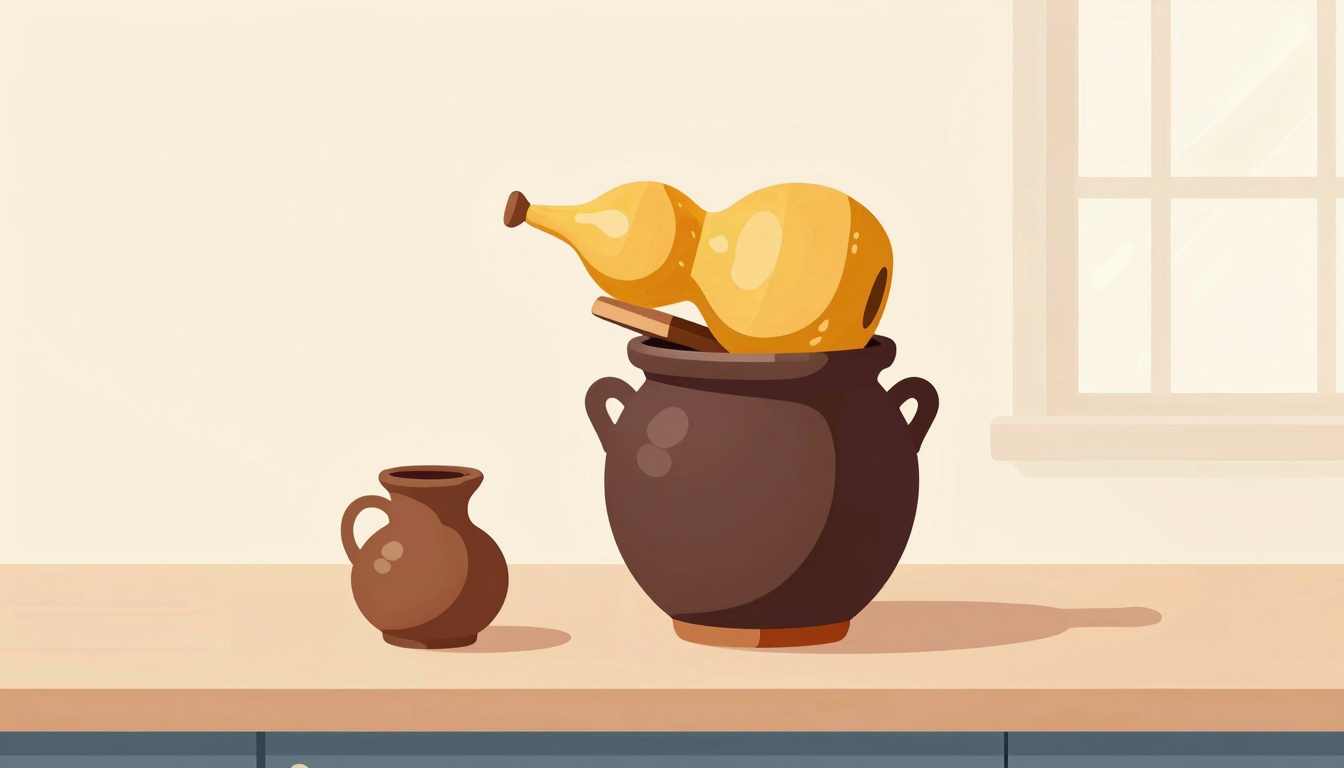
A dipper could scoop wine or water; one used for water was simply a water dipper. In the teacher’s childhood kitchen, a roughly hat-sized dipper made from a gourd grown by the grandmother stayed within reach all year. It rested on the water vat’s wooden lid or floated inside. At each of the day’s three meals, the mother used it to add water for cooking and to transfer dirty pot-washing water to the slop bucket.
Long use had turned the shell deep yellow and worn a crescent-shaped notch into one side. Its natural surface had a soft sheen that felt warm and familiar to the teacher. The aluminum and sheet-metal ladles that came later seemed cold by comparison. Dropped into the vat, they sank; the gourd dipper floated.
In summer, adults came home tired from work with sweat covering their foreheads. If no boiled water was ready, they lifted the vat’s cover, scooped up half a dipper of cold, unboiled water and drank it down. The teacher remembers the local river water then as scarcely polluted and drinkable without boiling. Alum added to the vat settled the suspended impurities, leaving the water clear and cool. A thirsty child followed the adults’ example, drinking a little less than half a dipper. The relief seemed to reach deep into the body, a sensation still vivid decades later.
Village families had little money and made few demands on their everyday comforts. Drinking unboiled water this way was ordinary, and the teacher does not remember seeing anyone in the village become ill from it. A dipper was something a household could hardly manage without. Some families grew gourds so they would have material for replacements.
Among the different varieties, the gourds used locally were called “large gourds” or “gourd dippers.” One end was large and round, suited to holding water; the other was narrow and elongated, making a handle. Two planting sayings stayed in the teacher’s memory: “Around Qingming, sow melons and beans,” and “On the third day of the third lunar month, sow gourds.” In those recollections, seeds went into the ground around the houses in the third lunar month, around Qingming. Through the summer, the gourds ripened from green to yellow.
After the solar term marking the beginning of autumn, they were picked from yellowing vines. A shake tested their maturity: rattling seeds meant a gourd was ready to be sawn lengthwise into halves. The moist flesh was scooped out, some plant ash was put inside, and the halves were left in the shade to dry. Several days later, the shells had hardened enough to ring when tapped with a finger. One gourd had become two dippers.
The grandmother also brought the dipper into childhood wordplay. She taught a tongue twister about soaking roasted flour, playing on “a dipperful” and “a dipper and a half” and using the Haian term for roasted flour. Said quickly, the words became tangled, and the child’s mistakes made her double over with laughter. Dippers held dry goods as well as water: the mother once borrowed a level dipper of rice from a neighbor, scraping the top flat with a chopstick.
After leaving the village for university, the teacher read an ancient Chinese philosopher’s essay and found that familiar utensil in a much older world. A speaker in the text recounts receiving giant-gourd seeds from the king of Wei and growing fruit with a capacity of five shi. Yet the shell could not withstand the weight of the water it might hold. Split into a dipper, it was so unwieldy that there was nowhere to put it. From this passage, the teacher understood that the objects so few students would later recognize had been used in China thousands of years earlier.
A good gourd dipper could last several years if protected from falls, knocks and forcible bending. A fall onto a hard floor, though, could split it. In a poem about a lake, a Qing-era poet describes vines hanging from an old house and joining a bean trellis, then a broken dipper scooping up water along with small fish. How could a broken dipper still scoop water? The teacher’s question leads back to a separate object: the dipper on the family vat. That one had cracked too. Unwilling to throw it away, the grandmother stitched the crack with hemp thread as though sewing pieces of cloth together, and it remained in use for a while longer.
Sheet-metal and plastic ladles eventually took its place. For the teacher, however, the memories still ripple inward like a dipperful of cool water. The childhood dipper remains unforgettable, along with the vat on which it rested.
Before piped water reached the village, households depended on vats for water to boil and cook with. The family’s dark-brown vat stood against the wall in a corner in front of the stove. The teacher thinks habit probably helped determine its position, as did convenience: anyone cooking could reach over and scoop up water, saving time and effort.
Two semicircular wooden covers, one fixed and one movable, fitted together into a full circle. Years of use had left them rough, with raised grain resembling an elderly person’s weathered hands. The yellowing dipper rested on the fixed half or floated inside. Marks from sharpening kitchen knives scored the rim.
At first light, the sound of scooping water joined the roosters’ calls. Breakfast was being made. For anyone still in bed, those sounds meant it was time to get up; plenty of work lay ahead. The vat also held a reserve for emergencies. A local saying advised keeping the stove mouth poor and the water vat rich: little straw fuel piled by the fire opening, plenty of water in the vat to put out an accidental fire.
For the child, it offered pleasures too. After playing outside in summer, sweaty and desperately thirsty, the teacher remembers hurrying home to drink deeply from the dipper, with no recollection of an upset stomach afterward. In winter, a thin layer of ice occasionally formed on the surface. Pieces could be lifted out and licked like natural ice pops, still a delight even when the mouth grew numb.
Sometimes a few small crucian carp caught while fishing were secretly slipped into the vat. Leaning over the rim, the child teased them with a slender bamboo twig and kept dropping in grains of cooked rice for fear they would go hungry. After several days, the water began to smell. The mother discovered the mischief, delivered a scolding and ordered the child to clean the vat.
Every last bit of water had to be scooped out before the vat could be carefully lowered onto its side on the ground. A clean broom swept out the sediment at the bottom, again and again, followed by a rinse with clean water. Then the vat was stood upright, its mouth open to the sun, and left to dry before being returned to its place. Fresh water was carried in to refill it. In the household routine the teacher remembers, crushed alum was added and stirred through with a stick. Suspended impurities settled to the bottom, leaving the water clean and clear again.
Each day, cooking smoke rose and pots, bowls and dippers sounded their accompaniment in the kitchen. A dipperful of water washed the pot, and family routines went on in good order. The vat supplied drinking water and water for chores. In the teacher’s memory, it held the passing days of a whole family as surely as it held their water.
As piped water reached village households, vats gradually lost their practical purpose. Long companionship with an object, the teacher reflects, can make it seem almost like kin. Even over a cup of tea made with tap water, the longing remains for the vat back home and the old days it seems to hold.
Another student’s question opened a different route into that kitchen. Reading a collection of stories, the student had encountered an old expression for face-washing water and wanted to know whether it could improve someone’s complexion. In the passage, one character brings in the water and announces its arrival; a woman removes an outer garment, washes her face and arranges her hair. The teacher explained that the expression here meant hot water for washing the face, rather than a beauty treatment.
The student’s surprise recalled an elderly man’s explanation of words still heard in Haian. Chopsticks, he said, had once been called zhu, cooking pots fu, and hot water tang. Those older words survived in local household names: zhu long for a bamboo chopstick holder, fu guan for a pot lid and tang guan for the iron hot-water reservoir set into a stove. He described them as usages handed down from people who had lived hundreds or thousands of years before. The word tang guan brought back the vessel in the family kitchen.
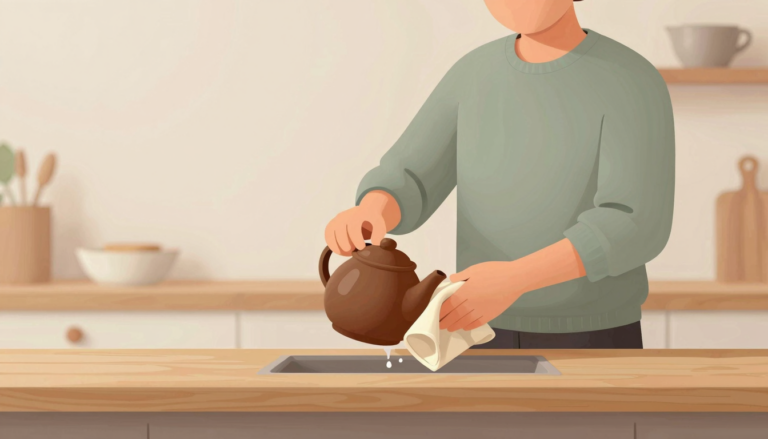
Before breakfast, the child would enter the small, steaming room and take up a fist-sized dipper. Unlike the salt and sugar containers nearby, the reservoir was cast iron: cylindrical, slightly wider than the mouth of a bowl, and rounded at the bottom like a cooking pot. It was sunk deep into the stove between two cooking pots, near the stove wall, with only its mouth projecting above the surface beneath a light wooden lid. A three-pot stove held two such reservoirs.
As fuel burned, fire and smoke traveled toward the chimney, and the reservoir picked up heat along the way. Its water was usually lukewarm rather than boiling. By the time the mother finished making breakfast, there was warm water for rinsing the mouth and washing the face. The teacher remembers feeling warm all over afterward.
The water also helped remove grease from pots and bowls after meals, a task cold water did poorly. The teacher describes it as unsuitable for drinking because it had not boiled; the family used it for washing. Their dipper was made from half a coconut shell, fitted with a bamboo-strip handle about eight cun long and a finger wide, allowing it to reach the bottom of the reservoir.
At festivals and holidays, the warm water quickly softened and plumped up wood-ear mushrooms, dried salted vegetables and shiitake mushrooms. They went into the hot pan with a hiss, sizzling as they were stir-fried or fried. Steam rose over the stove and appetizing aromas filled the kitchen. Two more dippers of water replenished the reservoir, and soon there was warm water again.
Its most tender associations belong to winter evenings spent reading and doing homework by a kerosene lamp, with cold winds blowing outside. The mother brought warm reservoir water for warming hands and washing feet, followed by food for an extra meal. The child was puzzled: how could the food still be warm when no one had lit another fire?
“I kept it warm in the reservoir, well covered,” the mother said with a smile. “Go on, eat it while it’s hot.” The warmth of the vessel remains inseparable from those evenings and her care.
The reservoir is said to have a long history. The teacher points to chapter 31 of a classic Chinese novel, where a man looks toward a light and sees two maids complaining beside one in a kitchen. In the rural kitchens of the teacher’s later account, electric rice cookers and gas stoves have become common, and washing water is heated on a gas burner or in an electric kettle. How many people still use the old reservoir?
A few years earlier, when the family house was demolished, the mother spotted one discarded in a heap of rubbish. “That could be sold as scrap iron,” she remarked. For the teacher, the sight brought back childhood, the mother and all the small moments of warmth that had gathered in the kitchen.
An old set of bellows at Haian’s memorial museum commemorating seven victories in seven battles summoned memories of tending the fire. The teacher describes the exhibit as having been used by civilian workers from Renqiao to support the war effort. Its familiar shape recalled the bellows at home and the hours spent working them.
At dawn and dusk, their clacking carried along the village lanes, mingling with roosters crowing, dogs barking, adults’ footsteps and conversation, and children’s laughter and shouts. Together, those sounds formed the village’s daily symphony in the teacher’s memory. With the mother busy and so much work to do, operating the household bellows often fell to the child.
Seated on a small stool, the child fed fuel into the stove while pumping. Both speed and force mattered. Stir-frying called for rapid strokes to build a fierce fire. Rice or porridge needed strong heat until it boiled, then slower strokes to maintain a gentle simmer. Flatbreads demanded the most care, with slow, measured movements of the handle.
The work could be monotonous, but the hot ash offered compensation. Sweet potatoes and corn could roast there while the bellows were worked. The teacher has always preferred roasted food to boiled food and remembers catching frogs, small crabs and shrimp to roast and eat at the stove. More than once, attention to sweet potatoes allowed the porridge to boil over and spread across the stovetop. A scolding from the mother usually followed.
The teacher likens the bellows to a suitcase with an extendable handle, or to a Chinese character, pronounced “you,” laid on its side. The character has a box-shaped outline with a horizontal stroke inside. In the teacher’s comparison, its first horizontal stroke becomes the handle, joined to a rod, while the inner horizontal stroke represents the piston board. Chicken feathers lined the board’s edges. Pushing and pulling the handle moved it back and forth, compressing air and sending it through an outlet beneath the stove to strengthen the fire. Small openings at the front and back had movable wooden flaps that controlled airflow. Their movement made the familiar clack-clack.
On a walk through the village, that sound seemed to come from everywhere, as though households had all begun playing the same instrument without arranging to. It gave repetitive days a cheerful beat. Bellows entered everyday teasing as well. Adults told a child with a runny nose, “Your nose is working like bellows.” A familiar saying described “a mouse in the bellows—getting air from both ends.” The phrase also meant being under pressure from both sides. Such wordplay reflected how closely the object belonged to ordinary life.
The mother used to explain that most household bellows were small; smithy bellows were much bigger. She turned the distinction into a warning about schoolwork: “If you don’t study properly, I’ll have you working the big bellows at a smithy. You need both hands to pull those, and the fire is hot enough to melt iron. Let’s see what you can roast to eat then!”
Traveling metalworkers often passed through the village, calling out offers to mend pots or cast plowshares. The children ran over to watch. One end of a worker’s carrying pole held a cabinet of tools and equipment; the other supported a furnace and bellows that could be taken apart for transport. Once hired, the worker assembled the equipment, pumped up the fire and began the job. The teacher remembers inspecting one portable set of bellows: about two chi long, one chi high and six cun wide, smaller than the one at home.
“Don’t try to scare me,” the child told the mother. “The metalworker’s bellows aren’t big at all!”
The mother laughed. “That was a pot repairer. They use small bellows, just like the ones coppersmiths carry. I mean the smiths who swing big hammers to forge iron. Their bellows are nearly as tall as you. If you don’t believe me, I’ll send you to a smithy tomorrow to work them!”
More than half a century separated those exchanges from the museum visit. Now in their sixties, the teacher had not expected to encounter such familiar equipment there. The exhibit was scarred all over; those marks seemed to speak of war and the passage of time.
For all the affection in these memories, the teacher welcomed natural gas and electrical appliances replacing working bellows. The preserved examples had another purpose: to remind later generations to cherish hard-won peace and the happiness of their lives today.
A friend’s invitation to a gathering at Earthen Stove House brought the teacher face to face with an earthen stove again. The restaurant’s stove differed from the one in the old family home, yet it felt familiar. The childhood stove had been built from mud blocks and bricks, work known locally as zhi zao. In years of material scarcity, a well-built stove saved fuel and cooking time. Much depended on the builder’s skill, and the best builders were known throughout the surrounding villages.
In the Haian countryside the teacher remembers, building a stove involved careful observance of custom. According to folk belief, the heavenly deities were too distant to oversee everyday household affairs; fortune, misfortune and prosperity usually fell within the stove deity’s care. Most families therefore chose an auspicious date before arranging for a builder to come.
On the appointed day, the builder generally ate only two meals. After breakfast, the old stove was dismantled, and the next meal had to be cooked on its replacement. Once the main structure was finished, a fire dried it partway, leaving the surface partly moist for painting.
Most stoves held two iron cooking pots, though some had three, with hot-water reservoirs set between them. Recesses in the stove wall held bottles and jars of oil, salt, sauce and vinegar. The body generally had three faces. The broad face most visible from the kitchen entrance carried decorative paintings; the other two bore brick patterns in limewash.
The paintings usually had a blue-gray ground. Rice straw was doused with water before it had finished burning, and the resulting ash was mixed with lime. Builders worked with masonry trowels, plastering floats, plumb bobs and wooden rulers, generally using limewash for the designs. Fish, splashing water and evergreen plants expressed wishes for abundance, safety from water and fire, and long life. As the pictures took shape, the builder recited auspicious rhymes, and householders gave money to mark the good wishes.
While the painting proceeded, the household began cooking meat and fish on the new stove. A celebratory saying went, “New pots, new stove—fish and meat leaping!” This was a more generous meal than usual. Quick, skillful building brought it to the table sooner; slower progress meant a longer wait.
In daily use, the stove became what the teacher calls a barometer of rural family life. Water sounds, wood chopping, food cooking, calls bringing children home to eat and aromas drifting from the kitchen suggested how a household was getting on. Coming home from school and sitting at the stove opening to feed straw into the fire while the mother cooked was one of childhood’s greatest comforts.
Even feeding straw took skill. Bundles needed to be loose and not too large. A bundle burning poorly had to be lifted with the fire fork; one burning too fiercely needed pressing down. Poor control let the fire flare and dwindle, filling the room with smoke that made eyes sting and water. In summer, the space beside the stove felt like a steamer. Tending it meant heavy sweating as well as enduring the smoke.
There was pleasure, though, in watching the embers while adding fuel. When they had gathered together and small flames still flickered among them, the child would fetch a sweet potato hidden in a corner by the stove and bury it in the hot ash. Before long, its aroma rose. Too impatient to wait, the child probed through the ash with the fire fork, sometimes puncturing the potato and filling the opening with ash. That hardly mattered: off came the skin, a few breaths cooled it, and the child ate eagerly. Its fragrant sweetness lingered in memory.
Even after the food was cooked, the remaining heat could be put to use. The family had an earthenware jar the grandmother always called a “foreign jar.” The teacher connects its later name, “simmering jar,” with a Cultural Revolution-era wave of renaming that changed familiar terms for soap, kerosene, matches and cloth containing the character meaning “foreign.” The jar’s new name described its use for heating slowly in the embers.
Filled with water, it was placed inside the stove and banked with hot ash. After half a traditional shichen, the water was steaming. After supper, a jarful provided hot water for washing the face and soaking the feet.
Gas stoves and induction cookers gradually displaced earthen stoves from the life the teacher recalls. Yet the restaurant owner had shrewdly chosen the name Earthen Stove House. Might many others, too, find themselves thinking of home now and then, and of the years spent tending an earthen stove?
Frequently asked questions
Which five kitchen objects appear in the teacher’s memories?
The memories center on a gourd dipper, a water vat, a hot-water reservoir built into the stove, bellows and an earthen stove.
How were gourd dippers made in the teacher’s village?
In the teacher’s recollection, mature gourds were picked after the beginning-of-autumn solar term. Rattling seeds indicated readiness for sawing lengthwise. The flesh was removed, plant ash was placed inside, and the halves dried in the shade for several days until hard, producing two dippers.
What was the stove’s hot-water reservoir used for?
In the family kitchen, the reservoir absorbed heat during cooking, usually warming water without boiling it. The water served for washing, cleaning greasy cookware and soaking ingredients; the mother also used the reservoir to keep covered food warm. The teacher describes its unboiled water as unsuitable for drinking.
How did bellows help control cooking heat?
The teacher recalls rapid strokes for stir-frying, strong heat until rice or porridge boiled followed by slower strokes for simmering, and especially careful, slow movements for flatbreads.
Does the teacher want older kitchen equipment to return?
The teacher cherishes the memories associated with these objects while welcoming natural gas and electrical appliances replacing working bellows. The recollections retain the labor, smoke, summer heat and maintenance alongside childhood pleasures and family warmth.