Summary
A continuous lawn, a dip in the ground and the width of a room can each shape perceived distance. Familiar object sizes provide another cue—and another opportunity for illusion.
At a glance
Distance judgments draw on surrounding surfaces, spatial boundaries and expectations about object size. In the reported studies, ground depressions, lower targets and larger simulated rooms were associated with tendencies to overestimate distance under the conditions tested. Familiar size can help us infer distance, but expectations can also contribute to visual illusions.
A mountain summit looks almost within reach. Yet after an exhausting climb, you check the map and discover that you have barely begun. Or you glance at your phone while walking down steps, miss your footing, and meet the ground with an ankle that seems to scream in protest. On a bicycle, you might confidently aim for the gap between two posts, trusting your riding skills—only to get stuck between them.
Our sense of distance can lead us badly astray. What distorts these judgments? To understand how we estimate distance, we first need to consider how we perceive space.
From points in space to the ground beneath us
In 1637, Descartes proposed an early account of spatial perception in which any point in space could be located by its angular direction and its distance from the observer's eyes. An object's three-dimensional size and shape could thus be reduced to the directions and distances of the points composing it.
This was a mathematical approach to distance, expressed through a coordinate framework: spatial perception became, in essence, a relationship between a point in the world and the eyes of an observer.
But mathematical space is an abstraction. This account treats the observer as though they were little more than a pair of eyes situated in an otherwise empty, conceptual space. Actual observers are more than eyes, and the spaces through which we judge distance are full of surfaces and objects.
In the mid-twentieth century, psychologist Gibson proposed Ground Theory, which offered a different account. Rather than understanding distance solely as a discrete relationship between two points, we perceive the surrounding background surface as a whole. Distance extends continuously across that surface, from where we stand toward the target.
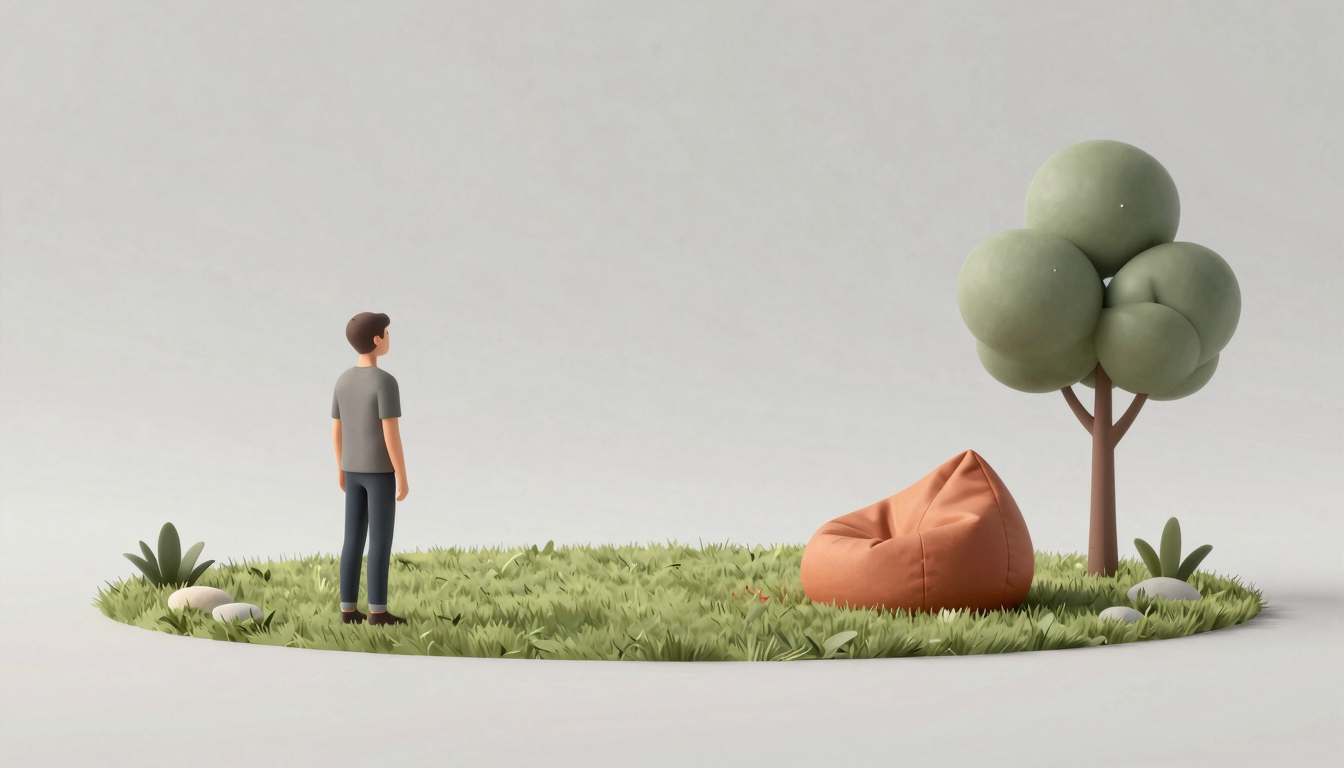
Imagine throwing a beanbag onto a lawn in a park. The grass forms an approximately smooth, continuous surface. To judge how far away the beanbag has landed, you use the stretch of lawn between yourself and the bag as a reference. You are not simply locating two isolated points in empty space and calculating the gap between them.
A real surface, then, provides an important reference for estimating distance. Ground Theory also points to a broader insight: the visual world we experience does not correspond perfectly, point for point, to the physical world. Our perception transforms it, and information from the surrounding environment helps shape that transformation.
How terrain changes the view
Two environmental features illustrate how this can happen: the terrain beneath and between us, and the boundaries of the space around us.
Pronounced rises and dips can affect our perception of a continuous surface. A crack or break in the ground may interrupt the information we use to establish a visual frame of reference, potentially causing us to misjudge the distance to an object.
In one study, participants first judged the absolute distance between themselves and a target. They were then blindfolded, turned 90 degrees, and asked to walk the distance they remembered.
On flat ground, the distances they walked were close to the actual distances to the target. When depressions of different sizes were introduced into the ground, however, participants tended to overestimate the distance and walk farther.
Researchers also compared estimates for objects located below the level of the ground on which observers stood with estimates for objects on ground at the same level. People tended to overestimate the distance to the lower objects.
One possible explanation involves eye height above the ground. For an adult standing on a flat surface, the distance between the eyes and the ground is usually relatively stable. That familiar height can serve as a kind of scale for judging distance. A change in the level of the ground beneath a target may therefore affect the estimate.
Why a larger room can make a target seem farther away
Indoors, distance judgments are also related to the boundaries of the surrounding space.
In a computer-simulation experiment, researchers created four spaces with different widths and lengths. They placed a marker at the same distance from the camera position in each space, then asked participants to estimate that absolute distance. This allowed the researchers to compare judgments across different surroundings while keeping the target distance constant.
As room width or length increased, participants became more inclined to overestimate the distance to the marker. In a space 40 meters wide, their estimates tended to be 16%–33% greater than their estimates in a corridor 1.5 meters wide.
That comparison concerns the estimates made in the two spaces: the marker had not moved farther away, but the surrounding dimensions changed how far away it appeared.
Familiar size helps us—and can mislead us
The environment is only part of the picture. Characteristics of the target itself also influence distance judgments, including our expectations about its size.
Suppose an elephant is standing 200 meters away while a squirrel sits beside you. In a photograph, the elephant may look smaller than the squirrel. Yet your immediate response is unlikely to be, “So elephants are smaller than squirrels.” You understand that the elephant looks smaller because it is farther away: nearby things appear larger, while distant things appear smaller.
Experience gives us a stable understanding of familiar objects. We know that an elephant is physically much larger than a squirrel, and that neither animal's actual size changes simply because it moves closer or farther away. Psychologists call this size constancy.
But expectations that usually help us interpret a scene can also lead us into a visual trap.
In 1934, an American ophthalmologist created the famous Ames Room, exploiting size constancy to produce an illusion. Two people of equal height move into corners that appear equally distant from the observer, yet one person seems taller than the other.
An expectation about the windows helps explain the effect. Assuming that the windows are the same size encourages us to infer that the two corners are equally far away. That inference draws us into the illusion. Expectations about object characteristics can therefore be used to create visual tricks that interfere with the accuracy of our judgments about distance.
Research also supports the idea that, as we grow up, we become familiar with both an object's typical size and the visual information it produces at different positions, including the image it forms on the retina. By combining these sources of information, we can work backward to infer how far away the object is likely to be.
The size-distance invariance hypothesis offers an account of this relationship, providing another possible explanation for why distance estimates can become distorted. Size constancy describes our stable understanding of physical size despite changes in viewing distance; the size-distance relationship concerns how size and visual appearance help us infer distance.
Looking again before setting out
We often say that seeing is believing. Yet psychological research shows that many influences can give our visual experience a misleading quality. What looks close, large, or equally distant is not always a straightforward reflection of physical reality.
Recognizing these biases and understanding where they may come from can help us reflect on our judgments and adjust how we see things.
At the very least, the next time a beautiful mountain peak looks temptingly close, perhaps remembering this will prompt you to consider your physical limits before deciding to walk toward it for a closer look.
Frequently asked questions
What does Gibson's Ground Theory say about distance perception?
Ground Theory describes distance perception through the surrounding background surface as a whole. The continuous surface extending from the observer toward a target provides a reference for estimating distance.
How can uneven ground affect distance judgments?
Terrain breaks may interrupt surface information used as a visual reference. In the reported studies, participants tended to overestimate distances across ground depressions and to targets below their own ground level. Eye height is offered as a possible explanation for elevation-related judgments.
Does the room experiment show a 16%–33% error?
The reported 16%–33% difference compares estimates in a space 40 meters wide with estimates in a corridor 1.5 meters wide. It does not describe error relative to the actual target distance, which was held constant across spaces.
How does size constancy differ from the size-distance relationship?
Size constancy concerns our stable understanding of physical size despite changes in viewing distance. The size-distance relationship concerns how familiar size and visual appearance help us infer distance.