Summary
Simple meals gradually became a morning art for Liu and Scarlett. Their story follows the breakfasts, conversations and shared pleasures they made room for amid continuing responsibilities.
At a glance
In this account, Liu’s breakfast routine gave him and Scarlett something to anticipate, more time for morning conversation, and a way to express affection through everyday care. It developed gradually from simple meals and Scarlett’s encouragement. Their shared mornings became steadier while demanding work, overtime, a mortgage and a car loan continued.
The Shape of Love on an Ordinary Morning
People have been asking a question lately: When did you feel loved? And what did love look like at that moment?
For someone attentive to small details—someone like Scarlett, who lives in Shenzhen—I imagine one answer might look like this.
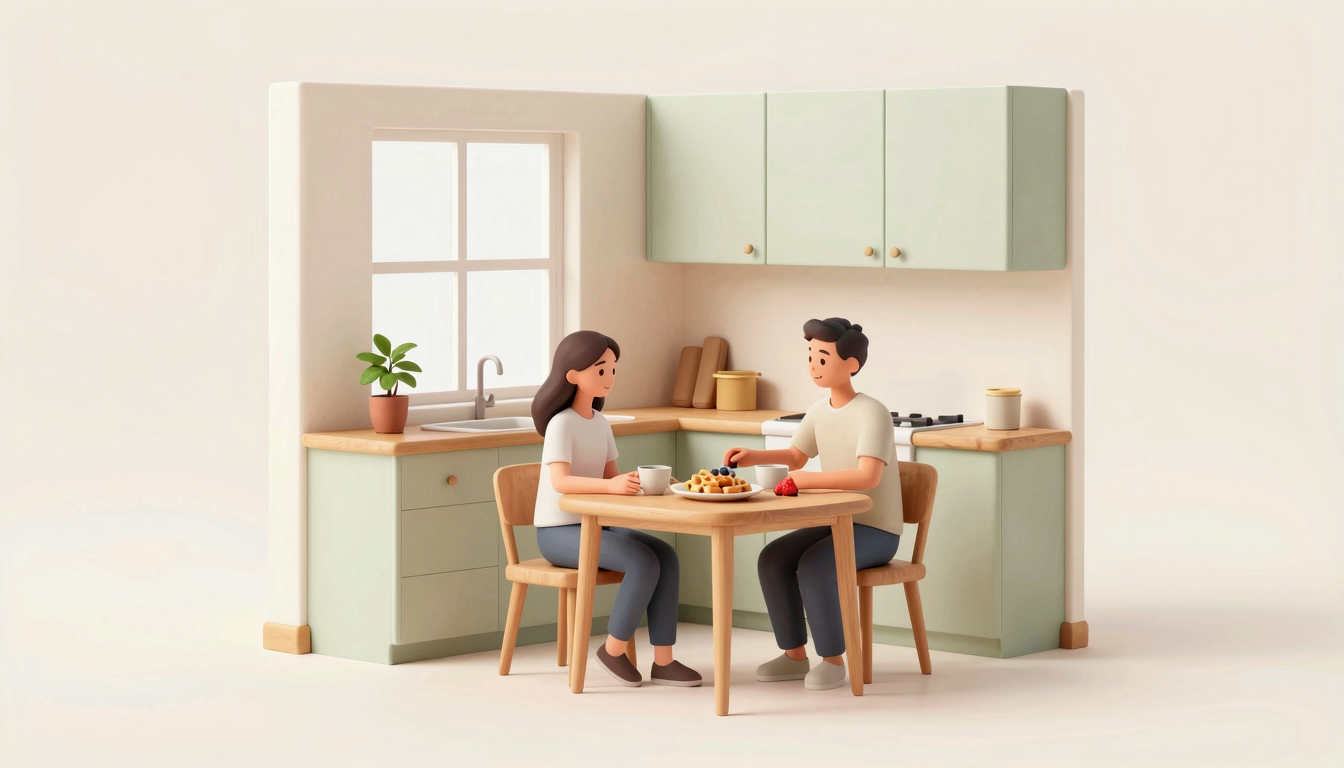
One morning, after getting up and quickly washing, she walks into the living room. Two beautifully prepared breakfasts are waiting on the table. On black plates with white rims, eight pieces of waffle sit in a symmetrical arrangement, toasted to just the right shade of golden brown. Each piece carries a little cream, a plump strawberry, and two small blueberries. The plates face each other. Beside each, on the right, stands an identical little cat ornament, with gleaming knives and forks nearby.
Someone is moving around in the kitchen. A spoon clinks against the side of a cup; perhaps the oatmeal is almost ready. She goes over to look. The morning sunlight is so clear that it seems to give the busy figure a halo. On the kitchen windowsill, a pot of mint glows green.
At that moment, Scarlett feels a quiet tenderness and a sense of stability rise within her. Today seems lovelier than yesterday. This is a moment when love spreads through a room.
The person in the kitchen is her partner, Liu Daqiang. He makes these breakfasts for both of them. Many of Scarlett’s mornings now resemble one another, yet they are quite different from the mornings that came before. She has experienced more than a hundred mornings like these and eaten nearly a hundred different breakfasts.
Ten Months of Mornings Reclaimed
On a day in May 2016, making breakfast began to take a place in Liu’s daily life as important as work. Neither he nor Scarlett can remember exactly what set it off. Perhaps it was a spontaneous impulse after growing tired of making do with breakfast—or skipping it altogether.
Liu vaguely remembers Scarlett complaining about it. When work is already overwhelming, beginning the day with another compromise can make everything feel more frustrating. Many people working in Beijing, Shanghai, and Guangzhou will recognize that feeling. A missed breakfast may seem small, but it joins a long list of things we settle for as we rush through our days. Repeated often enough, those compromises can feed a bleak mood and make us dismiss the value of our own lives.
Liu and Scarlett, though, are optimistic people who do not stay trapped in their uncertainty. Even their photographs suggest it: one face full of laughter, the other quietly assured. They tend to look for something they can do.
Faced with breakfasts that were unhealthy, monotonous, and unappetizing, Liu got up a little earlier one morning and made something from the ingredients already at home. It was simple, but it tasted good. Scarlett liked it and praised him for putting an idea into action.
Her encouragement helped him keep going. Even Liu had not expected that, ten months later, he would still be doing it. They had gained ten months of mornings.
Breakfast photographs fill much of Liu’s WeChat Moments feed. Against a black tablecloth or a natural wood tabletop, elegant plates hold banana toast, American-style fried eggs, vegetable salads, strawberry waffles, and butter cookies. Alongside them are fruit yogurt, orange juice, lattes, oatmeal, and soy milk. Occasionally there is a Chinese breakfast: braised beef noodles or rice noodles in a sour broth.
Whenever he has collected nine breakfast photographs, he shares another set. To those of us who have never made breakfast ourselves, the results look like the work of a professional chef.
Yet neither Liu nor Scarlett had been a capable cook before this began. Liu insists that what they do is not difficult. At first, they prepared plenty of ingredients the day before, then opened the refrigerator in the morning and decided what to make from what they saw. The early meals were straightforward: a fruit platter, perhaps, or milk and cereal. As Liu gradually learned to arrange food attractively, he began exploring ways to make breakfast more beautiful and abundant. The photographs that now astonish his friends grew out of that practice.
He describes the pleasure this way:
“The yellow of eggs, the orange of oranges, the red of tomatoes, the green of vegetables—the ingredients form a picture on your table, like a work of art waiting for someone attentive enough to discover and savor it. On a cold winter morning, you spend thirty minutes sleeping in; I spend thirty minutes making breakfast for someone I love. Affection expressed with care is always precious.”
By now, asking how he has managed to continue feels almost unnecessary. Making breakfast has become part of his life, a morning art he creates for Scarlett and himself. He says he intends to keep doing it.
What Breakfast Makes Room For
The practice solved the irritation of an unsatisfactory morning meal. It also brought pleasures they had not anticipated.
“Breakfast somehow became the thing we most looked forward to every day.”
To prepare it, they began learning about ingredients and nutrition. Rather than simply putting foods together, they paid attention to how carbohydrates, fruit and vegetables, grains, eggs, and meat could fit into a balanced meal. Breakfast became a more nourishing part of their day.
Their lives also grew more regular. Work remained demanding, and they still often worked overtime in the evenings. But a dependable breakfast routine gave them more time together in the morning. That time lent the day a sense of steadiness. Through attentive morning conversations, they came to understand each other better.
The refrigerator was always stocked with ingredients for breakfast. There was something ready to be made. Home felt more like home.
Their friends began to respond with more than likes beneath the photographs. Some started making breakfast themselves. Liu set up groups where people could share what they had made each day and discuss how to prepare it. Those exchanges encouraged still more people to join in, directly or indirectly. By the time of this account, there were six breakfast groups, with roughly a thousand people described as enjoying better breakfasts.
Some members had joined simply because they hoped that seeing other people’s breakfasts every day would give them a stronger desire to engage with their own lives. They, too, began cooking.
That was what Liu most wanted people to recognize: look at the care people around you are putting into their everyday lives. Your own life should not be something you live provisionally, as though it has yet to begin.
A Life That Does Not Have to Wait
Liu and Scarlett knew that provisional existence themselves. Three to five years earlier, before moving to Shenzhen, they had been working in Beijing. Liu worked for an internet company; Scarlett worked for a foreign public relations firm. Neither had a predictable time to leave work or a regular schedule for rest. Their days were crowded with work and restlessness, and many were darkened by smog and the low spirits it brought.
Around them, conversations kept returning to homes, cars, starting businesses, and becoming successful. Everyone seemed feverishly intent on winning those things, while everything else could be compromised.
Skipping breakfast was acceptable. So was ordering takeout for both lunch and dinner. Staying indoors all weekend was acceptable, as was going an entire year without traveling somewhere to clear the mind. Gathering with family or sitting down to talk with friends could also be put aside.
Life grew tense and monotonous, like a hard cocoon winding another layer around the body each day. Much later, a person might suddenly become aware of themselves again and discover how lonely and unable to move they had become.
Liu and Scarlett made a decisive choice to step away from that way of living. Their decision seems to have followed a great deal of anxiety that prompted reflection, along with quieter periods in which their thoughts could settle. They found a sense of peace that made sense to them.
They moved to Shenzhen. Along with leaving the smog for green trees and blue skies, they adopted a guiding idea: create the best daily life they reasonably could.
That care extended beyond breakfast. If they could find time to make an ordinary morning meal beautiful, they felt there was even less reason to let precious days off slip away. They made full use of their weekends, going out to experience Shenzhen: its botanical gardens, beaches, resorts, and art districts. They lingered in those places, enjoying the rare chance to slow down.
Liu’s photographs show blue water and white sand, leafy streets where the foliage shines, manhole covers painted with colorful designs, parks and gardens carpeted in green, and small art shops tucked deep into the streets. The Shenzhen they discovered and experienced looks deeply inviting.
They traveled farther, too. Over several years, they visited Taiwan, Thailand, Vietnam, Iceland, France, Germany, the Netherlands, Italy, the United States, Japan, and other places. They tried living as local people did, learned to cook local dishes, and joined local activities.
For Liu, one of the most unusual experiences was attending the funeral of a cat stationmaster at Kishi Station in Japan. A reporter interviewed him there, and he appeared on local television.
None of this meant that they had achieved financial freedom or freedom over their time. They had a mortgage and a car loan. They were still busy enough to feel constantly on the run. In that sense, their lives resembled ours. Yet in the attention they gave to breakfast, their enjoyment of everyday pleasures, and their plans for travel, they were doing something many of us keep postponing.
To find someone you love who loves you, to feel secure within yourself, and to discover a shared rhythm for resisting monotony—what good fortune that is. Liu and Scarlett had found those things. To me, that is the life we should ultimately be working toward.
Fifteen Minutes Before the World
In photographs of them together, Scarlett looks assured, while Liu smiles with wholehearted warmth. Looking at the ease between them, and then at the breakfasts he makes, I find myself thinking in something like poetry.
If you are looking for the shape of love, I would say: look at the savory bacon and the tender yellow eggs. Love flows from my heart onto a white plate in the morning sunlight, then spills beyond it and fills the room. If you are looking for the shape of love, watch me watching you eat. I am smiling. It is there in my eyes.
That is how I imagine it. Late at night, tired, I picture Liu and Scarlett sitting across from each other at a sunlit breakfast table, laughing and teasing as though in a Japanese film. My eyes grow warm. I feel close to tears.
The world can be so dull, so tangled, so full of people and things demanding attention. Every morning, fifteen minutes after Liu has finished making breakfast, he and Scarlett will open the door and go out to face their separate responsibilities.
For those fifteen minutes, there is no need to rush. Sit down. Enjoy a proper breakfast together. Then take each other’s hand, step outside, and go meet the world.
Frequently asked questions
Were Liu and Scarlett experienced cooks when they began?
Neither was a capable cook before the routine began. They prepared ingredients ahead of time, started with straightforward meals, and gradually learned food arrangement and more varied preparations.
Did their breakfast routine mean they had more freedom from work or financial obligations?
They remained busy, often worked overtime, and had a mortgage and a car loan. The account explicitly says they had achieved neither financial freedom nor freedom over their time.
What helped Liu continue making breakfast?
Scarlett’s praise encouraged his early efforts. Over time, making breakfast became an established part of his life and something he and Scarlett looked forward to.