Summary
An absorbing game can push time, hunger and fatigue into the background. This article explores two possible explanations, distinguishes recalled-gameplay self-reports from direct measurements, and presents reminders and daily planning as practical suggestions.
At a glance
Gaming may absorb attention so thoroughly that passing time and bodily signals become harder to notice. The article offers attentional gate theory as one explanation and discusses bodily-awareness research based on self-reports around recalled gameplay, rather than direct physiological measurements. It recommends reminders and daily planning, although the supplied source reports no intervention study testing these suggestions.
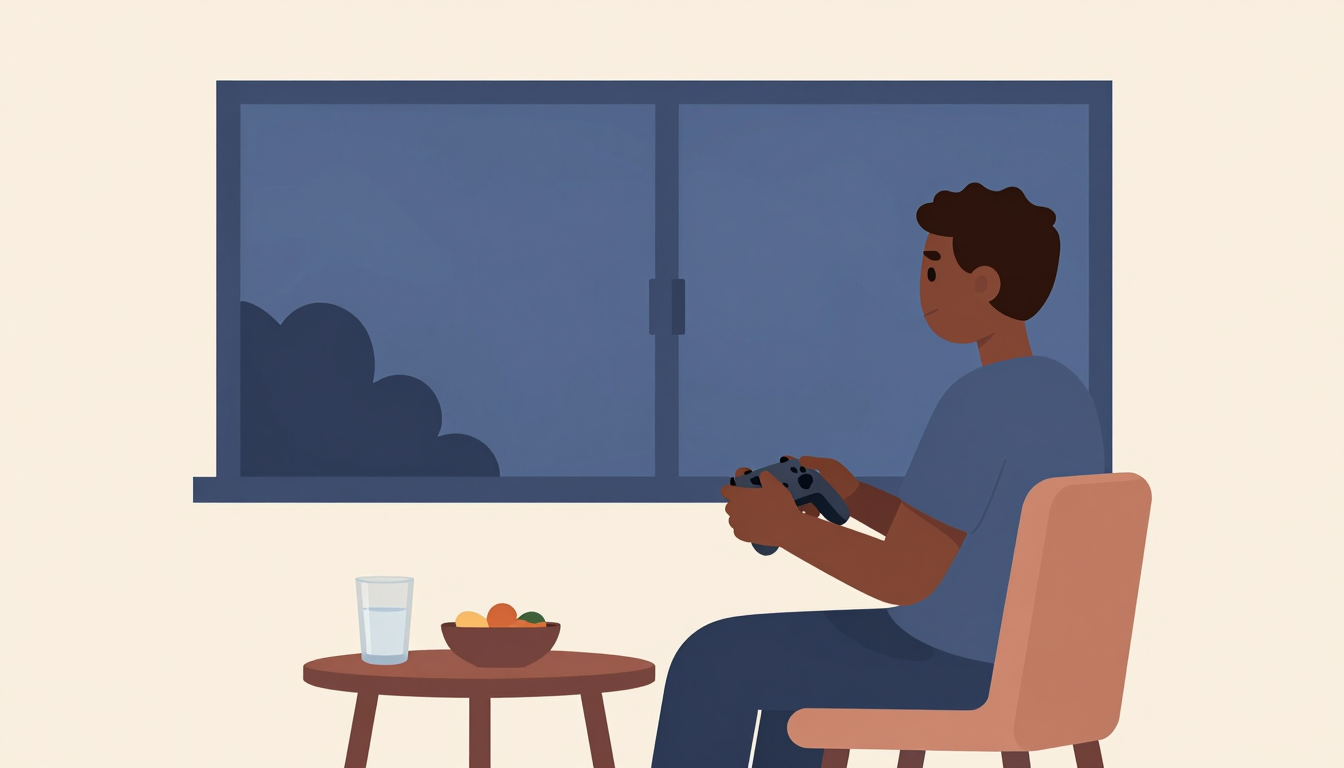
Have you ever had one of those almost eerie experiences while gaming? You open a game, stop noticing time passing, and eventually glance outside to discover that it is dark. Or you become so absorbed that hunger and thirst seem to disappear—until your stomach growls and you realize you have gone the entire day without eating or drinking.
Why can a game pull us in so completely? Two possible culprits are a distorted sense of time and diminished awareness of what our bodies are telling us.
Why time slips away
Psychologists use the term time perception to describe our subjective judgment of time passing. We can all recognize that time moves forward while experiencing its passage differently. When that perception becomes inaccurate, we can also lose touch with our own physical situation as the hours go by.
One study explored the difficulty people have estimating time while gaming. Researchers assigned one group to play a game for eight minutes and a comparison group to read for eight minutes. Compared with the readers, the participants who played a game felt that time had passed faster and estimated the elapsed time less accurately.
The researchers explained this result using attentional gate theory. In this account, paying attention to something opens an internal “gate,” but only a limited amount of attention can pass through it. Concentrating intensely on one thing leaves less attention available for everything else.
A stimulating, enjoyable game can take up nearly all that capacity. The gate is effectively open for the game, leaving little room for the attention we need to notice time passing. That helps explain how a session can stretch from morning until dark almost without our realizing it.
But losing track of the clock is only part of the experience. What makes hunger and sleepiness fade into the background, too?
When the body's signals become harder to notice
Playing a video game draws us into a virtual world. We identify with a character and can feel almost as though we have entered that world ourselves. Many third-person games can strengthen this identification, making it easier to become immersed.
In that state, awareness of bodily sensations—including hunger, thirst, fatigue and pain—can diminish. This immersion may even lead to changes in homeostatic functions, the processes that help maintain the body's internal balance, involving blood flow and skin temperature.
The article points to research by Swinkels and colleagues at Radboud University in the Netherlands as support for this reduced bodily awareness. They recruited 142 adults and asked them to rate how frequently they experienced bodily sensations such as hunger, pain and sleepiness while gaming. One example question asked how often they forgot to eat when playing.
Next, participants recalled a video game they had recently played on a computer. They were encouraged to remember the situation and their state during play as immersively as possible. Afterward, they wrote down the game's name and again rated the frequency of bodily sensations associated with gaming.
The researchers compared the ratings before and after this recollection. The reported result was a decline in hunger, pain, sleepiness and related sensations after participants recalled the game. These were self-reports surrounding a recollection exercise; the article interprets the finding as evidence that, during gaming, we become less aware of the signals our bodies send.
The concern, then, is that immersion can make physical feedback harder to notice, even when that feedback matters.
Bringing your attention back
Keeping track of time and sensing our physical state are essential to survival. Pain, hunger and even itching carry information about our health. If we ignore these signals and continue gaming while neglecting food and sleep, our health can suffer. In rare cases, that neglect can lead to death. Such events are uncommon, but the potential harm deserves attention.
How can we keep a compelling game from crowding out these basic needs? The article offers two practical responses.
Set reminders that interrupt immersion
The same immersive experience that makes a game absorbing can draw attention away from both time and the body. Deliberate reminders offer a way to interrupt that haze and become aware again of how we are spending our time and how we feel.
An alarm, for example, can prompt us to step back from the game and notice our current state. The aim is to create a moment in which attention returns to our lives and bodies.
Give the rest of your day a plan
The article also connects this neglect of time and bodily sensations with a lack of structure in daily life. When we do not know what we are going to do next, it can be easier to become absorbed in the game we are already playing.
Making a daily plan gives the activities beyond the current game a clearer place in the day. Following that plan consistently can help us make fuller use of our time and build a more meaningful daily life.
Frequently asked questions
Does gaming stop the body from sending hunger signals?
The article describes reduced awareness of bodily signals during immersion; it does not establish that the body stops generating them. Hunger, thirst, fatigue and pain may become harder to notice.
What did the 142-person bodily-awareness study measure?
Participants rated bodily sensations associated with gaming before and after recalling a recent computer game. The reported decline came from self-reports surrounding this recollection exercise, rather than direct observation of gameplay or physiological measurement.
What does the article suggest for noticing time and physical needs while gaming?
The article suggests reminders, such as alarms, to interrupt immersion and daily planning to give other activities a clearer place in the day. The supplied source reports no intervention study demonstrating the effectiveness of these recommendations.