Summary
A cat’s collar, a well-traveled violin and letters saved after university reveal the lives attached to familiar things. Nine accounts revisit what has stayed.
At a glance
The personal accounts in this article describe keeping old possessions because they preserve memories of companionship, care, friendship and recognition. A familiar television series and the self broaden the collection beyond physical keepsakes. Together, these nine stories present “traveling through time” as a metaphor for revisiting a past that can still offer strength.
Nine Ways to Travel Through Time
There is a statistic that puts the things each person throws away at an average of one kilogram a day. Look around: 5G is replacing 4G, new computers are taking over from older models, and this year’s clothes may be thrown out next year. Everything keeps getting replaced. It can seem as though nothing is irreplaceable.
Decluttering advice tells us to let go of anything that no longer sparks joy. But I struggle with that. Everything I own once made my heart leap a little. That makes it hard to say goodbye.
A few days ago, I asked what possessions had been with you the longest. Apparently, I’m not the only one with this particular “condition.” Reading more than 200 stories about things you couldn’t let go of felt like traveling through time, stepping into the unforgettable parts of your lives.
We can throw away old things, but can we throw away the lives attached to them? That’s much harder, isn’t it? Look closely at what we’ve kept. Our past is still here.
- A cat’s collar. The possession I’ve kept longest is a cat’s collar. It belonged to Xiaohan, a little sweetheart I looked after for six months. I had just graduated and was living alone in a rented apartment in the city. The two of us relied on each other.
My proudest achievement was getting her plump and well cared for. Hers, I like to think, was learning to recognize my footsteps. So many times, I would be coming home from work, still in the stairwell, and she would run down to rub against my legs. The happiness she brought was warm and lingering.
When I eventually left that city, I entrusted her to a friend and kept the collar. Her name is on the front. On the back, it says, “Let the world bustle; a cat’s leisurely days stretch on.” Whenever I see it, I feel grateful to Xiaohan for sharing that happy part of my life.
- A childhood notebook. When I was little, my grandparents wrote poems in this notebook, word by word, to introduce me to learning. I credit their companionship with what I could do so early: at eighteen months, I could count from one to one hundred and use Chinese idioms. By three, I recognized more than 3,000 Chinese characters, could read independently, and had memorized many poems, including the Ballad of Mulan.
At six, I was taken back to live with my busy parents and grew up with little supervision. These days, I’m thoroughly ordinary. My grandparents have long since passed away, but their love and the foundations they gave me remain. Whenever I see this little notebook, I remember what it felt like to be loved and accompanied so wholeheartedly.
- A television series. My longest-standing companion isn’t an object. It’s the series Wulin Waizhuan. When it was popular during my childhood, I wasn’t interested at first. I didn’t like martial-arts stories and assumed it was just another one. Then, one day, I was bored enough to watch the time-travel episode. It was so entertaining that I was hooked.
All these years later, I still put on a random episode while eating, going to bed, or playing games, and suddenly I feel much less alone. It kept me company through the times when I shut myself away and through every move to the next stage of school. Even now, when I can’t sleep, I put it on and soon drift off. I think I’ll always love it.
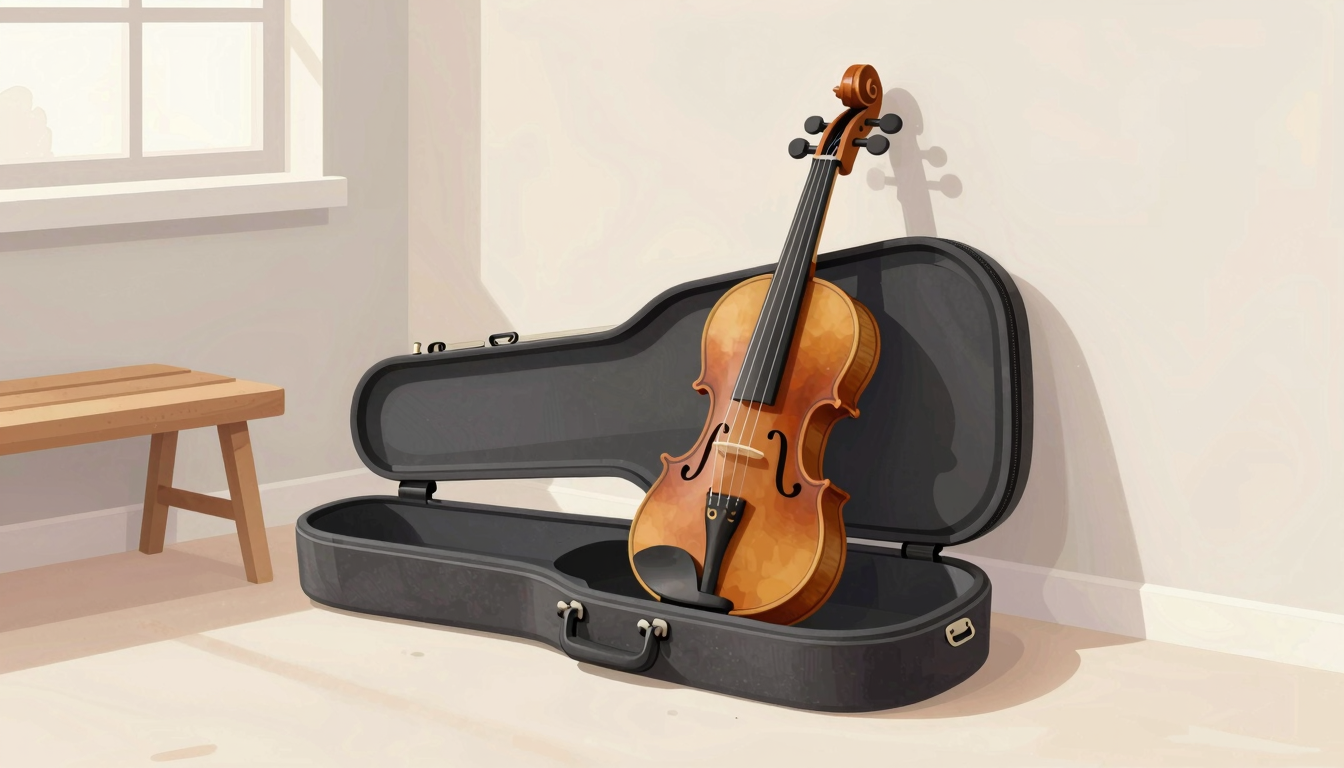
- A violin. Through boarding school in both junior and senior secondary school, and then studying abroad, this violin has always come with me. We’ve been together for nearly ten years. I started learning at three or four and began using this full-size instrument around fourth or fifth grade. I think my mother had only recently divorced then, so changing violins happened at a significant moment: the beginning of our new life. However long I’ve had this violin, that’s how long our new chapter has lasted.
Since taking the Grade 10 violin exam, I’ve practiced on and off. Sometimes I think about getting another violin, but I’ve never actually replaced this one. Playing may be the thing I’ve stuck with longest since childhood; even if I seriously decided to change instruments, I suspect I’d struggle to let it go. It holds so many dreams I haven’t yet been able to fulfill, the love of music I started with, and the people I carry in my heart.
Wherever I’m going, walking through a vast airport terminal with it on my back gives me the courage to make a home anywhere. In the photograph, the largest violin is the one I use now. The other two are smaller instruments from my childhood. They look like toys, and they’re adorable.
- A red cord bracelet. I always wear a red cord around my left wrist. It’s incredibly plain—the sort of thing a shopping mall might give away for free and you might still turn down. There’s a tiny yellow gourd charm on it that, unless you look closely, resembles a little piece of poop. Usually, my enthusiasm fades quickly, and I’m forever moving on to something new. I could count on my fingers how often I’ve worn the bracelets and earrings I bought before.
Yet somehow, this red cord has stayed on my wrist for nearly four years. If I take it off even briefly, I become distracted with worry that I’ll lose it. Giving it away is harder still. Once, when I had a boyfriend, I decided to give my favorite possession to my favorite person. Within a few hours, I shamelessly asked for it back.
Is there anything particularly special about it? I don’t think so. Perhaps it’s the inscription: “A lifetime of safety and peace.” Of all the good wishes you can offer someone, peace and safety are my favorite. I especially love the Chinese character pronounced “an,” which conveys peace and safety. When I was younger and sillier, I loved it because I associated its pronunciation, “an,” with “ai ni,” meaning “love you.”
Then there are the “seven wishes for peace”: peace in the morning, peace at noon, peace in the evening, peace on your travels, peace in an ordinary life, peace in poverty, and peace in wealth.
Four years really is a long time. Apart from my parents and close family, no one has kept me company for that long. As long as this cord is here, though, I feel secure. I hadn’t realized an object could stay with a person for so much of their life.
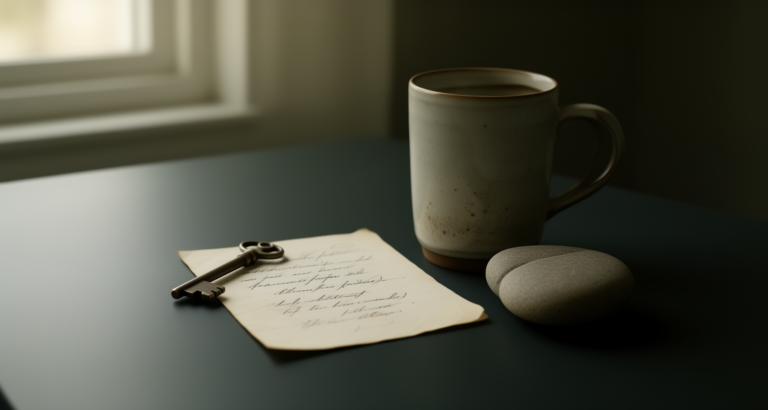
- Letters from friends. When I left university, I threw away almost everything except the necessities. But I took every single letter my friends had sent me. In an age when so much happens online, handwritten letters already feel like something from the distant past.
Often, I would write to one of these friends to tell her what was happening in my life. By the time she received the letter a week later, the sadness or happiness I’d described had already faded. Yet seeing the photographs she sent still made me happy. I can still remember, just as clearly, the little rush of excitement on the walk to the mailroom after class.
At university, I bought 400 envelopes, imagining I would use them little by little and have sent them all by graduation. In the end, I wrote only about ten letters. The internet made short work of my grand ritual. Still, seven years on, she is in my life. In the years ahead, there will still be a real name and address for me to write on my envelopes.
- A 100-yuan banknote. I have a 100-yuan note that is both very old and very new. Old, because I’ve kept it for more than six years, from my final year of junior secondary school to my third year of university. New, because I’ve never spent it. It was a reward for coming first in a Chinese-language exam, but that isn’t the whole story.
Many of us have known a dark stretch when nobody expected much of us and we couldn’t accept ourselves either. That was where I was. But in a place the light didn’t reach, there was someone gentle who told me I could do well. My teacher brought light into my life.
After moving on to the next stage of school, I went back to visit her. I told her I still had the 100 yuan, tucked beneath my desk. She had almost forgotten about it, but she was as kind as ever. I will never forget that quiet recognition.
Since then, we’ve grown into better adults. Looking back at how small I felt, I know how fortunate I was to meet the person who handed me that 100-yuan note with a gentle smile. I’m preparing for my teacher-qualification exam now. At a time like this, I miss you so much, teacher.
- An old photograph of my dog. The possession that has stayed with me longest is an old photograph of my dog. We spent thirteen years together, and my dog has been gone for eleven. Keeping the photograph makes me feel that my companion hasn’t really left.
As a child, I was afraid of the dark. If I had to go downstairs at night to fetch something, or upstairs to turn on a light, having that little white bundle beside me, tail wagging, made me feel brave. When the phone rang and we couldn’t hear it from inside the room, my dog would howl along with it: “Ooo.”
Later, when my dog was old, there was a time when even standing up was impossible. I thought this might be the end. Before leaving to attend school away from home, I said, “Hang in there. I want to see you when I come back.” Then, miraculously to me, my dog stood up and wagged that tail. Later still, my dog slipped away from home—as I imagined it, worried about dying in the house. Thankfully, we found our companion again.
These memories are distant and a little muddled, and I’ve gone on and on. All I really mean is that I miss my dog.
- Myself. Thinking it over, I’m someone who gets bored with old things and is always misplacing them. I’ve studied away from home for six years, and my family has moved three times. Very few possessions have stayed with me for long. The longest-standing one must be me. Of course I don’t need a reason to hold on to myself. Seventeen years together—this is the closest, most understanding “possession” I have. We’ve grown rather attached.
In my darkest days, when even my parents didn’t understand and so many friends turned their backs on me, I was the one who stayed and got me through. In the end, I’m my own last supporter, still waving the flag and cheering. I don’t have to look elsewhere for strength or wait for someone to bring a torch. I am my own light. Forget cherishing anything else: love yourself well. Learning to do that is a lifelong requirement.
A Final Thought
Behind every old possession we keep is a stretch of time we cannot quite let go of: the passionate, striving years of youth; long, lonely periods spent alone; and leisurely, unhurried days with family.
However much laughter or crying those years held, we would need a time machine to return to them. Our old possessions are little time machines of their own. They remind us that time may have swept through our lives, but it hasn’t erased them. They bring back a past that feels both hazy and startlingly clear, saying, “Look. All of this is your life.”
As reader @wanyi put it, old possessions preserve a period of our lives while continuing to give us strength to grow, both now and in the future.
So, amid all the calls to declutter, we feel drawn to look back and open these personal stores of memory. After all, carrying our past with us can help us step into the future, can’t it?
Frequently asked questions
What does traveling through time mean in this article?
Traveling through time is a metaphor for revisiting memories through familiar possessions and enduring companions. The nine accounts include physical keepsakes, a television series and the self.
Why did the contributor keep the cat’s collar?
The collar reminds the contributor of six happy months with Xiaohan while living alone after graduation. When the contributor left the city, the cat was entrusted to a friend.
Why was the teacher’s banknote never spent?
The contributor kept the 100-yuan reward because it represented a teacher’s belief in them during a difficult period. Its meaning went beyond coming first in a Chinese-language exam.