Summary
Time can drag while it is happening and seem brief afterward because attention and remembered landmarks contribute differently.
At a glance
Present boredom can draw attention to passing minutes, while a repetitive period leaves few distinct memories to reconstruct later. Small meaningful changes may give days clearer landmarks; no single memory rule explains all timing.
During pandemic restrictions, many people encountered an odd combination: a day at home seemed to take forever, yet a week could vanish before a teacher asked for a progress report. The deadline suddenly felt close, even though the individual hours had dragged.
There is no contradiction in remembering time differently from how you experienced it. Waiting through a quiet afternoon and looking back over that afternoon are different tasks. Attention matters while you are living it; the memories available afterward help shape what you make of the interval.
A long day can leave a short memory
When little is happening, you may keep noticing how slowly the next event arrives. Even a meal that stretches to an hour and a half can feel like something to get through. Your attention repeatedly returns to the passage of time, and there may be little else competing for it.
Later, the question changes. What happened today? If the day contained few distinct events, there may be little to separate it from yesterday. You can remember the boredom yet struggle to retrieve much that gives the period substance. In retrospect, it seems to have slipped away.
Memory therefore contributes to our sense of past duration. The events available in memory can give a period landmarks: a change of setting, a conversation, a task with a clear beginning and end. A day that offers more distinctions may feel fuller when recalled.
This does not mean that the brain literally counts stored events and converts the total into hours. Nor is every vivid memory a reliable indication of how long something lasted. The useful distinction is between the experience of time passing and the later reconstruction of a period from what remains accessible.
Routine can make those reconstructions harder. When the surroundings and activities are almost unchanged, one day can resemble another closely enough that their boundaries blur. An empty-looking week in memory may still have involved effort, ordinary responsibilities and real fatigue.
Timing involves more than one explanation
It is tempting to imagine a single internal clock that records every experience. Researchers instead study multiple timing processes across different tasks and timescales. The timing needed for coordinated movement is not identical to judging a wait or remembering the shape of a week. Work on time perception describes distributed neural involvement, rather than one location responsible for every kind of timing.
One proposal discussed in the original account is that changes in a recent memory trace could help an observer estimate a short interval. The idea is that information about something that just happened changes as time passes, and those changes could provide a cue to elapsed time.
That is a model to investigate, not a settled explanation that replaces all timing mechanisms. Memory strength can depend on more than age, and a proposal about brief intervals does not automatically explain the experience of several monotonous weeks. It is more accurate to say that memory offers important timing information than to say that time is nothing but memory.
Variety may give the day more landmarks
Variation can matter to mood as well as memory. A 2020 study by Aaron Heller and colleagues examined the association between real-world experiential diversity and positive affect. The work used location and emotional-experience data to investigate how everyday variety relates to feeling.
The distinction between association and cause matters. Such work should not be described as proof that confinement inevitably reduces happiness or that visiting more places will improve everyone's mood. People have different constraints, and mood may itself influence what they choose to do.
Still, it offers a useful prompt: where could a little meaningful variation fit into your actual circumstances? Travel is one possibility, but so are differences in what you notice, learn or make. Repeating familiar routines can be comforting; the aim is to add distinctions when days feel indistinguishable, rather than declare routine a problem.
Make a small journey at home
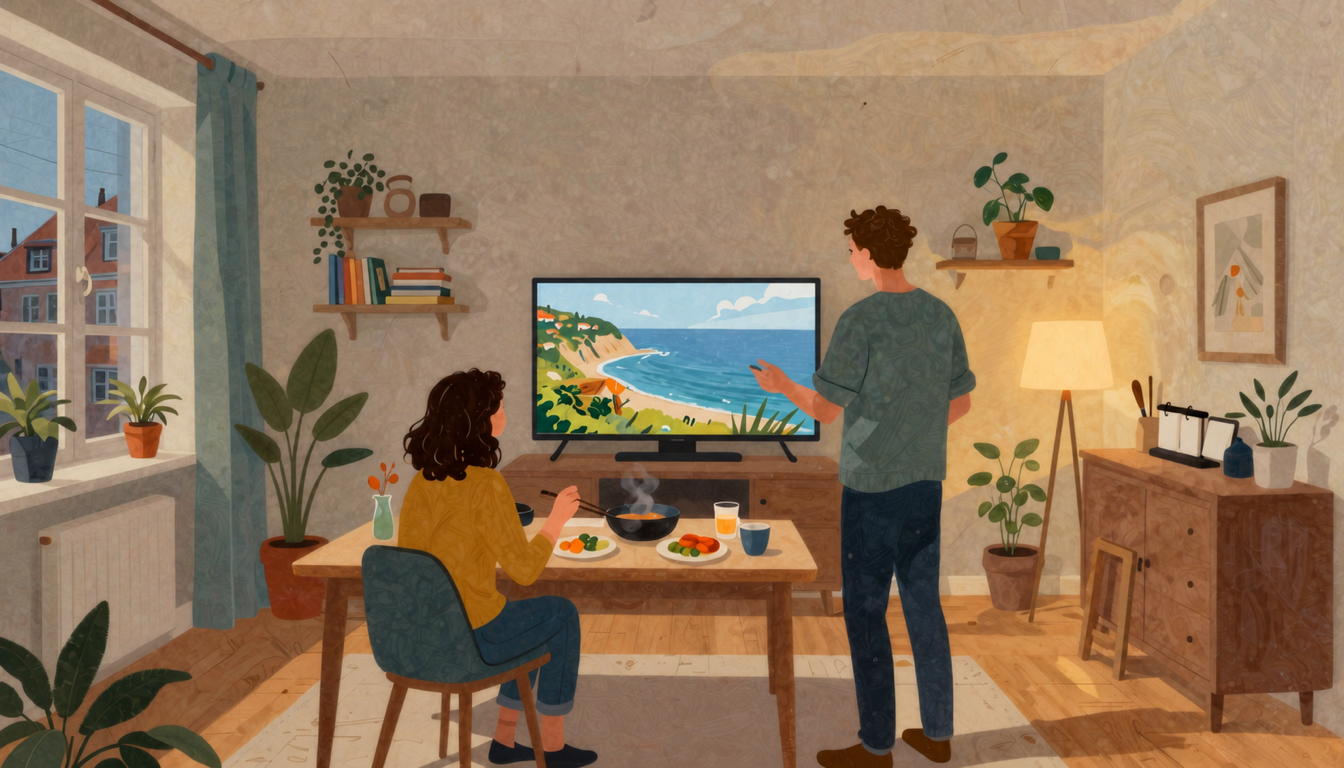
One vivid idea in the pandemic-era account is a virtual country evening. Choose a country and spend an evening learning about it through a documentary or podcast. Cook a relevant dish if that is practical, explore the colors of its flag, and keep notes in a spreadsheet about what you discover.
The details make the activity different from simply letting another evening disappear into an undifferentiated stream of content. Choosing, preparing and paying attention can give the experience a clearer shape. You might remember the food, a surprising fact, or the discussion afterward.
A weekly rhythm can provide something to anticipate, but the example is an invitation rather than a prescription. You can simplify it to suit your energy, interests and access. An elaborate project that adds pressure may not be the variation you need.
More broadly, notice what distinguishes today from the days around it. That need not mean producing an achievement every day. Rest can count as part of a life even when it leaves few dramatic memories. The point is to understand why slow hours and a quickly vanished week can coexist—and, where you wish, to give ordinary time a few more recognizable features.
Frequently asked questions
How can one day feel slow and fast?
Living through it and recalling it afterward involve different information.
Is time simply memory?
No. Memory contributes, but timing includes several processes and timescales.
Does visiting places cause happiness?
The cited study concerns an association, not a guarantee or proof about confinement.
What is virtual travel here?
A country-themed evening using documentaries, podcasts, food and notes to create a distinctive experience at home.