Summary
A preschool action-sequence experiment suggests children can show an animacy-related memory advantage. The puppy, beetle and block comparison also raises questions about perceived animacy and developmental origins.
At a glance
Children may remember actions involving animals better in some tasks, but a preschool finding does not establish an innate advantage or a rule for all learning.
Think back over your day. Which moments come to mind first: a conversation, an animal crossing your path, or the objects on your desk? People and other living things often feature prominently in what we remember. Psychologists call a tendency to remember animate material better than comparable inanimate material an animacy advantage.
The interesting developmental question is when this advantage appears. If preschool children also remember events involving animals better, that would show the pattern does not depend on decades of adult experience. It would still leave open how the pattern develops.
Why living things might receive extra attention
One explanation is the animacy-monitoring hypothesis. For our ancestors, noticing living things could matter for avoiding predators, finding food and responding to other people. A cognitive system especially responsive to animate things might therefore have been useful. On this account, heightened sensitivity could influence which events receive attention and become memorable.
That is an evolutionary proposal, rather than a demonstration of what caused a particular memory. Familiarity, interest and learning also deserve consideration. Children encounter people and animals from early life; their knowledge can develop quickly. An effect observed in a young child can be compatible with both biological preparedness and experience.
Adult research has found an animacy advantage across different memory tasks. A 2023 study of word learning, for example, examined it under different study conditions. Such work helps establish a phenomenon, but the existence of an advantage does not by itself settle its mechanism.
Remembering what happened to a puppy or a block
The developmental experiment discussed here comes from the supplied account of a 2020 study in Cognition. Its full original report was unavailable for this review, so the procedural details below should be read as that account's description.
The adult task tested memory for action sequences. Participants watched a demonstration involving either a gray-and-white puppy target or gray-and-white blocks. They were not initially told that they would later have to remember the demonstration.
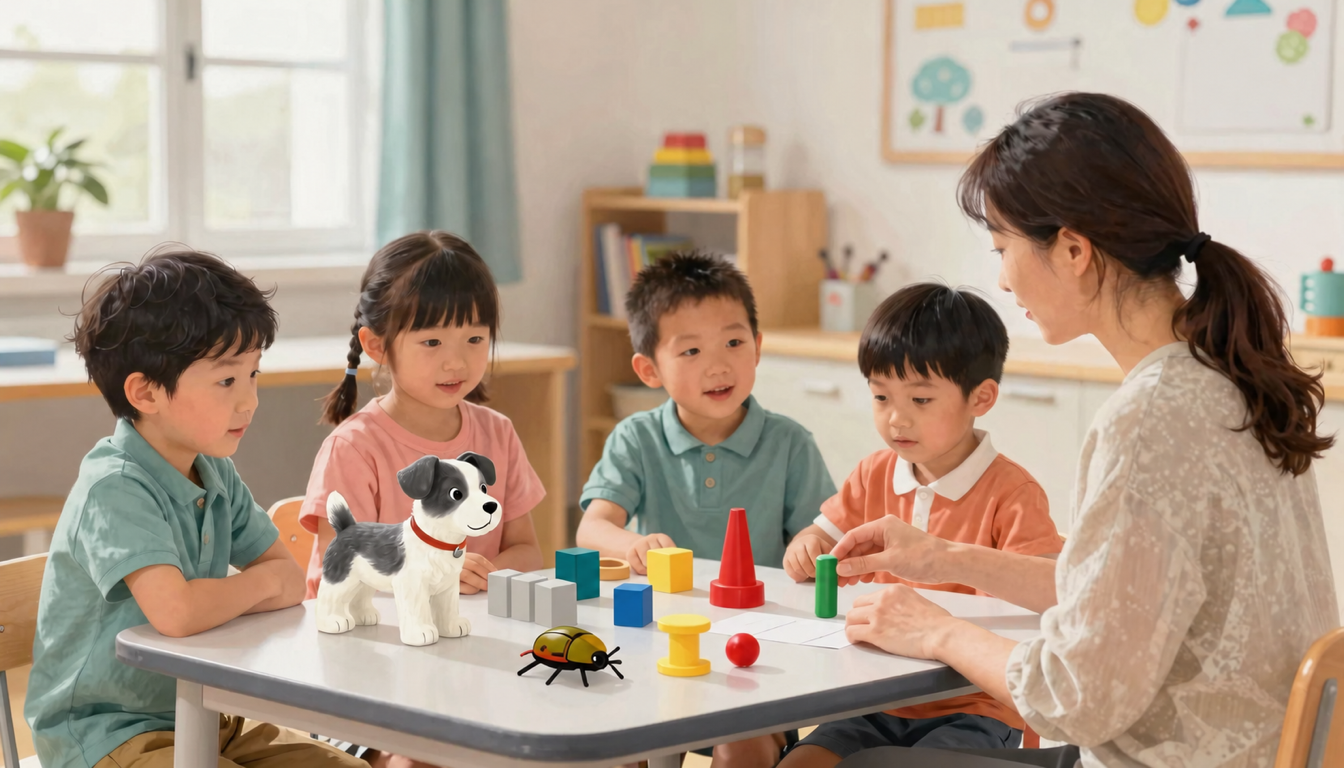
The sequence was concrete and deliberately unusual. The experimenter tapped the target three times with a green stick, moved it from the bottom to the top of a red tower and down another side, placed it on a blue block, and moved a yellow spool around it twice. Later, participants tried to reproduce what they had seen. Recall was reportedly better for the sequence involving the puppy.
This design goes beyond asking whether someone remembers the word “dog.” It asks whether the nature of a target affects memory for actions performed with it. The distinction matters: a memorable object and a well-remembered sequence are related questions, but they are not interchangeable.
How the children's task changed
The next experiment used children aged four to five. It added a beetle target alongside the puppy and blocks. Although a beetle and a puppy are both animals, the researchers considered the possibility that children would respond differently to them.
The instructions also changed. Children were told beforehand to remember the demonstration. Early testing produced very good recall across targets, creating a possible ceiling effect: when almost everyone does well, the task has little room to reveal differences.
The task was therefore made longer. Two additional sequences involved placing a wooden ring above the target, rotating it and removing it, and using the target to push a small red bead aside and back again. These details help explain why the child task cannot be treated as an exact copy of the adult procedure. The memory instructions and difficulty differed.
Children reportedly remembered the puppy-related actions better. The finding suggests that an animacy-related advantage can appear in early childhood, including in an event task rather than only in lists of items. It does not tell us that every child will show the same advantage in everyday learning.
A beetle is alive, but it may feel different from a puppy
The beetle result complicates a simple living-versus-nonliving division. Memory for actions involving it reportedly fell between the puppy and blocks. Biological classification alone therefore may not capture everything affecting recall.
A puppy can seem more expressive, responsive or familiar than a beetle. Those possibilities are explanations to investigate, not conclusions established by the comparison. The useful idea is that perceived animacy may vary by degree. Saying a puppy appears more animate does not mean a beetle is biologically less alive.
Other properties could also contribute to performance. Targets can differ in familiarity, visual interest or the associations they evoke. A comparison is most informative when those alternatives are considered rather than allowing the label “animate” to explain every difference automatically.
Early appearance does not establish an innate origin
Four or five years is early in a lifespan, but it is a substantial period of learning and accumulated experience. The children had already had years of encounters with people, animals, toys and demonstrations. Their performance cannot tell us what would have happened without those experiences.
The result is therefore narrower, and more useful, than a claim that children are born remembering animals better. An advantage was observed in the described task by preschool age. Establishing its origins would require further developmental evidence and careful comparisons of competing explanations.
There is also no basis here for turning every lesson into an animal story or assuming an animal picture guarantees learning. Remembering depends on the task, the material and how someone engages with it. Living things may receive a special place in memory, while the reasons for that place remain an open scientific question.
Frequently asked questions
What is the animacy advantage?
A tendency to remember animate material better than comparable inanimate material in a particular task.
Did the children perform the same task as adults?
The child task added a beetle, advance memory instructions and extra actions to reduce a ceiling effect.
Does a beetle count as less alive?
No. Perceived animacy can differ even when both targets are biologically living animals.
Does this prove the effect is innate?
No. Four-to-five-year-olds already have years of experience.