Summary
Bedtime delay may reflect a wish for personal time, lost time awareness, timing preferences or sleep difficulty. Identify the reason before choosing an adjustment.
At a glance
Bedtime procrastination is going to bed later than intended without an external reason. Immediate rewards and evening habits can contribute, while insomnia and clinical sleep scheduling need separate consideration. Use realistic plans and reduce the specific cues that extend the evening.
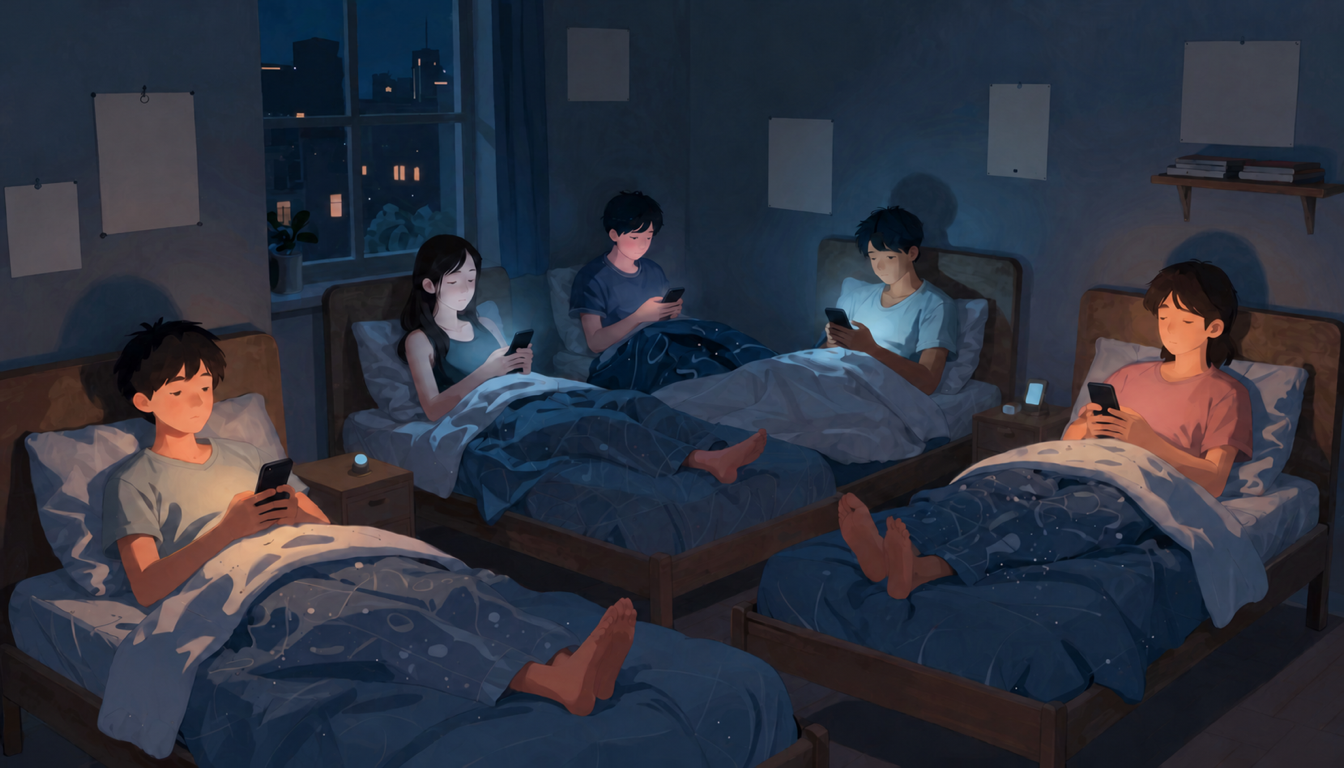
The overhead light goes out, but six smaller lights appear around the dormitory: phones, reading lamps and a flashlight. Everyone had promised to stop staying up late. By morning, the promises have become another rushed journey to an eight o’clock class, with breakfast missed and attention still somewhere near the pillow.
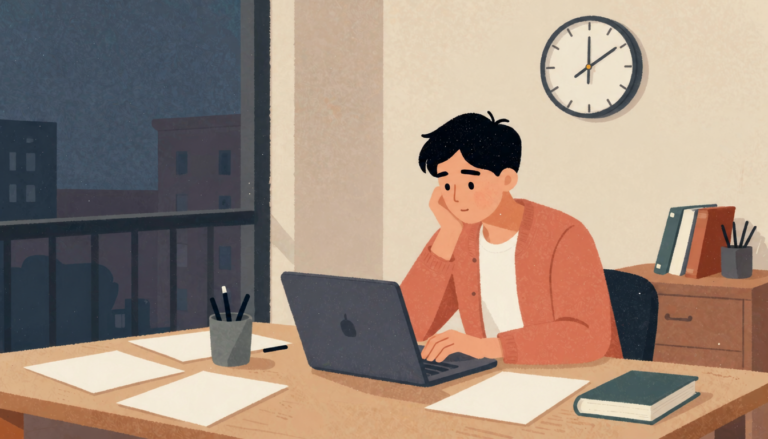
The familiar explanation is “just five more minutes.” Five becomes a video, another chapter or another round of a game, until the planned bedtime is far behind. The next day brings fatigue and the question of why a decision that seemed simple was so difficult to carry out.
Bedtime procrastination names that gap between an intended bedtime and what someone actually does. Understanding the gap requires more than calling the person undisciplined.
What counts as procrastinating at bedtime?
The term generally refers to going to bed later than intended when no external reason prevents it. A night shift, caregiving emergency or unavoidable work demand is different from freely continuing an activity despite intending to stop.
Difficulty falling asleep is different too. Someone can go to bed on time and remain awake for reasons that have little to do with procrastination. Distinguishing the experiences matters because they call for different responses.
An occasional late evening also differs from a pattern that repeatedly reduces the time available for sleep. Ask what you intended, what kept you awake and whether you regarded the delay as unnecessary. That gives a clearer picture than the clock time alone.
Different reasons can produce the same late hour
A qualitative study by Nauts and colleagues interviewed 17 frequent bedtime procrastinators without diagnosed sleep disorders or shift work. It identified three themes: deliberate procrastination, mindless procrastination and strategic delay. These were themes in people’s explanations, not three established medical diagnoses.
Deliberate delay involves recognizing the intended bedtime and choosing to continue anyway. For some people, only at bedtime do they finally feel that their time belongs to them again. After a day organized around work, study and other people’s needs, remaining awake can feel like holding on to a little freedom.
The activity itself may be less important than that feeling. Watching another video offers something immediate, while sleep seems to end the only unclaimed part of the day. Understanding the appeal does not remove the cost, but it reveals why a stricter bedtime alone may feel unsatisfying.
Mindless delay involves losing track of time while absorbed in an activity. Reading, crafts or writing can carry someone beyond bedtime without a deliberate decision to change the plan. Working late does not automatically fit this category; the point is that the person intended to stop and failed to notice the moment passing.
Strategic delay involves staying up because the person believes it will help them fall asleep more quickly. The interview study noted that this may involve undiagnosed insomnia. It therefore raises a classification question: a person using a strategy to manage difficulty sleeping is not necessarily postponing sleep without a reason.
These distinctions help identify what needs attention. They do not establish how common each form is in every population or prove that all forms have identical consequences.
Treatment-related sleep scheduling is a separate matter
Someone receiving treatment for insomnia may be advised to adjust time in bed. That is not equivalent to drifting into another hour of entertainment. It is part of a treatment plan with a different purpose and safeguards.
The National Heart, Lung, and Blood Institute describes cognitive behavioral therapy for insomnia as a treatment that may include changing time in bed and habits associated with sleep. A person with persistent difficulty sleeping should seek assessment rather than improvising severe sleep restriction from a general article.
Likewise, reading late to avoid anxious thoughts may be understandable without being the most helpful long-term response. If bedtime repeatedly brings distress or prolonged wakefulness, the underlying difficulty deserves attention. Calling everything procrastination can obscure it.
Why good intentions lose to immediate rewards
Self-regulation concerns acting in line with a goal when something else is attractive. At bedtime, the conflict between the temptation of immediate gratification and a long-term goal is unusually concrete: the game is available now, while the benefit of rest belongs partly to tomorrow.
The situation can become harder when you are tired, unsettled or still trying to obtain some enjoyment from the day. A room full of available entertainment also asks you to make the stopping decision repeatedly. One clear intention at dinner may not be enough to organize the whole evening.
This is more useful to examine as a pattern than as a fixed personal weakness. What happens just before the delay? Which activity is difficult to stop? Are you seeking enjoyment, avoiding a thought or simply missing the time? The answer points toward a different adjustment in each case.
Your preferred timing matters, but does not explain everything
People differ in their preferred sleep and waking times. Morning-oriented larks and evening-oriented owls may experience the same early schedule differently. Someone who tends to feel alert later can face a mismatch between their preferred timing and school or work obligations.
That mismatch should make us cautious about assuming that every late bedtime is a choice to disregard sleep. It also does not mean an evening preference inevitably produces procrastination. Sleep timing, obligations, habits and the intended bedtime all need consideration.
A useful goal is workable alignment: enough opportunity for sleep within the schedule you actually face. If a proposed bedtime is unrealistic, repeatedly failing to meet it provides little information beyond the need to reconsider the plan. If the timing seems workable but the phone keeps extending the evening, the environment may be a better place to intervene.
What the smartphone study found
In a 2020 study by Chung, An and Suh, 106 young adults were classified into higher- and lower-procrastination groups. They completed questionnaires, a seven-day sleep diary and forty-eight hours of time-use records.
The higher-procrastination group reported more depression, anxiety and insomnia, later sleep and waking, and a stronger evening preference. During the three hours before bed, they spent an average of about 61 minutes more on smartphones—approximately 451% more than the lower group. The absolute difference helps make sense of the dramatic percentage.
This was a comparison of existing groups, not an experiment assigning people to use a phone longer. It shows an association in that sample. It cannot establish that the phone alone caused the delay or that reducing use by a particular amount will produce the same benefit for everyone.
Change the part of the evening that keeps slipping
Make the transition into sleep easier to notice. If you lose track of time, choose a stopping cue before beginning an absorbing activity. If the phone is the main obstacle, put it somewhere that does not keep inviting another decision from the bed.
If you are protecting personal time, consider whether some of that time can exist earlier. The wish for an enjoyable part of the day deserves a place in the plan, rather than being treated as an enemy of sleep. A bedtime routine that feels only like deprivation may remain difficult to sustain.
Keep demanding study and entertainment from taking over the place where you intend to sleep. A quiet wind-down, a relaxation practice you find comfortable or a small reward for meeting a realistic goal may help. Treat these as experiments and notice the result instead of expecting one rule to solve every cause.
When lost sleep is involved, next-day difficulties deserve attention. Sleep deficiency is associated with reduced alertness and concentration; persistent fatigue or inability to sleep should not be explained away as laziness. The aim is to understand the delay well enough to protect rest without dismissing what the evening has been providing.
Frequently asked questions
Is all late sleeping procrastination?
No. External demands, preferred timing and insomnia require consideration.
What does mindless delay mean?
Losing track of time while the intention to go to bed remains unchanged.
Did the phone study prove causation?
No. It compared existing groups of young adults and reported associations.
Is prescribed sleep restriction procrastination?
No. Treatment-related scheduling serves a clinical purpose and should be guided appropriately.