Summary
Learned expectations, surprise, context and personal memory can all make a song worth replaying. These processes interact rather than forming a single formula for musical taste.
At a glance
Songs may become compelling when musical expectations and surprises work well for a listener, while attention, knowledge, bodily state and personal associations shape their value. Replaying a favorite is not automatically addiction, and brain-imaging findings do not establish a single cause.
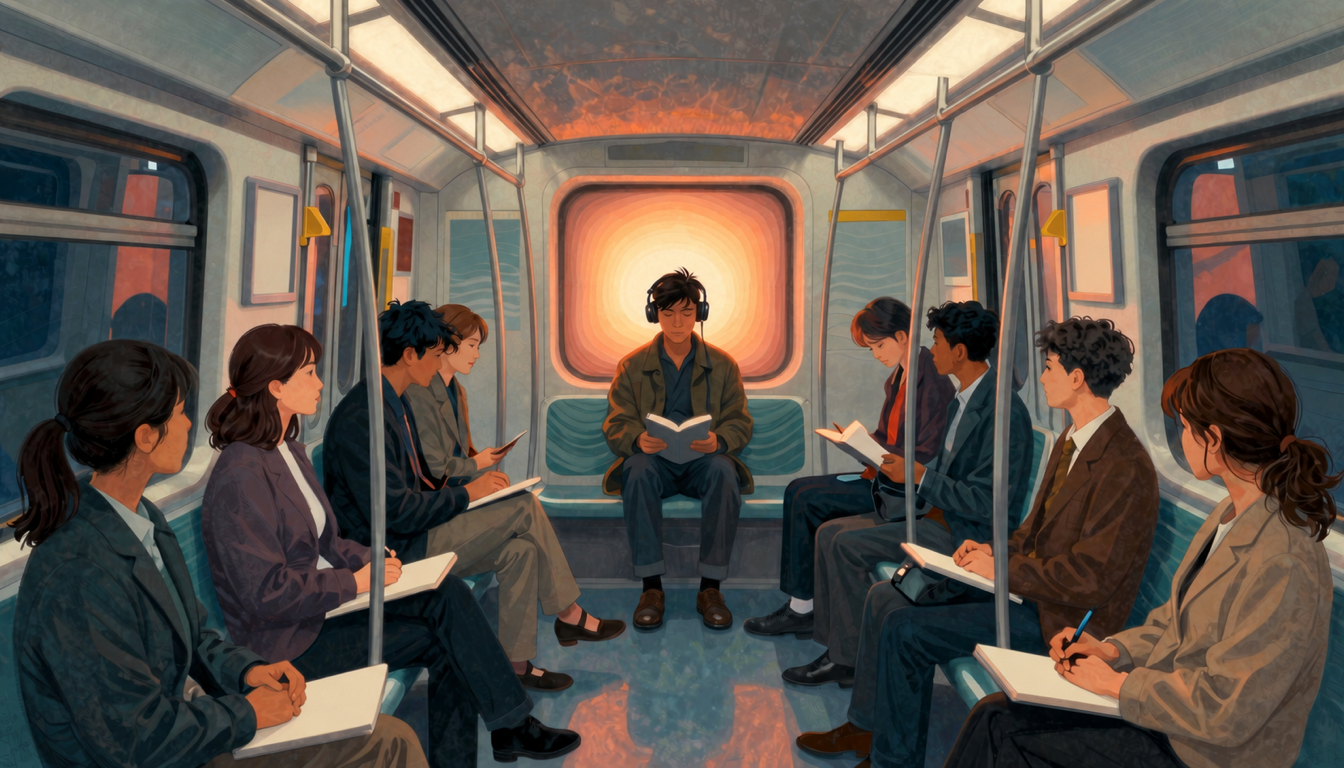
A song begins while you are scrolling on the train. You have never heard it before, but something in the introduction makes you look up. By the chorus, you have opened the music app to find its name. You save it, play it again and soon know exactly which moment you are waiting for.
Why does this song become a favorite while another stays untouched in the same playlist? The answer involves more than a catchy tune. Listening history, expectation, attention, bodily state and memory can all shape what the music means and how strongly you want to return to it.
These processes do not turn taste into a formula. They help explain why music can feel immediately compelling and deeply personal at the same time.
Listening teaches you what might come next
You do not need to read music to develop expectations about it. Repeated listening exposes you to patterns in rhythm, melody, harmony and structure. Some become familiar within a song; others reflect years of hearing particular styles.
Statistical-learning accounts describe how people can absorb regularities without deliberately studying them. Musical enculturation is the broader process through which experience with a musical culture shapes what sounds familiar or likely. A listener raised on Mandarin pop, for example, may recognize its conventions without knowing the names of the chords.
Probabilistic-prediction accounts build on that learning. When something new begins, familiar patterns help generate expectations about where it may go. You might anticipate a return to the chorus, a resolution or a particular rhythmic arrival without consciously making a prediction.
That anticipation is not a single conscious guess with a right or wrong answer. Several possible continuations can feel more or less likely. A song can satisfy one expectation while changing another.
Your listening history therefore matters. A musical turn that surprises one person may feel conventional to someone immersed in the style. What initially sounds unfamiliar can also become easier to follow with repeated listening.
Pleasure can depend on both certainty and surprise
Two useful concepts separate what happens before a note or chord from what happens when it arrives. Uncertainty concerns how difficult it is to anticipate the continuation. Surprise concerns how unexpected the actual continuation is.
In Cheung and colleagues’ 2019 study, a statistical model analyzed more than 80,000 pop-song chords. Pleasure was associated with the interaction between uncertainty and surprise: an unexpected chord could be pleasing after a predictable passage, while a relatively expected chord could be pleasing when the preceding context was uncertain. Activity in auditory cortex, hippocampus and amygdala also related to that interaction.
A useful listening example is a familiar chorus following an unsettled transition. The sense of arrival may be part of its appeal. In another song, a confident, predictable setup makes an unusual turn enjoyable. These are illustrations, rather than a claim that every composer is deliberately following one neurological recipe.
Predictability is not always boring, and complexity is not always rewarding. You may want a well-known song precisely because you can anticipate every word. Another day, an unfamiliar sound is the attraction. The balance depends on the listener and the occasion, not just on the number of unexpected chords.
The study also should not be translated into a claim that every surprising chord instantly releases dopamine. Brain activity measured during a task and a direct measurement of a neurotransmitter are different kinds of evidence. Musical reward is a wider subject than a single response to surprise.
Several processes contribute to the experience
Hearing and enjoying a song draw on interacting systems. Auditory processing helps us represent the sounds and their relationships. Memory lets current patterns connect with earlier listening. Emotion and valuation influence whether we want to keep listening.
It is tempting to assign each brain area one job: this region remembers, that region is surprised, another decides to press repeat. That picture is too tidy. Brain regions participate in multiple processes, and activity in a region does not reveal one particular thought.
The more useful idea is cooperation. What you hear is evaluated in relation to what you know, what you expect and how it feels. The same acoustic passage does not need to produce the same response in every listener.
Nadal and Skov’s sensory valuation account describes aesthetic experience in terms of sensory information interacting with reward-related valuation. Their framework includes the influence of executive, semantic and physiological regulation systems. It is a proposed account of aesthetic experience, rather than a literal scorecard inside the head.
In ordinary terms, your experience of the music includes its meaning, the attention you give it and your current state. Those influences help explain why a technically impressive song may leave you cold while another becomes hard to leave alone.
Why the same song can feel different tomorrow
Knowledge changes the context of listening. Discovering that a singer you admire performs a track may make you more interested. A lyric can gain weight when you understand what it refers to. Neither response means you have stopped hearing the sound; the sound is being heard with additional meaning.
Attention matters too. A track playing while you work may pass largely unnoticed. Listening closely, following the lyrics or waiting for a particular transition can reveal something you missed. Focus does not guarantee liking, but it changes what you are available to notice.
Bodily and emotional state can alter the experience again. Rock music might feel too forceful when you are already tense, yet welcome during exercise. That is an example of context, not a fixed rule that anxious people dislike rock or that the same track motivates everyone at the gym.
This helps make sense of the feeling that a song found you at exactly the right moment. It may have met a particular combination of mood, attention and experience. Hearing it later can bring back something of that moment, even when the circumstances have changed.
A favorite also need not become more enjoyable without limit. Repetition may reveal new details or provide a familiar pleasure; eventually, you may want a break. Pressing repeat is an ordinary preference, not by itself evidence of an addiction.
When a song becomes part of your own story
Some music carries more than structural enjoyment. Sometimes a song can recall a place, relationship or period in your life. Its value includes the person you were when you heard it and what was happening around you.
The default mode network is often discussed in relation to self-generated thought, autobiographical memory and thinking about oneself. It is not simply a part of the brain that switches on whenever the outside world disappears.
In a 2014 study of music preference and functional connectivity, researchers examined how preferred music related to patterns of brain-network connectivity. The findings provide evidence that personal preference is associated with how networks interact. They do not let us read a specific memory from a scan or establish that this activity causes someone to replay a favorite song.
You may know exactly what a song recalls. In other cases, the connection feels less precise: a mood, a sense of recognition or words that fit something you have struggled to express. Those experiences can be meaningful without being treated as proof of a buried memory or a message from outside yourself.
There is no need to choose between musical structure and emotional resonance. A song can draw you in through a rhythmic or harmonic turn and become important through what happens while you listen to it. Later, both can be present when the introduction begins.
The next time you reach for repeat, notice which part you want to hear again. It might be the surprise, the familiar arrival, the lyric or the memory attached to it. The science offers several ways to understand that pull, while leaving room for the simple fact that this is the song you want now.
Frequently asked questions
Do I need music theory to predict a song?
No. Listening experience can teach regularities without formal study.
Is surprising music always more enjoyable?
No. Surprise interacts with prior uncertainty, and listeners and contexts differ.
Why can a song feel different at another time?
Attention, knowledge, mood and bodily state can change the context in which you hear it.
Does favorite-music brain activity prove a hidden memory?
No. Network associations cannot identify a specific memory or establish why someone presses repeat.