Summary
BDD is more than dissatisfaction with appearance: consuming preoccupation, repetitive responses and significant distress or disruption call for professional assessment. Care can include adapted CBT and prescribed medication.
At a glance
Appearance anxiety may indicate BDD when slight or unobservable perceived flaws generate persistent preoccupation, repetitive behavior and significant distress or impairment. Ordinary dissatisfaction alone is insufficient; a clinician must consider other explanations, including eating disorders where relevant.
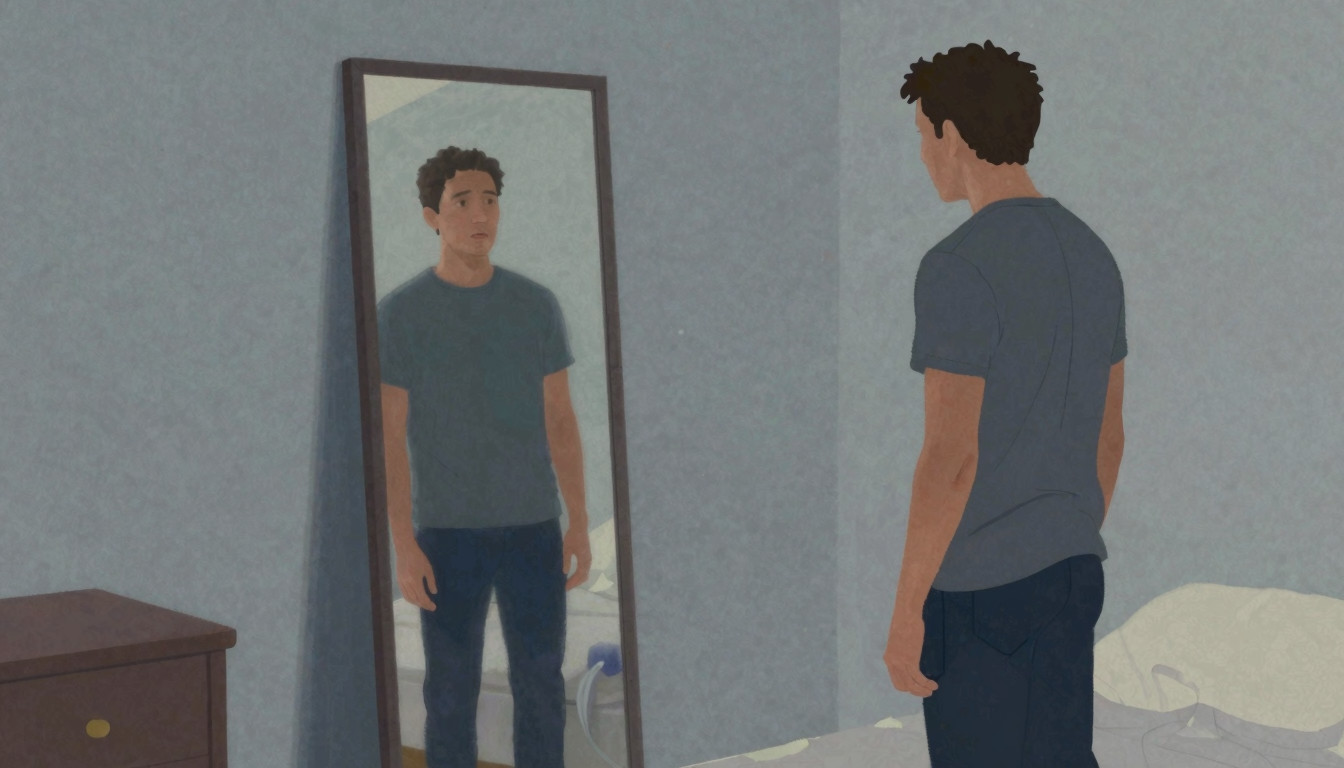
After double-eyelid surgery, Xiao A began to feel that one eye was larger than the other. The clinic saw no need for further correction, and a doctor at a public hospital found no obvious abnormality. Yet each time Xiao A checked the mirror, the difference seemed more alarming. Other features began to look swollen too.
In this vignette from the original Chinese article, repeated appointments and time off for procedures did not bring lasting reassurance. Xiao A eventually received a diagnosis of body dysmorphic disorder. The example captures a painful mismatch: someone can feel certain that their appearance is wrong while other people cannot see the defect that seems so obvious to them.
The distress deserves care. It is not vanity, and telling someone to stop worrying rarely addresses what is keeping the worry alive.
What body dysmorphic disorder involves
Body dysmorphic disorder, or BDD, belongs to the group of obsessive-compulsive and related disorders. A person becomes preoccupied with perceived appearance flaws that are slight or not observable to others, and responds with repetitive behaviors or mental acts. Clinically significant distress or disruption to life is part of the diagnosis. The International OCD Foundation's diagnostic guidance also explains that clinicians must distinguish relevant weight concerns from an eating disorder.
The pattern may involve repeated checking, concealment, comparison or attempts to obtain reassurance. Someone might look in a mirror again and again, use makeup to hide a perceived defect, or seek another procedure because the previous one has not produced the hoped-for relief. The particular action matters less than the consuming cycle it becomes part of.
For Xiao A, another examination did not settle the question. The next reflection reopened it. That is why an apparently reassuring answer about appearance may have little lasting effect: the person is still caught in a way of attending to and interpreting what they see.
Not everyone has the same degree of insight. Some can consider that their perception might be inaccurate. Others remain convinced the defect is real and that other people are noticing it. Current diagnostic language describes levels of insight, including absent insight or delusional beliefs, rather than treating this as a completely separate disorder. Strong conviction is not, by itself, evidence that a person is aggressive.
A clinician evaluates the pattern, its effects and other possible explanations. A scan is not the test that confirms BDD. Assessment questionnaires may help organize information, but they also do not replace clinical judgment.
How it differs from ordinary appearance anxiety
Disliking a photograph or thinking about a cosmetic change does not automatically mean someone has BDD. Everyday curiosity about your reflection or what other people think is not, on its own, a clinical sign. Appearance concerns become more concerning when they repeatedly demand attention, drive difficult-to-resist responses and interfere with living.
The Chinese article uses a “main quest” metaphor. A student may care about appearance while still organizing life around studying, friendships and plans for the future. A worker may feel self-conscious without having every day revolve around correcting a feature. With a consuming appearance preoccupation, getting a supposedly normal face or body can start to displace those other aims.
That metaphor is useful for describing lost freedom. It is not a requirement that a person abandon all work or study before they deserve help. Someone may keep meeting responsibilities while experiencing intense distress. Nor does another person's disagreement about appearance establish a diagnosis.
Consider the article's second illustration, Xiao B. After university entrance examinations, Xiao B decides to exercise, then continues alongside studying. The activity fits within a wider life. In the contrasting version, Xiao B repeatedly seeks extreme fat-loss methods and liposuction, misses university for procedures and still feels unable to reach the desired result afterward.
The contrast concerns the pattern's rigidity and consequences, rather than exercise being good and all appearance changes being bad. Persistent weight or shape worries can also involve an eating disorder or another condition. A professional needs to assess that distinction rather than infer BDD from a wish to lose weight.
You do not need to decide on the correct label before asking for help. If appearance concerns are painful, difficult to interrupt or changing how you participate in life, that is worth discussing with a qualified professional.
Why the concern can become so convincing
There is no single established explanation for BDD. The NHS overview identifies possible contributions from family history and experiences such as childhood teasing, bullying or abuse. These are possible risk factors, not a checklist that explains every person's condition.
Researchers have also examined how people process visual information. The International OCD Foundation's neurobiology review describes evidence of differences in the balance between attention to details and the overall visual picture. It also emphasizes that findings are not entirely consistent and that many questions about cause remain unresolved.
This offers a more careful way to understand the mirror example. A tiny feature can take up disproportionate mental space, while the whole face becomes harder to appreciate. It would be too strong to conclude that one damaged pathway explains everyone with BDD, or that an individual brain image can show why a particular person is distressed.
The source also presents two cognitive and learning-based explanations. One concerns information processing: a thought such as “my face is uneven” draws attention to a feature; later checking keeps returning to that feature; the resulting mental picture feels increasingly convincing. This is a proposed way of understanding a cycle, rather than proof that one passing thought causes the disorder.
The other concerns the importance attached to appearance through experience. Praise for a particular body shape can make that shape feel central to being accepted. Mockery or humiliation can make appearance feel like a source of danger. The article discusses these as possible learning histories, not experiences that every person with BDD must have had.
Neither account assigns blame. A person did not choose the distress, and identifying a possible contributing experience does not mean it is the only explanation. The useful question for care is also what keeps the current pattern going and what can help change it.
Treatment addresses the distress and the cycle
BDD can improve with treatment. Options include cognitive behavioral therapy adapted to BDD and, where appropriate, prescribed medication such as a selective serotonin reuptake inhibitor. CBT commonly includes exposure and response prevention: working gradually with feared situations and changing habitual responses. The appropriate approach depends on clinical assessment and symptom severity. The NHS treatment guidance explains these options.
A further appearance procedure does not necessarily address the preoccupation that made the feature feel intolerable. In the Xiao A and Xiao B illustrations, physical changes do not provide the lasting resolution the person seeks. That is a reason to discuss the concern itself with a mental health professional, including when cosmetic treatment has become frequent or urgent.
Seeking help need not mean agreeing in advance that every perception is wrong. Someone can begin with what they already know: the worry is exhausting, the checking takes time, or the search for another correction is interrupting life. Those difficulties are legitimate reasons to ask for care.
How to support someone without joining the checking cycle
A friend may notice that conversations keep returning to the same feature, that appointments are multiplying, or that the person is missing activities they used to value. These observations can help start a caring conversation. They do not make the friend responsible for diagnosing the condition.
Focus on the distress and its effects. A hypothetical response might be: “This sounds exhausting, and I can see how much of your day it is taking. Could we look for someone who understands body-image concerns?” That offers support without endorsing the belief that the feature needs correction.
It can be tempting to argue at length about whether a nose is crooked or to keep supplying reassurance. But the relationship can become organized around another appearance inspection. Listen without ridicule, avoid agreeing that a perceived flaw is unacceptable, and encourage professional support. The International OCD Foundation's family guidance offers further help with approaching treatment conversations.
Support also means respecting the person beyond appearance. Keep room for their interests, abilities and ordinary companionship. A difficult conversation about care should not turn every future encounter into a discussion of symptoms.
If someone may harm themselves or cannot stay safe, seek urgent local emergency or crisis support. Serious distress needs a response even when the appearance concern is hard for others to understand.
A wider view of beauty can support recovery
The article ends by questioning narrow beauty standards. Different cultures and periods have valued different appearances. Treating one face or body type as the measure of everyone else encourages comparison and leaves little room for ordinary variation.
That is a worthwhile social change, but it is not a substitute for BDD treatment. A person struggling with the disorder has not simply failed to learn that beauty is diverse. Asking them to recognize their uniqueness may be kind in intention and still leave the central distress untouched.
We can make everyday life less appearance-focused without promising that a change in attitude will cure a condition. Reduce casual judgments about bodies. Notice what a person does, cares about and brings to relationships. Allow a face to be part of a whole person, rather than the problem around which their whole life must revolve.
Frequently asked questions
Does disliking my appearance mean I have BDD?
No. Ordinary dissatisfaction alone does not establish BDD; the pattern of preoccupation, repetitive responses and distress or impairment matters.
Does a brain scan diagnose BDD?
No. Diagnosis relies on clinical assessment; research imaging findings do not confirm the diagnosis in an individual.
Can a friend diagnose it from conversations?
No. Friends can notice distress and disruption and encourage assessment without assigning a diagnosis.
What treatments can help?
Adapted CBT, often including exposure and response prevention, and prescribed medication are options guided by clinical assessment.
Are broader beauty standards a cure?
No. A less judgmental environment can support someone but does not replace BDD treatment.