Summary
Meaningful belongings can provide security, continuity and a tangible connection with personal history. Shared decisions help families make room while respecting the owner’s memories and autonomy.
At a glance
Older adults may keep things for practical reassurance, identity, memories and familiarity. Ask about those meanings, agree on treasured items and usable space, and consider optional photographs. Severe accumulation that compromises living areas requires a separate assessment.
“This can still be used.” “It isn’t broken.” In a family conversation about clearing a home, those sentences can sound like an argument about rubbish. Often, they carry a different argument: about security, memory and who gets to decide what remains in someone’s life.
A younger relative may see crowded shelves and an opportunity to make a room easier to use. An older person may see years of careful saving, reminders of people they love and the familiar arrangement that makes the room their own. Understanding that difference can change how a family approaches the work.
Attachment alone does not establish a disorder. Nor does emotional meaning make every accumulation harmless. The American Psychiatric Association’s description of hoarding disorder emphasizes persistent difficulty discarding, distress and accumulation that compromises living spaces. Keeping treasured possessions and needing clinical help are questions to consider separately from age or a preference for a full home.
Stored things can stand for security
Someone who lived through material scarcity may have learned to keep anything that could be useful again. A working container, spare fabric or cupboard of supplies can represent preparedness. What looks excessive to a person accustomed to easy replacement may feel like sensible protection against an uncertain future.
That history offers a possible explanation, not a diagnosis. You cannot infer trauma from a crowded cupboard, or conclude that all older people save things for the same reason. Ask what the supply means to the person who keeps it. The reassurance may be real even when the family needs to discuss how much can be stored safely.
The source describes making full use of things as a survival philosophy as well as a virtue. Throwing away an object that still works can therefore feel wasteful in a moral sense. Simply saying that a replacement is cheap may not answer the concern. The disagreement may involve different experiences of what it takes to remain secure.
An object can carry a chapter of a life
Some possessions matter because they connect a person with an earlier version of themselves. A medal can recall professional achievement. A child’s first gift can preserve the feeling of being loved at a particular moment. The object’s market price tells you little about that value.
Russell Belk’s idea of the extended self offers a useful way to understand this: possessions can form part of how people express and recognize their identity. It is an interpretive framework, rather than evidence that every keepsake has the same psychological function. For a particular person, an ordinary-looking object may make an important part of their life tangible.
This is why objects that hold personal history can be difficult to discard. A family member may hear “We do not need this” as “That part of your life does not matter.” The intention may be practical, but the loss can feel personal.
Familiar placement matters too. Knowing where things belong can make a home feel manageable. That does not mean every older adult struggles to learn something new, or that a full room is always comforting. It means that rearranging a familiar environment can affect more than its appearance. A person may lose the small, dependable cues through which they navigate daily life.
Why clearing out can feel like deprivation
The source uses the image of a museum of a life. An adult child sees objects to remove; the owner sees a collection through which their history remains present. Clearing the shelves without agreement can feel like dismantling that collection and taking away authority at the same time.
Erik Erikson’s account of later life places importance on looking back and making sense of one’s life. That lens helps explain why being listened to can matter during a discussion about belongings. It does not mean that resistance to decluttering proves a person has failed to accept their past.
The practical conflict is often between two understandable aims. Children want a safer, more comfortable home for their parents. Parents want continuity, respect and a say in their surroundings. Neither aim disappears when the other is acknowledged. A workable plan needs to address both.
Listen first, then decide together
“What story goes with this?” is a better opening than “Why are you keeping this?” Give the person time to explain the medal, the gift or the familiar household item. Listening may reveal which objects are irreplaceable and which have remained mostly through habit.
A conversation like this is not automatically narrative therapy, and it need not make attachment vanish. Its immediate value is simpler: the family learns what it is being asked to preserve. The older person also has a chance to feel heard before being asked to make a decision.
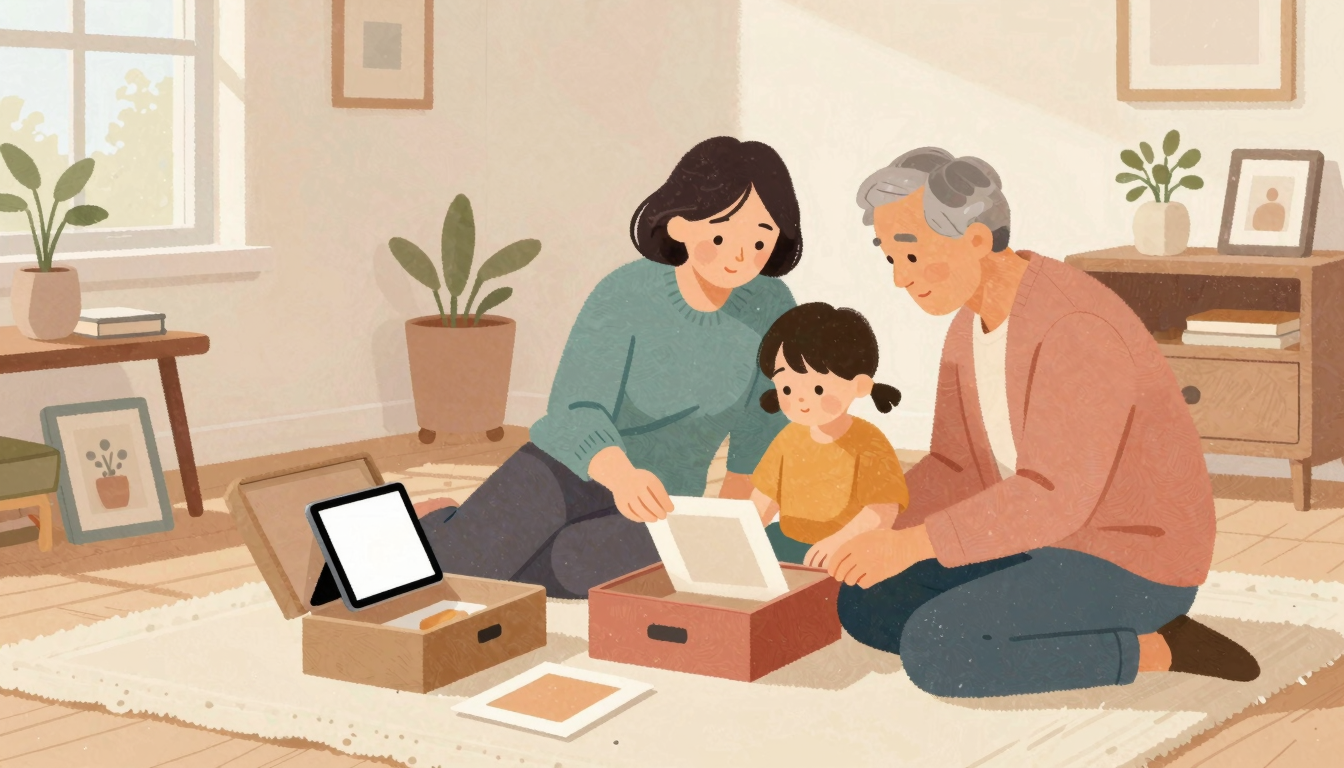
Then shift from a general demand to throw things away toward a shared plan for what to keep. Identify the most important belongings and agree on a display area, shelf or memory box. The size and location should be discussed with the person whose possessions they are. Joint curation can restore a sense of control while making space more usable.
Selected photographs can help when the owner wants a record of an item without keeping the item itself. An electronic album might include old photographs, pictures of larger belongings and a few notes about their stories. It can be useful to preserve a memory in a form that is easier to share.
A photograph is an option, not a substitute someone else can impose. It may not replace the texture, use or emotional presence of the original. Nor does making a digital album establish that cognition, depression or loneliness will improve. The source’s broader claim about digital technology does not justify promising those outcomes from photographing keepsakes.
Safety remains a concrete part of the conversation. The CDC recommends removing things that people could trip over. Focus discussion on an actual blocked route or hazard rather than treating every treasured object as a problem. Respect for memories and clear walking space can belong in the same plan.
The aim is a home where the person’s past still has a place and their present life is easier to live. Getting there may require patience, several conversations and different decisions about different objects. Seeing the meaning behind “I can’t part with it” gives that work a better starting point.
Frequently asked questions
Does keeping old things mean someone has hoarding disorder?
No. Emotional attachment alone is insufficient; persistent difficulty discarding, distress and compromised living spaces matter.
Why can clearing a parent’s home cause conflict?
Removal may feel like losing memories and authority while relatives are focused on safety and comfort.
How can we begin the conversation?
Ask about the story behind an object, listen, then agree together on what to retain and where it will go.
Can photos replace meaningful objects?
They can preserve a record when the owner wants that option, but may not replace the original’s emotional presence.