Summary
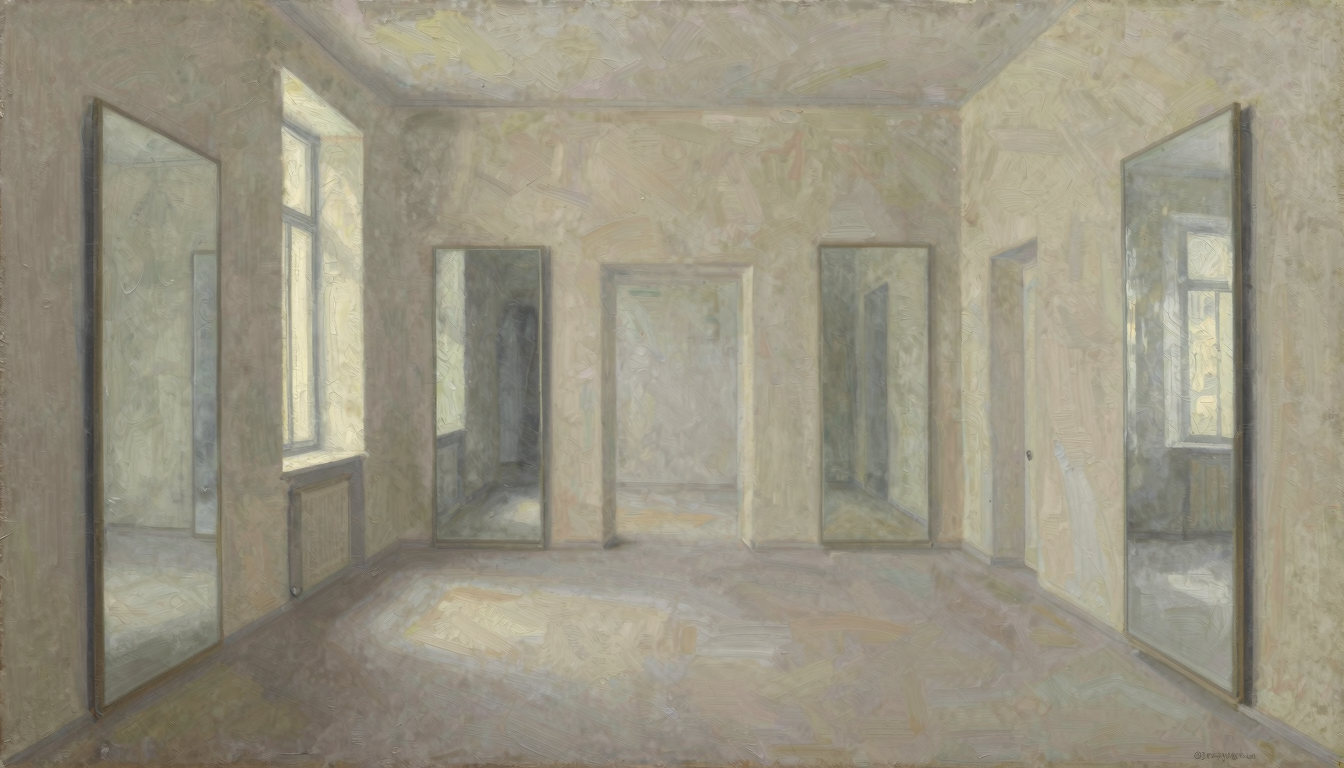
A room full of mirrors may symbolize uncertainty about which image, opinion, or version of yourself deserves your trust. Many reflections can offer perspective, but they can also make one thing appear to have many independent witnesses. The dream cannot establish that someone is deceptive or that your judgment is wrong. Notice whether the mirrors agree, whether you recognize yourself, and whether you can find the actual doorway. Those details can help distinguish useful reflection from a loop of checking the same impression.
At a glance
A room full of mirrors may symbolize uncertainty about which image, opinion, or version of yourself deserves your trust. Many reflections can offer perspective, but they can also make one thing appear to have many independent witnesses. The dream cannot establish that someone is deceptive or that your judgment is wrong. Notice whether the mirrors agree, whether you recognize yourself, and whether you can find the actual doorway. Those details can help distinguish useful reflection from a loop of checking the same impression.
Separates recognition from orientation and multiple reflections from independent confirmation.
Record reflected image and doorway; choose one concern; check an independent fact; clarify one decision.
Many reflections can still come from one thing
A mirror shows an image rather than the object itself. A room full of mirrors multiplies that relationship: the same person or scene may return from several directions. Symbolically, this can suggest a life surrounded by impressions, comparisons, or responses. Its relevance to trust lies in the difference between seeing something repeatedly and having several independent reasons to believe it.
If the reflections agree, the room may suggest coherence or the wish to feel recognizable from every angle. If they seem distorted, it may suggest uncertainty about how you appear or what others see. Neither detail identifies dishonesty in a real person. The mirror's image is a possible metaphor, not a report about someone else's intentions.
The room also sets a boundary. You are inside a place where reflection dominates the view. That can make the image feel enclosing even if nothing threatens you. Notice whether there is an ordinary wall, window, or doorway you can orient yourself by. A fixed feature may offer a contrast to the repeated image: something you can approach rather than only inspect.
Trust in yourself and trust in an image
Recognizing your reflection may suggest familiarity with the person you believe yourself to be. Seeing several versions may invite reflection on roles that do not feel fully aligned. A work persona, a family role, and a private preference can coexist without one being false. The symbolic question may be whether you can recognize your own choice beneath those different presentations.
If you cannot identify which reflection is yours, the scene may suggest reliance on other people's responses to tell you who you are. This is a tentative reading. Do not turn it into a diagnosis or assume that the dream has revealed a hidden defect. Ask what decision has become difficult to make without checking how it will look.
A spiritual reflection can treat the mirrors as an invitation to examine appearance and awareness. Looking honestly can feel clarifying; looking endlessly can become a substitute for acting. The scene does not establish a supernatural visitor, a portal, or a warning. Its usefulness comes from the remembered relationship between the person, the reflections, and the room.
A clear reflection and a confusing route are different problems
You may see yourself clearly yet struggle to find the exit. In that case, the symbolic concern may be orientation rather than identity. Knowing how you appear does not necessarily tell you where to go. If you can leave easily but dislike the reflection, the concern may be presentation rather than being trapped.
Do not add broken glass or an unfamiliar figure when the dream showed neither. An intact mirror, a damaged mirror, and a mirror displaying someone else would create different scenes. A room full of ordinary reflections does not require a story of danger merely because the repetition felt unusual.
Likewise, count only if the number mattered in the dream. Many mirrors can convey multiplication without carrying a fixed numerical message. The more useful detail is what changes from one reflection to the next and what remains physically present.
The room is a setting, not a universal verdict
Rooms in dreams may symbolize a bounded area of life: privacy, work, rest, or a place you are allowed to occupy. Their contents change the question. A room filled with mirrors emphasizes reflected images; one filled with clothing may emphasize roles or presentation; one filled with water may emphasize containment or feeling immersed.
Other full-room images should be read as their own scenes. Animals, insects, people, and objects do not become mirror symbols because they share an enclosed setting. You can compare how the space feels crowded or usable while keeping the contents distinct. This prevents one broad idea of being overwhelmed from erasing the actual dream.
A house can broaden the setting beyond a single room. A problem confined to one room may feel local; a house filled throughout may feel pervasive. That is a possible spatial distinction, not evidence that the dream predicts a household event.
Relationships: repeated reassurance and direct contact
In relationships, the mirror room may suggest a loop of looking for reassurance. You might revisit a message, replay a conversation, and ask several people about the same detail. Symbolically, those reflections can seem like separate confirmations while still resting on one original exchange. Check what is directly known and what is an interpretation repeated in different places.
One useful action is to clarify a specific point with the person involved when appropriate. The aim is a concrete agreement, not an interrogation based on the dream. Trust becomes easier to assess through consistent actions and explicit expectations than through multiplying guesses about an image.
Work: feedback that adds perspective
At work, many mirrors may symbolize being visible from several roles or receiving several kinds of feedback. That can feel useful when each view adds something distinct. It can feel confusing when you reshape the same task for every imagined observer. Check whether the feedback describes different facts or repeats a shared assumption.
Choose one criterion that matters for the actual work and ask for a concrete example. Symbolically, this gives the room an orienting feature. You can use several perspectives without making every reflection a separate command about who you must be.
Money: appearances and independent reasons
Around money, a mirror-filled room may suggest the appeal of a picture repeatedly presented as convincing. Familiarity can feel like confirmation, especially when a claim appears in several places. The dream itself does not identify a scam or certify an opportunity. Check the origin of the information and the terms you can actually verify.
One next action is to find an independent basis for a decision rather than another repetition of the same account. The symbolic distinction is between a reflected appearance and the underlying arrangement. Use actual costs, commitments, and documented conditions to decide what is workable.
Family and home: roles you can recognize
At home, the mirrors may symbolize several versions of the role others expect you to hold. A familiar face can remain visible while the room offers no quiet place to stop looking. Check whether the current issue concerns a real household responsibility or the wish to satisfy every imagined view of it.
One action is to agree on a specific division of a task. The scene may help distinguish belonging from constant self-inspection: you can have a place in a family without ensuring that every reflection looks the same. The agreement, rather than the dream, establishes what each person will do.
A repeated message that needed one direct question
Consider Priya, who is uncertain about a work arrangement after several brief exchanges with colleagues. In a dream, she stands in a room whose walls reflect her from different angles. She recognizes herself, but every turn returns another view of the same posture. A plain doorway remains visible at one side.
She reads the scene as a possible image of repeated impressions rather than new information. She lists what each colleague actually said and notices that several comments came from the same unresolved announcement. She asks the project owner one direct question about her responsibilities and writes down the agreed scope.
The answer clarifies which task belongs to her and which remains undecided. She spends less time rereading the earlier messages and begins the part she can complete. The ordinary result comes from a direct question and a clear agreement. The mirrors helped frame the distinction; they did not expose anyone's hidden intentions.
Find one thing you can orient yourself by
Record what the mirrors showed, whether the images agreed, and whether you could identify a real doorway. Leave missing details unknown. Then choose the closest concern: self-recognition, multiple opinions, or difficulty deciding where to go.
Check one fact that does not depend on repeating the same impression. A room full of mirrors may offer a useful image of trust when appearances multiply. You do not have to reject every reflection; you need to know what it reflects and what gives you a place to stand.
Frequently asked questions
What does a room full of mirrors mean in a dream?
A room of mirrors may symbolize multiplied impressions of yourself or a situation. Clear agreement can suggest coherence; confusing reflections can suggest uncertainty about which view to trust. Notice whether you recognize yourself and can find a real doorway. The scene does not establish deception.
What do mirrors symbolize or represent in dreams?
Mirrors may symbolize self-recognition, appearance, comparison or the difference between an image and what it reflects. Seeing a mirror does not by itself reveal a hidden truth. The reflected content and your response make the possible reading more specific.
What do rooms represent in dreams?
A room may symbolize a bounded part of life, such as privacy, work or rest. Its contents and accessibility shape the question. A single room and an entire house are different scales; neither has a universal fixed verdict.
What does a room or house full of spiders mean in a dream?
A room full of spiders may symbolize an enclosed space that feels difficult to use or filled with unwanted activity, depending on your own response. A house full of spiders can extend that feeling across a larger setting. Neither predicts danger, and neither should be substituted for a mirror-filled room.
What does a room or house full of snakes mean in a dream?
A room full of snakes may suggest movement, caution or a difficult shared space if those feelings were present. A house full of snakes can broaden the sense of encroachment across several areas. Snakes do not prove betrayal, and this separate scene does not determine the meaning of mirrors.
What does a room or house full of bugs mean in a dream?
A room full of bugs may symbolize numerous small disturbances or an unwanted occupation of space. A house full of bugs can suggest that the discomfort feels widespread rather than local. The reading depends on the remembered scene, not a prediction of infestation or illness.
What does a room or house full of water mean in a dream?
A room full of water may symbolize immersion or a question about containment. A house full of water can broaden that image to the home as a whole. Calm water and a threatening rise differ; do not invent a flood or disaster when neither appeared.
What does a house full of people mean in a dream?
A house full of people may symbolize company, belonging or a lack of private space. Welcome gathering and unwanted crowding invite different reflections. The dream does not establish what any particular person intends.
What does a room or house full of cats mean in a dream?
A room full of cats may suggest a space shared with many independent presences, or simply animals you welcome. A house full of cats can extend that sense across the household. Notice comfort, care demands or crowding rather than assigning a universal omen.
What does a house full of rats mean in a dream?
A house full of rats may symbolize a setting that feels difficult to protect or share if the animals disturbed you. It does not establish dishonesty, illness or a future loss. Keep this tentative reading separate from the mirror scene.
What does a house full of animals mean in a dream?
Many animals may symbolize diverse needs or lively activity within a shared place. Identify which animals appeared and whether you welcomed them; a generic verdict would erase those differences. The dream is not a factual report about the household.
What does a room full of cicada nests mean in a dream?
Cicada nests may suggest waiting, shelter or accumulated signs of activity if those associations fit the scene. The image does not establish a fixed cycle, deadline or event. Record what you saw without turning the nests into an automatic prediction.
What does a room full of clothes mean in a dream?
Clothes may symbolize roles, presentation or the practical things you keep for daily life. A room full of them can suggest many possible presentations or storage that has become difficult to use. That differs from mirrors, which emphasize reflected images rather than items you can choose and wear.
Can a mirror dream tell me whether someone is trustworthy?
No. It may offer a metaphor for uncertainty or repeated impressions, but it cannot identify another person’s intentions. Assess trust through actual actions, agreements and information whose origin you understand.