Summary
Dreaming about a dead parrot may symbolize an ended conversation, a familiar voice becoming absent, or words that no longer feel alive or useful. It can also evoke a change in companionship or a repeated message losing its meaning. These are conditional symbolic readings, not predictions of death. Notice what has become silent, how you respond, and whether the scene feels like loss, relief, or an unresolved ending.
At a glance
Dreaming about a dead parrot may symbolize an ended conversation, a familiar voice becoming absent, or words that no longer feel alive or useful. It can also evoke a change in companionship or a repeated message losing its meaning. These are conditional symbolic readings, not predictions of death. Notice what has become silent, how you respond, and whether the scene feels like loss, relief, or an unresolved ending.
Separates absence of voice from repetition that no longer responds.
Record silence setting response ending; revise one exchange with a concrete question.
The parrot's association with voice and repetition gives this image a particular emphasis. A dead bird is not simply a louder warning. It may make you consider the difference between hearing familiar words and experiencing a living exchange that can answer, change, and respond.
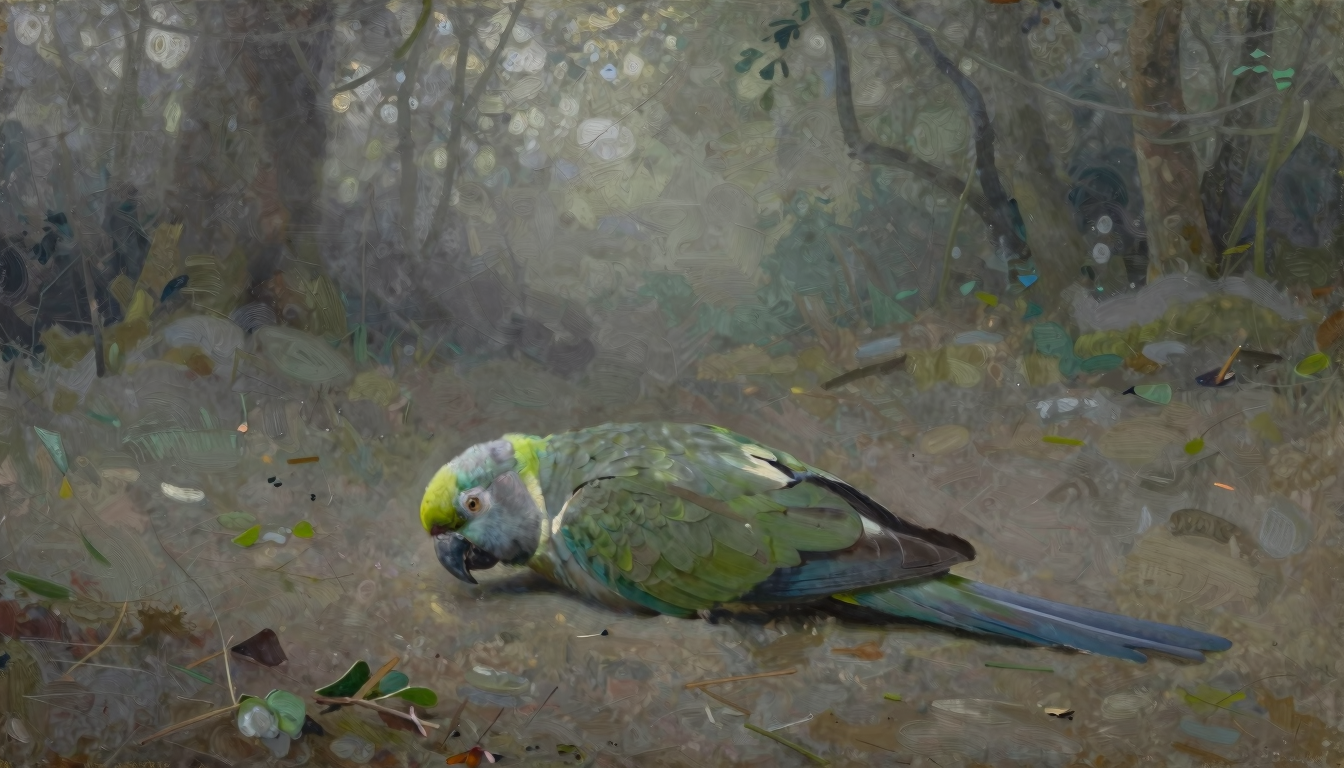
Seeing a dead parrot
Seeing a dead parrot may symbolize recognition that something once lively has stopped participating in your life. That could be a conversation, a familiar routine, a source of company, or a phrase you used to rely on.
If you discover the bird unexpectedly, the dream may emphasize recognition arriving before you know what to do. If its death was already understood within the scene, the image may concern living with an ending rather than anticipating one.
Your response helps shape the reading. Sadness can point toward attachment; relief may suggest release from a repetition that had become burdensome. Confusion may emphasize the gap between knowing an arrangement has changed and understanding its practical consequences.
None of these responses proves that an external loss is approaching. The image can be meaningful through what it brings into focus now, without becoming a forecast.
A voice that no longer answers
A parrot can evoke familiar sounds, repeated words, or a presence known through its voice. Its silence may symbolize an exchange that has become one-sided. You may still remember what was said while finding that the words no longer answer your present circumstances.
This can be a reading about communication rather than literal bereavement. An old reassurance may have lost its usefulness, a routine response may no longer fit, or a conversation may have ended without a clear acknowledgment.
The distinction is between silence that leaves room and silence that leaves uncertainty. A peaceful ending may feel complete; an unexplained absence can feel unfinished. Remember whether anyone in the dream recognizes the change or continues acting as though nothing has happened.
A useful symbolic question is what a living answer would now require. It may involve a different question, an honest acknowledgment, or accepting that an old exchange cannot simply be repeated back into life.
Repeated words and lost meaning
The dead parrot may symbolize language that survives after its usefulness has ended. A saying, promise, or habitual explanation can remain familiar while no longer helping anyone understand the situation.
If the dream feels strangely ordinary, this reading may be especially relevant. Something important can become easy to overlook when the same words are used for it every time. The image may sharpen the difference between repetition and responsiveness.
A repeated phrase is not automatically false. It may once have served a real purpose. The question is whether it still describes what is happening or whether familiarity has replaced attention.
The favorable possibility is release from an empty script. The difficult possibility is recognizing that an exchange needs a more honest form. Neither requires accusing someone of deception solely because of the dream.
Companionship and an altered routine
If you associate parrots with pets or daily company, the image may concern a familiar presence no longer available in the same way. The meaning can be close to ordinary attachment: the sound, activity, and small interactions that give a place its character.
If you have known an actual animal loss, the dream may draw on that memory. A symbolic interpretation need not replace your personal experience. The recognizable details may matter more than a general meaning attached to the species.
An unfamiliar dead parrot can evoke a different kind of absence, such as a routine that seemed lively but no longer brings connection. Consider whether the scene concerns a particular bond or a broader way of organizing your days.
The useful distinction is between honoring what mattered and expecting it to remain unchanged. An ending can deserve acknowledgment even when the next arrangement has not yet become clear.
The setting and your response
The location may show where silence or an ending becomes noticeable. A private room can bring attention to daily companionship; a shared place may emphasize an absence others have not acknowledged. Keep the actual setting rather than adding a cage, house, or road that was not present.
Your actions matter as much as the discovery. Turning away may evoke difficulty facing a change. Caring for the bird's remains may emphasize acknowledgment or respect. Trying to obtain a response can suggest a wish to continue an exchange whose form has ended.
These are possible distinctions, not instructions to reproduce the dream. An image of care can be useful through the attention it invites, without requiring a ritual or a particular physical action.
Notice the ending too. Does the scene become quieter, remain unresolved, or move toward another activity? The dream's sequence may help you distinguish a completed farewell from uncertainty that still needs ordinary clarification.
Spiritual reflection without a death forecast
Spiritually, a dead parrot may invite reflection on truthful speech, attentive listening, or releasing words that no longer support your conduct. A familiar voice can offer comfort, yet meaningful guidance also needs to respond to the present.
The image may feel sobering because it makes an ending visible. That does not make it a curse, punishment, or message predicting someone's death. No specific divine intention or required religious action is established here.
A more useful reflection may concern how you speak after an old explanation stops working. Honest silence, a revised promise, or a different conversation can have value when automatic repetition no longer does.
Where the image meets ordinary life
Work and shared communication
An ended voice may resemble a regular update that repeats the same explanation while a problem remains unresolved. Check what information the group actually needs, then ask one concrete question about the next step. Symbolically, a living exchange offers an answer that can change what happens next.
Relationships and unfinished conversations
The image may evoke a bond where familiar phrases no longer create understanding. Check whether you have explained your present need rather than relying on an old response, then choose a suitable time for one direct conversation. Do not treat the dream as evidence that another person intends to leave.
Home and familiar routines
A quiet familiar place may resemble a routine that has changed after someone moved, a schedule shifted, or an activity ended. Check which practical part of the day now lacks company or structure, then arrange one small replacement activity. Acknowledging the old rhythm can coexist with making the new one usable.
Personal commitments and resources
A repeated promise may no longer fit your time or available resources. Check what you can actually sustain, then revise one commitment honestly. The symbolic issue may be the life remaining in your words, not whether repeating them more firmly will make them workable.
A modern example of replacing an empty response
Nadia coordinated a small reading group. Attendance had changed, but she kept sending the same invitation and saying the original schedule would work once everyone settled down. In her dream, she found a dead parrot beside the chair where people usually gathered, and waited for it to repeat a familiar greeting.
She connected the absent voice with an invitation that no longer received a useful answer. Her judgment was that repeating the old message avoided a practical question about when the remaining members could meet.
She asked each member for one available evening and proposed a shorter monthly session. Four people agreed, and the next meeting took place on the revised date. The ordinary result came from making the conversation responsive again instead of expecting familiar wording to restore an old routine.
Reading what has become silent
Record what you actually see, the setting, your response, and what happens afterward. Separate remembered loss from anticipated loss, and an ended exchange from words that remain present but no longer help.
A dead parrot dream may help you consider where familiarity has outlasted a living response. Its useful question can be what needs acknowledgment, revision, or release so that your next words fit the life you are actually living.
Frequently asked questions
What does seeing a dead parrot in a dream mean?
It may symbolize recognition of an ended conversation absent companion or familiar response that no longer works. Your reaction and the sequence matter.
What does a dead parrot dream symbolize?
The image may emphasize silence lost responsiveness or repetition without meaning. It does not predict death.
What is the dream meaning of a dead parrot?
It may invite acknowledgment or revision of something once lively. Separate personal memories from a universal interpretation.
Does this dream mean someone will die?
No death forecast follows from the image. It may concern communication routine or a remembered loss rather than an approaching event.
Can the image concern repeated words?
Yes as a possible symbolic reading: familiar language may remain after its usefulness has ended. Check whether the words still answer the present situation.
What if the parrot reminds me of a real pet?
Personal attachment and actual memories may be the closest context. A general symbolic reading need not replace those details.
What spiritual reflection can the image invite?
It may invite attention to truthful speech listening and release of empty repetition. No curse punishment or required ritual is established.