Summary
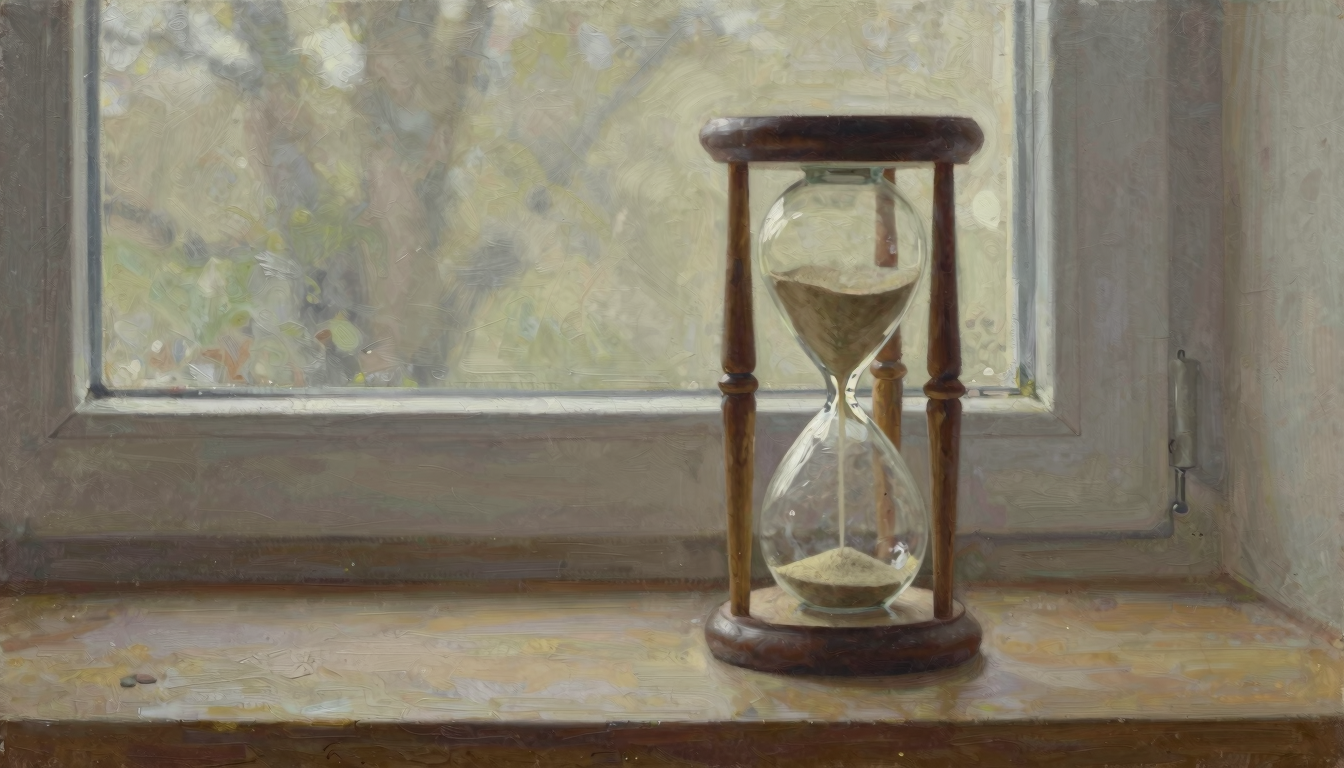
Dreaming about an hourglass may symbolize awareness of passing time, a chosen period of attention, or the feeling that a phase has a beginning and an end. The meaning depends on whether you calmly watch the sand, rush to finish, turn the glass over, or find its flow stopped. An hourglass makes duration visible; it does not reveal how much time you have left, predict death, or establish a real deadline.
At a glance
Dreaming about an hourglass may symbolize awareness of passing time, a chosen period of attention, or the feeling that a phase has a beginning and an end. The meaning depends on whether you calmly watch the sand, rush to finish, turn the glass over, or find its flow stopped. An hourglass makes duration visible; it does not reveal how much time you have left, predict death, or establish a real deadline.
Visible passage finite interval and restart distinct from glass water ritual or mirror.
Recall pace action transition; clarify one interval purpose.
The image can hold patience and urgency together. Sand moving steadily may feel reassuring when you trust the pace and unsettling when you expect to control every moment. Your action toward the glass helps distinguish those readings.
Time made visible
An hourglass separates what has passed from what remains while keeping both in view. Symbolically, that can emphasize a finite interval rather than time as an endless abstraction. The dream may draw attention to how you experience a particular period.
An encouraging reading may concern giving something enough time to develop. A cautionary reading may concern watching the remaining sand so closely that you neglect the activity the interval is meant to serve. Neither proves that your waking pace is right or wrong.
A large amount of sand may evoke room to continue; a small amount may evoke an approaching endpoint. These are impressions within the scene, not measurements of your future. The dream cannot calculate a date or tell you that an opportunity will disappear.
The practical distinction is between acknowledging an interval and treating it as a prophecy. A visible ending can help organize attention without requiring fear of everything that ends.
Watching calmly and waiting for completion
Calmly watching sand fall may evoke patience, acceptance of a sequence, or confidence that a process can continue without constant interference. The steady movement can make waiting feel purposeful rather than empty.
If you wait for the last grains before beginning something else, the dream may emphasize respecting an agreed order. If you remain seated after the sand ends, it may emphasize a transition that has become available but has not yet been taken.
Watching alongside someone may evoke a shared interval. Watching alone may emphasize private attention. Neither scene determines whether you should involve other people in a waking decision.
Notice what the waiting serves. Waiting for something to settle differs from postponing an action whose conditions are already clear. The same hourglass can accompany either experience, so the surrounding activity matters.
Rushing against the falling sand
Trying to finish before an hourglass empties may evoke pressure to fit an activity into a limited period. The image may emphasize the gap between the task and the time you imagine it requires.
If you rush and lose track of the task, the scene may emphasize attention moving from the work to the countdown. If you finish calmly, it may emphasize a limit that supports focus. The dream cannot establish whether a real deadline is reasonable.
Someone else setting the hourglass may evoke a pace imposed within the scene. Choosing it yourself may evoke a voluntary constraint. That distinction helps avoid treating every time limit as oppression or every self-imposed limit as useful.
The reflective question is what must actually be completed and who agreed on the interval. A dream of urgency is not evidence that you must make an immediate decision in waking life.
Turning the hourglass over
Turning an hourglass over may evoke beginning another interval, renewing attention, or wanting a fresh start. The sand is the same while its direction changes, which can make renewal feel different from obtaining unlimited time.
Turning it after completion may emphasize a chosen return. Turning it repeatedly before it finishes may emphasize difficulty allowing an interval to reach its end. Neither action proves that a real effort is wasted.
If another person turns it without asking, the scene may emphasize a change in the agreed rhythm. If you ask someone to help, it may emphasize shared timing. The dream cannot reveal another person's hidden intentions.
A new turn may symbolize another chance to engage, but it does not erase what happened during the previous interval. Reflection can preserve what was learned while making a different choice about the next period.
Sand that stops or moves strangely
Sand that stops flowing may evoke interruption, waiting, or a process whose movement is no longer visible. Relief and frustration change the emphasis. Stillness does not automatically mean that something has failed.
Sand falling unusually fast may evoke a compressed experience. Slow movement may evoke patience or difficulty noticing progress. The dream's pace is not a reliable measure of time in the world outside it.
An empty upper chamber may emphasize completion. An hourglass with no sand may emphasize a form without the movement you expect. A sealed glass you cannot turn may emphasize limits on restarting within the scene.
Keep imagined control separate from actual control. The dream can show what it feels like to adjust time without establishing that a waking event can be delayed, repeated, or reversed in the same way.
Broken glass and scattered sand
A broken hourglass may evoke the loss of a familiar way to mark an interval. Scattered sand may emphasize difficulty keeping a period contained or recognizable. It is not a prediction of bad luck, illness, or death.
Trying to gather the sand may evoke wanting to recover an arrangement after an interruption. Leaving it may evoke accepting that a different way of proceeding is needed. The action matters more than assigning breakage a fixed ominous meaning.
If the broken object belongs to someone else, the scene may emphasize concern about their expectations. It cannot establish that you have harmed their future. If you repair it, the image may emphasize restoring a useful structure rather than restoring lost time.
The symbol invites attention to how a period is organized. Losing one way to measure it does not mean that every opportunity has ended or that a real problem is beyond repair.
Hourglass shape and named dream phrases
The phrase dream hourglass body may concern a desired body shape rather than a sleep experience. A silhouette resembling an hourglass is different from a glass timer with falling sand. If that shape appears in your dream, it may evoke appearance, comparison, or a personally imagined ideal; it cannot establish health, attractiveness, or what your body ought to look like.
Ravenswatch – Hourglass of Dreams is a named entertainment phrase rather than a sufficient account of a sleep scene. Its name alone does not establish an item's function, game mechanics, or a symbolic message. If a remembered game appears in your sleep, interpret what you actually do and feel there instead of assuming an unprovided explanation of the name.
For personal spiritual reflection, an hourglass may invite consideration of how you inhabit a limited period and what deserves attention now. That is a possible reflection, not a fixed religious ruling or evidence that fate has set a countdown.
Where an interval may help
Work and the scope of a task
A countdown may resemble fitting too many activities into one meeting. Check the actual purpose and available duration, then choose one result the meeting can achieve. Symbolically, a limit can clarify scope without proving that everything else is unimportant.
Relationships and time together
Watching the sand may resemble spending a visit worrying about its end. Check what both people want from the time, then make room for one shared activity. The dream cannot predict separation or determine how long a relationship will last.
Home and transitions between activities
Turning the glass may resemble carrying one task into the next without a pause. Check where a household activity can finish, then choose a clear stopping point. A transition can be deliberate without demanding a perfect routine.
Creativity and allowing a first version
Restarting the hourglass may resemble repeatedly extending preparation before beginning a piece. Check what a short working interval could produce, then make one version during it. The symbolic limit concerns attention rather than a guarantee of creative quality.
A modern example of choosing a useful interval
Arun planned a small community reading session. He kept adding introductions until the participants' reading time nearly disappeared. He dreamed of turning an hourglass over each time he finished arranging the chairs, while nobody began reading.
He connected the repeated turns with restarting preparation instead of allowing the session to move into its main activity. His judgment was that the interval needed a purpose and a clear transition.
He reduced the introduction, asked each reader to choose one passage, and reserved the remaining time for discussion. Everyone read before the room booking ended, and the group had time to respond to the passages. The ordinary result came from adjusting the scope and beginning; the dream did not reveal a destined deadline or guarantee the session's success.
Read duration alongside purpose
Recall whether you watched, rushed, restarted, or found the sand still. Distinguish a useful interval from an imagined countdown, completion from loss, and renewal from avoiding an endpoint.
Choose one real period whose purpose you can clarify. An hourglass dream may support reflection on attention and transition without telling you how much life remains or requiring you to hurry every decision.
Frequently asked questions
What does dreaming about an hourglass mean?
It may evoke passing time patience or a chosen interval. Your response to the sand matters; the image cannot reveal a real countdown.
What does turning an hourglass over mean?
It may evoke renewal or beginning another interval. Repeatedly restarting before completion may emphasize difficulty allowing an endpoint.
What if the sand stops flowing?
It may evoke interruption waiting or relief. Stillness in the scene cannot establish that a waking process has failed.
Does a broken hourglass predict death?
No. It may symbolize losing a familiar way to mark a period, but cannot predict death or bad luck.
What does dream hourglass body mean?
It may concern a desired body shape rather than a sleep scene. In a dream a silhouette may evoke appearance or comparison; it cannot determine health or an ideal body.
What is Ravenswatch Hourglass of Dreams?
The named phrase alone is insufficient to establish game functions or mechanics here. It differs from a described sleep experience; consider the actual remembered action if a game appears in your dream.