What this article is really about
Dreaming about fossils may symbolize a preserved trace of the past, an old pattern becoming recognizable, or the question of what still matters after its original setting has changed. Finding a fossil can emphasize discovery; keeping one can emphasize your relationship to what remains. The dream does not prove that you are stuck in the past, reveal a hidden historical truth, or predict a valuable discovery. Its meaning is a conditional symbolic comparison.
Direct answer
Dreaming about fossils may symbolize a preserved trace of the past, an old pattern becoming recognizable, or the question of what still matters after its original setting has changed. Finding a fossil can emphasize discovery; keeping one can emphasize your relationship to what remains. The dream does not prove that you are stuck in the past, reveal a hidden historical truth, or predict a valuable discovery. Its meaning is a conditional symbolic comparison.
Preserved past traces and present usefulness distinct from live creatures or generic stones.
Recall form place discovery action; compare original and present purpose.
Start with the trace itself. What did you recognize, where was it, and what changed when you noticed it?
A trace rather than the whole past
A fossil can offer an image of something preserved without bringing its original world back into the present. Symbolically, this may resemble an old expectation, a remembered role, or a habit whose outline remains after circumstances have changed.
The distinction matters because a trace can be meaningful without being complete. One remembered detail does not supply everything about a relationship or period of life. The dream may invite you to notice what remains while leaving what is missing uncertain.
An encouraging reading may concern recognizing continuity or learning from a previous form. A cautionary reading may concern treating a partial trace as the complete account of what happened. Neither reading establishes the accuracy of a particular memory.
Ask what the preserved form helps you understand now. If the answer is vague, you do not need to make the dream refer to your whole history.
Finding a fossil unexpectedly
A dream about finding fossils may symbolize noticing an old pattern in a place where you were not looking for it. The discovery may make something familiar visible within an otherwise ordinary setting.
This can resemble realizing that a current expectation began in an earlier role or that an old method still shapes how you approach a new task. The symbolic discovery is recognition, not proof of a hidden cause.
If you felt curious, the scene may emphasize room to investigate without deciding immediately. If you felt uneasy, recognition may have brought uncertainty about what the trace means. The feeling describes your experience; it does not establish that the past was either harmful or beneficial.
Notice whether you found the fossil by chance or searched deliberately. Unexpected recognition and a purposeful search can carry different emphases. Do not add a history of searching if the dream showed only a sudden discovery.
Looking beneath a surface
If you uncovered a fossil, the dream may emphasize attention to something previously unnoticed. Removing a covering can suggest examining a familiar situation more closely, especially when its surface appearance gave little indication of what was there.
The amount you uncovered matters. A small exposed section may leave the meaning incomplete. A recognizable whole may give you a clearer object of attention. Neither detail allows the dream to establish facts about an actual person's past.
A useful interpretation may concern asking a more precise question rather than accepting the first explanation. A cautionary interpretation may concern forcing an answer from an incomplete shape because you want it to be recognizable.
Keep uncertainty visible. In an ordinary situation, further information comes from records, conversations, and observation. The dream cannot replace those with a claim that something concealed has now been proved.
Recognizing the shape
A recognizable shell, leaf, or other form may bring a particular association to mind. An unfamiliar impression may leave the emphasis on age, preservation, or discovery without identifying a specific meaning.
Your association with the shape can qualify the interpretation. A remembered object from childhood may differ from something that simply appeared old. That difference comes from what you remember, not from a universal code assigning one outcome to every form.
If the fossil seemed incomplete, it may symbolize the limits of recognition as much as recognition itself. You can notice a pattern without knowing all its details. That can be a reason for curiosity rather than a reason to invent a complete story.
The dream does not establish the identity, origin, or value of a real specimen. A striking shape can support a personal comparison without becoming a factual discovery outside the dream.
Keeping, carrying, or leaving it
Keeping a fossil may symbolize choosing to retain a connection with something old. The question is what you wanted to preserve: a memory, a method, a sense of continuity, or simply an object you found interesting.
Carrying it may make responsibility prominent if the object felt heavy or difficult to protect. If it felt easy to hold, the emphasis may be closer to appreciation. The dream does not automatically turn possession into a burden.
Leaving it in place may suggest that recognition does not always require taking something forward. You can understand an earlier pattern without making it the rule for your present circumstances. It could also reflect hesitation; the action alone does not establish a wise decision.
Describe what happened after your choice. If you do not remember, leave the result open. Keeping and leaving are symbolic actions, not instructions to preserve or discard a real relationship.
Fragility and damage
If the fossil broke, the scene may symbolize concern about preserving a connection or making sense of an incomplete record. The important detail may be your response: disappointment, relief, careful attention, or uncertainty.
Damage does not prove that your past has been lost or that a future loss will occur. A fragment can still hold meaning while no longer offering the shape you expected. Symbolically, the question may concern what remains useful when a complete account is unavailable.
Trying to restore it may suggest a wish for coherence. The dream cannot guarantee that an ordinary disagreement or memory can be restored to its previous form. Sometimes a clearer account includes the limits of what you know.
If the fossil remained intact, do not invent damage to make the interpretation more dramatic. The preserved form itself may be enough to support the question of continuity and change.
What preservation does not tell you
A fossil dream can make age and endurance noticeable, but endurance alone does not establish present usefulness. Something may survive as a recognizable pattern without remaining the best guide for a new situation.
An encouraging reading may concern respecting what helped you before. A cautionary reading may concern repeating an old arrangement simply because it has lasted. These possibilities depend on the actual purpose of the arrangement, not the dream's apparent age.
Likewise, an old pattern is not automatically a problem. Familiarity can support continuity, competence, or belonging. The useful distinction is whether the pattern still serves the purpose you currently need.
Compare its original role with its present role. That can produce a more specific judgment than declaring that you must either cling to the past or leave it completely behind.
Spiritual reflection on what remains
A personal spiritual reading may consider fossils as an image of continuity, remembrance, or the limits of a visible trace. The image may invite reflection on how you honor earlier experiences without requiring them to determine every present choice.
These possibilities do not establish ancestral communication, a past-life memory, or a divine message. The dream cannot verify such claims from the appearance of an old object alone. A meaningful association can remain a personal reflection with uncertain truth.
If a tradition matters to you, consider its teachings in their own context. Do not attach a named authority to the dream without a relevant account. Respect for the past does not need an invented religious verdict.
A useful question may be what you want to carry forward and why. That keeps the reflection connected to a choice you can understand rather than a command you believe the dream has imposed.
Where the comparison may fit in ordinary life
Work and an inherited method
A procedure may continue because it helped an earlier team, while the present task has changed. A preserved trace may resemble that continuity. Identify the purpose the procedure once served and test whether one step still serves it now. The dream cannot establish that the method is obsolete or that a colleague is resisting change.
Relationships and an old expectation
You may respond to a current conversation as though an earlier disagreement is still being repeated. Finding a fossil may resemble recognizing that expectation. Ask what was actually said this time and discuss the present issue directly. The image does not prove the other person's motives or make every old concern irrelevant.
Home and objects carrying memories
An object may remain important because it connects you with an earlier period. Keeping a fossil may resemble that chosen continuity. Decide what you want the object to preserve and where it fits in the home now. The dream cannot tell you that keeping it is unhealthy or that discarding it is necessary.
Creativity and a previous version
An earlier draft may contain an idea that no longer fits its original form but still has value. A preserved impression may resemble that remaining usefulness. Separate the idea from the old structure and try it in one new passage. The dream cannot determine quality or guarantee that the revision will succeed.
A modern example of recognizing an inherited pattern
Mateo helped organize a monthly community workshop. He used a registration sheet from an earlier event, including several questions that had been needed for a larger program. Participants often left those questions blank, and Mateo spent time following up before confirming their places.
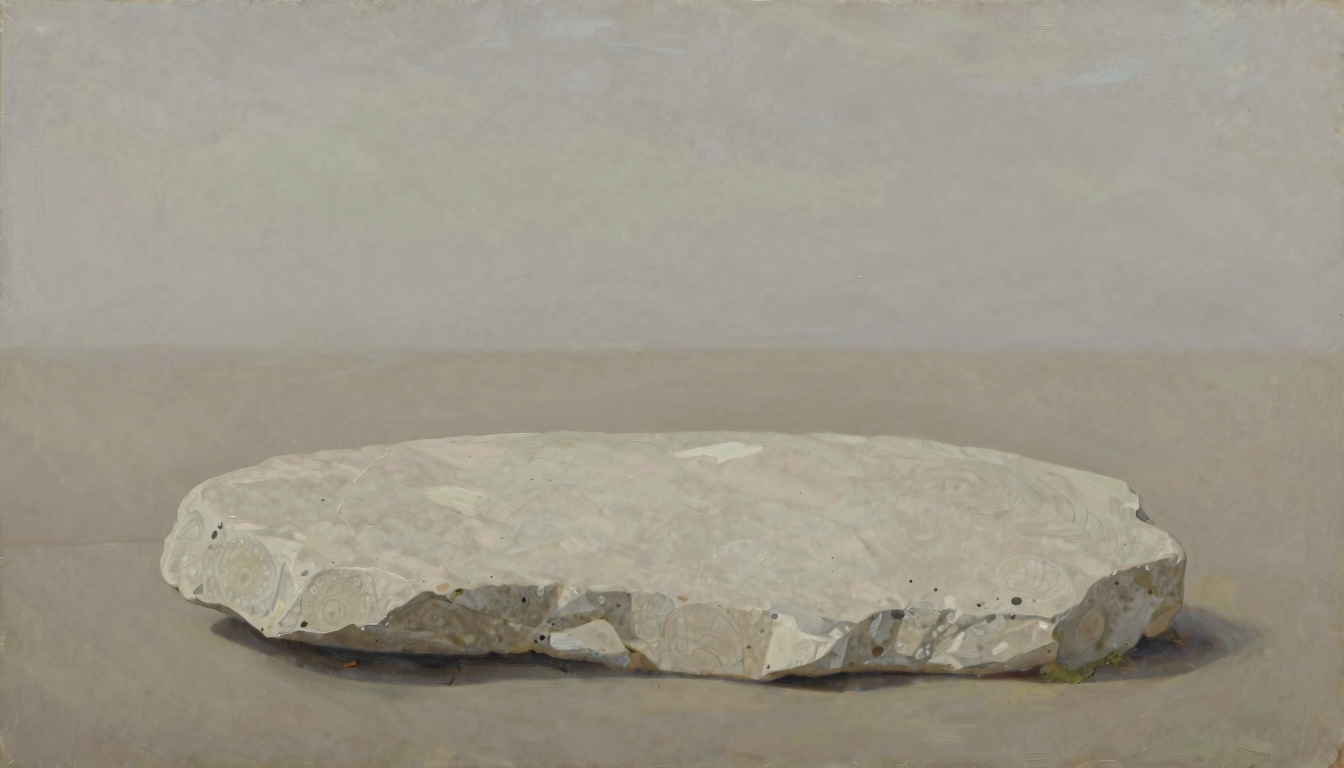
He dreamed that he found a fossil impression in a flat stone beside a path. He recognized a curved shape but could not see the whole outline. He turned the stone once, then left it where he had found it. The recognizable fragment stayed with him.
Mateo compared the image with the registration sheet. The old form preserved a useful purpose, but not every question still belonged to the current workshop. He asked the organizer which details were needed, kept the contact and attendance fields, and removed the questions tied to the larger program.
The next round produced fewer incomplete replies, and he confirmed places without the same number of follow-up messages. The workshop still required preparation, but the registration task became clearer. The result came from checking the present purpose of an inherited method, not from the dream revealing a hidden fact.
A judgment that respects both past and present
Recall the form, place, discovery, your action, and any change. Separate what you recognized from what you assumed the object must have been. A partial impression can remain partial without losing all symbolic value.
Then consider whether one familiar pattern offers a useful comparison. Ask what it once helped you do, what remains valuable, and what the present situation actually requires. If the comparison is unclear, leave the dream's meaning uncertain.
Choose a modest action whose result you can observe: clarify one expectation, inspect one inherited step, or preserve one useful idea in a different form. Fossils can offer a way to think about what remains without making the past a complete explanation or a permanent instruction.
Frequently asked questions
What does dreaming about fossils mean?
Fossils may symbolize preserved traces old patterns or the question of what remains useful. The image does not prove that you are stuck in the past.
What does finding fossils in a dream mean?
Finding may emphasize recognizing something old in a present setting. It is a symbolic comparison rather than proof of a hidden cause or historical discovery.
What if I cannot identify the fossil?
An unclear form may emphasize the limits of recognition. Leave missing details uncertain rather than inventing a complete account.
What if I keep the fossil?
Keeping may symbolize chosen continuity or appreciation. Consider what you wanted to preserve rather than assuming that possession means a burden.
What if I leave it behind?
Leaving may suggest that recognition need not become a present rule. It does not automatically mean rejecting a relationship or forgetting the past.
What if a fossil breaks?
A break may emphasize concern about preserving a connection or understanding an incomplete trace. It does not predict loss.
Does the dream prove ancestral contact or a past life?
No. An old object in a dream cannot verify those claims. Spiritual associations remain personal reflections with uncertain truth.
Why did fossils appear in my dream?
The image alone cannot establish its cause. Recent impressions or personal associations may suggest possibilities without proving an explanation.