The Quiet Omen / Psychology
Why the Life You Didn’t Choose Still Follows You
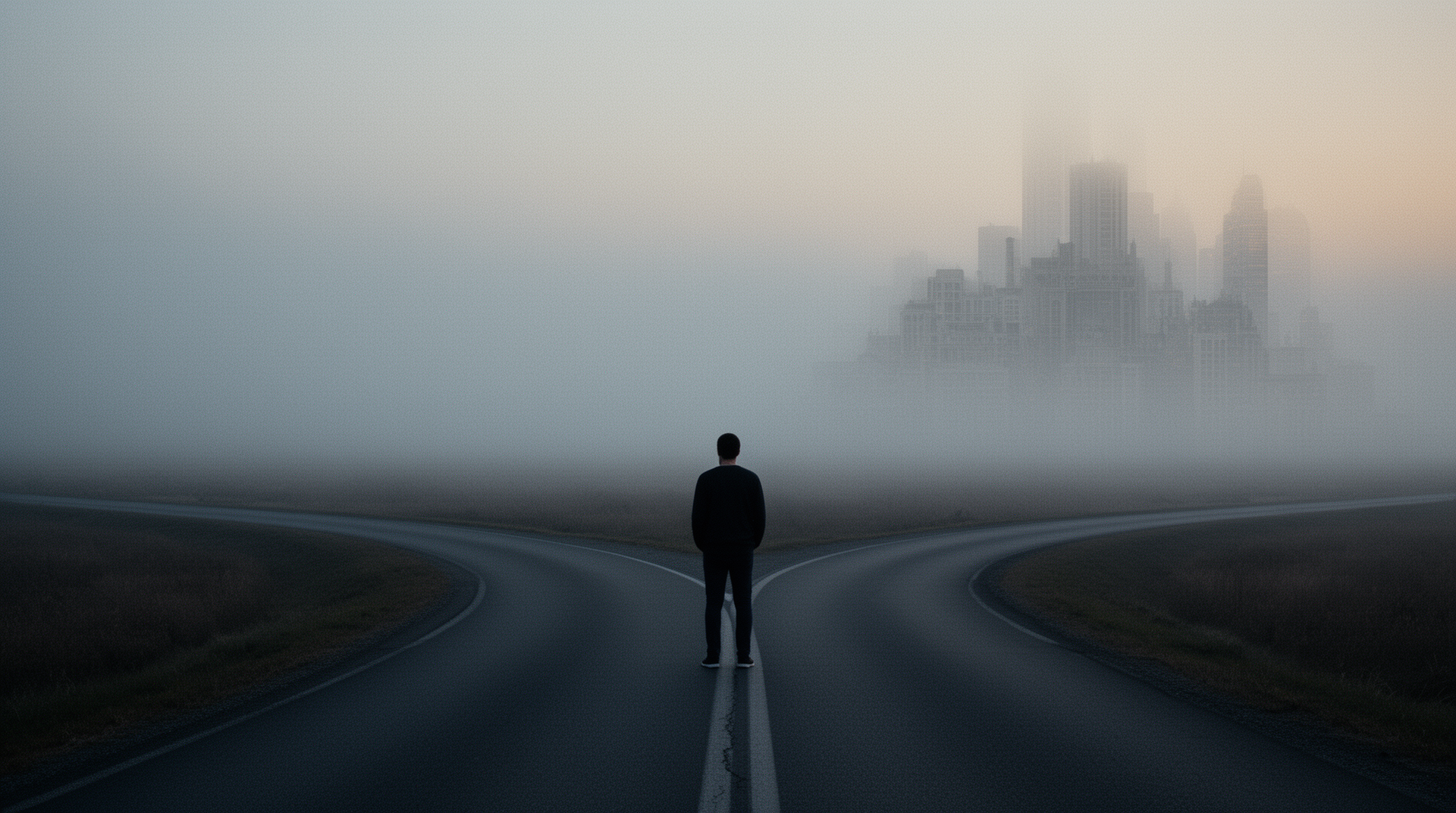
The roads we leave behind often return in dreams, sudden memories, and the strange feeling that another version of us is still living nearby.
- Published
- Read time
- 6 min
- Topics
- Life Transitions / Meaning Making / Memory and Emotion
- Sections
- 3
What this essay is really about
The roads we leave behind often return in dreams, sudden memories, and the strange feeling that another version of us is still living nearby.
- The roads we leave behind often return in dreams
- sudden memories
- and the strange feeling that another version of us is still living nearby
There are moments when the life you did not choose comes back without warning.
You see a photograph of a city where you almost moved. Someone mentions the profession you once imagined for yourself. A former love appears in a dream, not as they are now, but as they were at the exact point when your lives could still have gone another way. For a few seconds, the present loosens. Another version of your life seems to be standing just behind it.
This feeling can arrive even when you are grateful for the life you have.
That is what makes it difficult to admit. We are taught to speak of major choices as clean decisions: one door closes, another opens, and the mature person walks forward without looking back. But a choice does not erase the future that once gathered around the alternative. It only makes that future impossible to enter.
The psyche is less tidy than a calendar. It keeps traces of the roads not taken.
Sometimes those traces return as regret. More often, they return in less direct forms: a recurring setting in a dream, an unreasonable tenderness toward a place you barely knew, a fascination with people whose lives resemble the one you declined. You may find yourself watching their choices with an intensity that feels out of proportion. What moves you is not necessarily envy. It may be recognition.
You are seeing a life that once knew your name.
Psychologically, this makes sense. Whenever we make a serious choice, we are not selecting only an outcome. We are selecting an identity. To take one job is to strengthen one version of the self and leave others without a stage. To marry one person is to surrender the futures attached to other people—and also the self you might have become beside them. To stay in one country, care for a parent, have a child, remain child-free, leave a faith, or abandon a creative ambition is to make some forms of life real by making others unavailable.
We usually focus on what the decision gave us. The mind, however, also registers what disappeared.
This is why the unlived life often becomes louder at thresholds. A birthday. A reunion. A move. The death of someone who remembered you when you were still undecided. A child reaching the age you were when you made a defining choice. These moments disturb the sense that life is one smooth line. They reveal its branches.
The feeling may be especially strong when the present has become repetitive. Routine makes the existing life feel inevitable, while the unlived life remains protected from ordinary disappointment. It never had to pay bills, survive illness, endure boredom, or reveal the flaws of the person you might have become. Because it was never lived, it can remain strangely luminous.
That glow is not proof that you chose wrongly.
It is partly the glow of an untested world.
This distinction matters. When people are lonely, exhausted, or frightened, an alternate life can begin to look like a message: I was supposed to go there. I was meant to choose differently. Everything would have made sense if I had taken the other path. But the unlived life is edited by distance. We see its promise and not its weather.
Still, dismissing it as fantasy misses something valuable. An imagined alternative may not tell you where you should have gone, but it can reveal what is missing where you are.
Perhaps the city you almost moved to represents anonymity, movement, or the right to begin again. Perhaps the old relationship carries not the person themselves, but the self you were around them—more reckless, more open, less managed. Perhaps the abandoned profession still appears because a capacity in you has gone unused. The symbol points backward, but the need may be present tense.
This is one of the most useful ways to read the life not chosen: not as a lost prophecy, but as a messenger carrying neglected qualities.
The road behind you may be closed. What it represented may not be.
Symbolically, crossroads have always carried weight because they force separation. Before the choice, several futures seem to coexist. Afterward, one becomes biography and the others become ghosts. Stories fill crossroads with bargains, warnings, meetings, and supernatural figures because choosing a direction never feels purely practical. A choice changes which self will get to continue.
Modern life prefers the language of optimization. We ask which option is smarter, safer, more productive, more aligned. Yet no framework removes the cost of choosing. Even a good decision contains a small burial. The person who says yes to one life must quietly say no to several others.
We rarely hold ceremonies for those endings.
There is no funeral for the country you never moved to. No anniversary for the child you decided not to have, or could not have. No formal farewell to the vocation abandoned for stability. No public ritual for the self who would have emerged if you had stayed, left, spoken, refused, or arrived five minutes earlier.
So these lives return informally. They visit through dreams, coincidences, music, anniversaries, and sudden bodily recognition. A particular street feels charged. A stranger resembles someone from an old turning point. A sentence in a book seems addressed to the person you almost became.
This does not mean the universe is ordering you to reverse course. It may mean that an ending was never fully acknowledged.
The mature response is neither to obey the ghost nor banish it. It is to ask what it has come to recover.
When the unlived life appears, try to separate the literal path from the quality it carried. Do you truly want that old relationship, or do you miss being seen with curiosity? Do you want the abandoned career, or the sense of making something that bears your mark? Do you want to leave your current life, or do you need more risk, privacy, beauty, movement, or permission within it?
These questions turn haunting into information.
Sometimes the answer will be grief. A real possibility was lost, and no clever interpretation should pretend otherwise. Not every road can be reopened. Time does close doors. Bodies change. People die. Circumstances harden. Part of living honestly is allowing a good life to contain sorrow for another good life that never happened.
Gratitude and grief are not opposites. You can love what you chose and mourn what choosing cost.
In fact, refusing that grief can make the unlived life more seductive. What is denied tends to return without proportion. Once it is named—yes, that mattered; yes, I gave something up; yes, I sometimes wonder—the ghost often becomes quieter. It no longer has to impersonate destiny just to receive attention.
And sometimes the return is an invitation. Not to recreate the past, but to reclaim a piece of yourself from it. The writer can begin writing without recovering the abandoned career. The person who stayed can travel without destroying the home they built. The cautious self can make one brave decision without becoming the reckless person they once imagined.
We cannot live every possible life. But we can sometimes bring home what one of those lives was carrying.
That may be why the road not taken keeps appearing at the edge of attention. It is not always asking to replace your present. It may be asking you to make your present larger.
The next time another version of your life seems to pass close by, do not rush to call it regret. Notice what becomes vivid. Notice who you were in that imagined world. Notice what that person could do, feel, or desire that has become difficult here.
Then ask the question beneath the haunting:
What part of that unlived life is still asking to be lived now?