The Quiet Omen / Rituals
Why We Need Rituals Before We Leave
The small gestures we repeat at thresholds may be how the mind gives uncertainty a handle.
- Published
- Read time
- 6 min
- Topics
- Rituals / Threshold Rituals
- Sections
- 3
What this essay is really about
The small gestures we repeat at thresholds may be how the mind gives uncertainty a handle.
There is a moment before leaving when the ordinary world becomes strangely ceremonial.
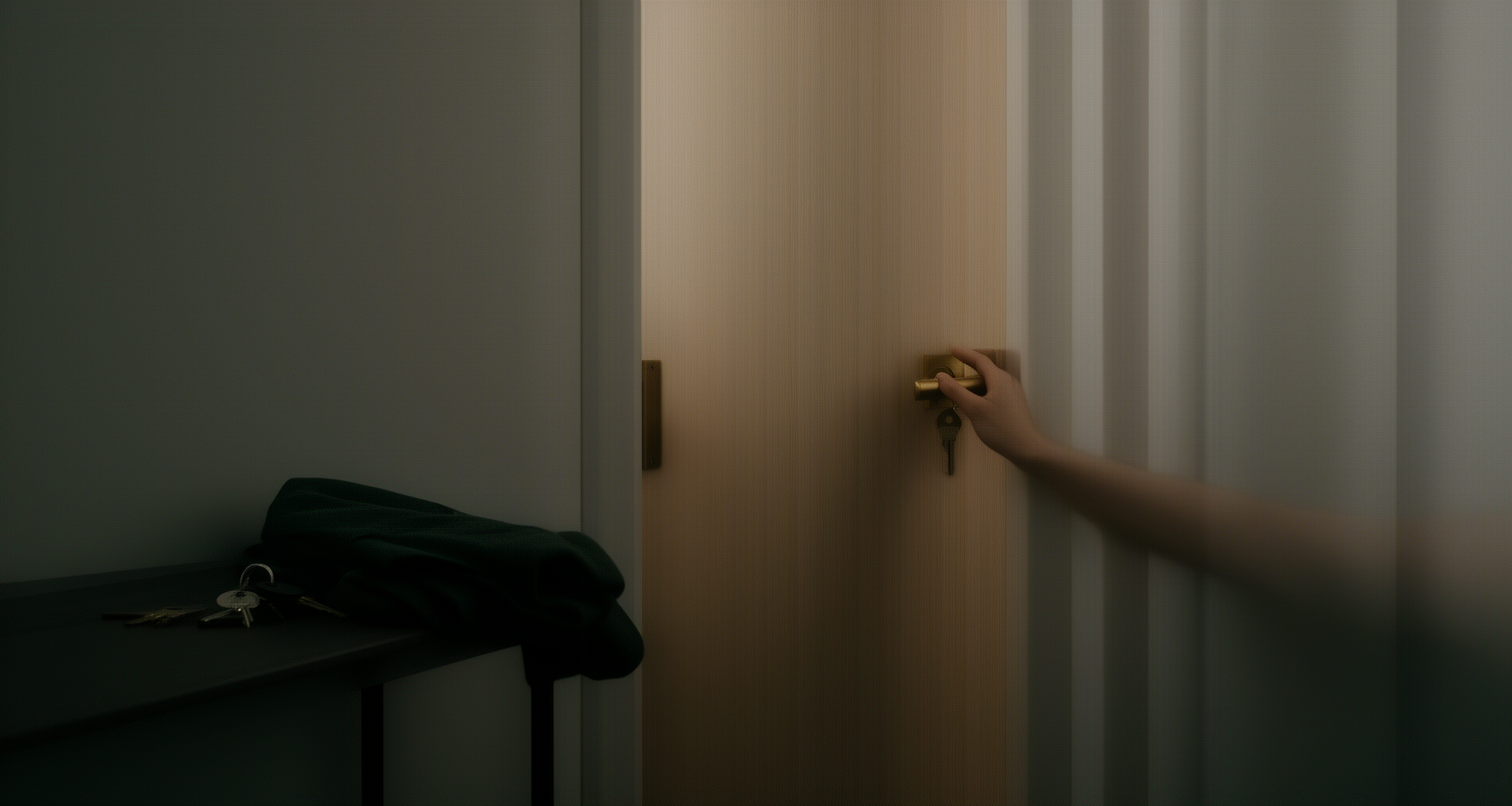
You check the lock. You touch your pocket for keys. You look back into the room, even though you already know what is there. Maybe you say something to yourself before a meeting. Maybe you wear the same shirt when something matters. Maybe you pause at the door, not because the door requires it, but because some part of you does.
Most of these gestures are too small to call beliefs. They are not formal prayers. They are not dramatic rituals. They are almost invisible: a breath, a glance, a touch, a repeated order of actions, a private rule about what must happen before the day can begin.
But small rituals reveal something important about us. We do not move through uncertainty as clean, rational machines. We cross thresholds with bodies, memories, fears, hopes, and old lessons about what safety feels like. Before we enter the unknown, even the ordinary unknown of a Tuesday morning, the mind often asks for a handle.
A ritual gives it one.
This is why leaving can feel charged. To leave a room is not only to change location. It is to give up control over one scene and enter another. Behind you is the place where objects are known, roles are stable, and the day has not yet made its demands. Ahead of you is weather, traffic, messages, strangers, decisions, timing, and accident.
The door is a practical object. Symbolically, it is a border.
Human beings notice borders. We may pretend we do not, but the psyche is old enough to understand entrances and exits. A doorway, a platform, an airport gate, the moment before pressing send, the silence before walking into a room: these are not neutral spaces. They are in-between places, and they make us aware of risk.
That risk does not have to be dramatic. It may be as small as wanting the day to go well. It may be the wish not to forget anything, not to be embarrassed, not to arrive carrying the wrong mood. It may be the quiet hope that the self who leaves the house will be able to manage what the self inside the house cannot yet see.
So the ritual appears.
You put the cup in the sink before you leave because an unfinished cup makes the room feel wrong. You check the stove twice, not only because fire is possible, but because the second check gives the body permission to stop imagining catastrophe. You choose a certain necklace, not because metal changes fate, but because it lets you carry a small continuity of self into a changing day.
Psychologically, rituals help compress uncertainty into sequence. First this, then this, then I go. The order matters because order is one of the simplest forms of reassurance. When life feels open-ended, a repeated sequence gives the nervous system a beginning, middle, and release.
This does not mean every ritual is healthy or harmless. Some repetitions become costly. Some checks stop calming the mind and start recruiting it into more fear. When a ritual begins to shrink a life rather than steady it, it deserves more care than a symbolic essay can provide.
But many private rituals are not signs of weakness. They are small acts of psychological architecture. They build a threshold where the world has given us only a gap.
Traditional cultures understood this more openly than modern life does. Departures, arrivals, meals, sleep, birth, grief, harvest, travel, and marriage were rarely treated as raw events. They were surrounded by gestures. Words were spoken. Hands were washed. Objects were carried. Candles were lit. Shoes were removed. Doors were marked. The point was not always superstition in the crude sense. The point was transition.
A life changes quality when transition is acknowledged.
Modern people still need that acknowledgment, but we often privatize it. We create quiet rituals without calling them rituals. We play the same song before a difficult commute. We arrange the desk before work. We touch the necklace, check the calendar, refresh the bag, straighten the bed, look once more at the sleeping child, the empty room, the street below.
Then we say we are just being practical.
Sometimes we are. Practicality and symbolism are not enemies. A checked lock is both a checked lock and a little ceremony of protection. A packed bag is both logistics and a declaration: I am prepared to enter the day. A made bed is both fabric in order and a promise that some part of the self will return to a place that has not collapsed in its absence.
The mistake is to think meaning begins only when practicality ends. In real life, meaning often hides inside useful actions.
This is why certain small disruptions can disturb us out of proportion. You cannot find the usual ring. The morning order breaks. Someone interrupts the last quiet minute. The coffee spills. The train door closes just as you arrive. None of this is necessarily an omen. But the irritation may be more than inconvenience. The transition has lost its shape.
The day has begun without your consent.
That line matters because much of symbolic life is about consent. Not consent in the legal sense, but inner consent: the feeling that you have been allowed to meet the next moment with enough of yourself intact. Rituals help create that feeling. They say: before I cross, I gather myself.
Without some form of gathering, modern life turns thresholds into collisions. We wake and immediately receive the world through a screen. We move from sleep to news, from bed to urgency, from private self to public self without a border. We enter conversations carrying the residue of other conversations. We leave home with the mind scattered across objects, messages, weather, imagined outcomes.
Then we wonder why the day feels like it has already taken something from us.
A ritual does not need to be mystical to matter. It only needs to be intentional enough to make the crossing visible. One breath before opening email. One sentence before leaving the house. One hand on the door, not as magic, but as attention. One moment of asking: what am I carrying, and what can I leave here?
The best rituals are not attempts to control the future. They are ways of not entering the future fragmented.
This is the distinction that keeps ritual from becoming fear. A fearful ritual says, if I do not do this, something bad will happen. A steadier ritual says, when I do this, I remember how to arrive. One is a bargain with catastrophe. The other is a gesture of alignment.
The difference can be felt in the body. Fearful repetition tightens. Steady repetition settles. Fear demands more and more proof. Ritual, at its best, asks for one clear movement and then releases you.
So if you have a small leaving ritual, it may be worth noticing without mockery. What is it trying to protect? What border does it mark? What version of you does it help assemble before the day begins?
Maybe it is not irrational that you pause at the door.
Maybe some part of you understands that departure is never only departure. Every leaving contains a small surrender: of control, of privacy, of the self who was safe a moment ago. Every entrance asks us to become legible to a different world.
The ritual is the bridge between those selves.
This does not require elaborate candles, chants, or antique language. The most powerful rituals are often almost plain enough to miss. Locking the door with attention. Putting one object in the right place. Saying, quietly, "I am ready enough." Taking one breath before the next room.
Ready enough is important. Ritual should not promise perfect safety. It should not pretend the future will behave because you touched the doorway or folded the blanket or wore the right coat.
But you may enter it differently.
That is the real value of a small threshold ritual. It does not guarantee the day. It gathers the person who has to live it. It gives uncertainty a handle, not so you can drag the future toward you, but so you can cross into it with a little more presence.
Before you leave, something in you may still need to be met.
The ritual is where you meet it.