The Quiet Omen / Signs, Psychology
Why Waiting Makes Everything Feel Like a Sign
In the space before an answer, the mind turns timing, silence, and small interruptions into symbols.
- Published
- Read time
- 6 min
- Format
- Audio essay
- Sections
- 3
What this essay is really about
In the space before an answer, the mind turns timing, silence, and small interruptions into symbols.
- In the space before an answer
- the mind turns timing
- silence
There is a particular kind of day when everything starts to feel arranged.
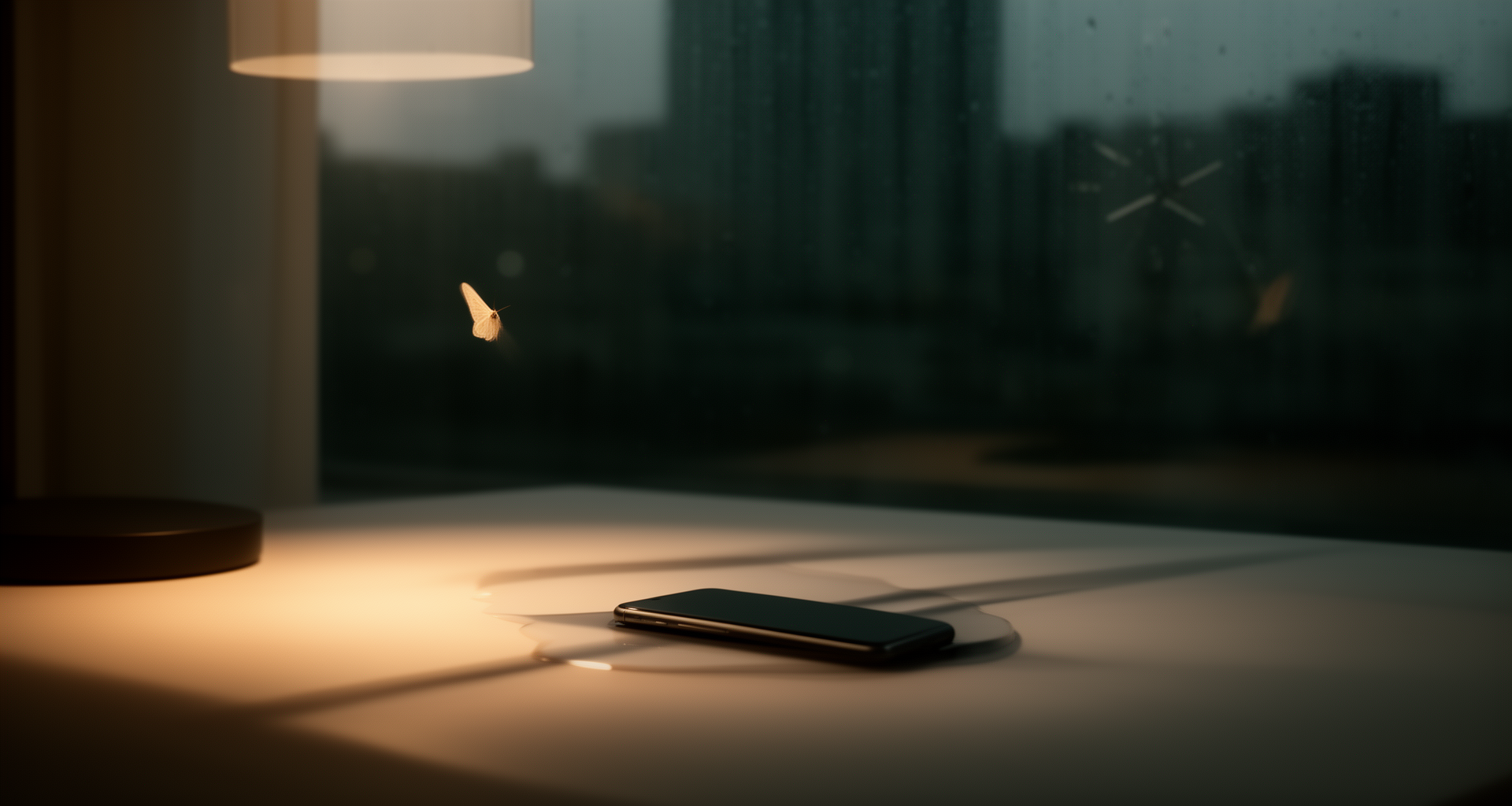
You are waiting for a reply, a decision, a result, an apology, a yes, a no, a door to open or close. Nothing has happened yet, which somehow makes everything feel more active. The phone stays silent for three hours and the silence becomes a message. A light flickers. A stranger says the exact word you have been avoiding. The clock shows a number you have seen too many times this week.
You may not even believe in signs. That does not stop the day from feeling full of them.
Waiting changes the atmosphere of attention. When life has not delivered an answer, the mind starts searching the room for one. It listens harder. It scans the timing of things. It notices coincidence with unusual intensity, not because it has become foolish, but because uncertainty has made it hungry for pattern.
This is one reason signs often seem to multiply during thresholds. Before a message comes. Before a meeting. Before leaving someone, choosing something, confessing something, admitting something to yourself. The outer world may not have changed very much. But the inner weather has. And once the inner weather changes, certain details begin to shine.
Psychologically, waiting puts the nervous system in a state of suspended interpretation. The story has started, but the ending has not arrived. Human beings are not built to sit comfortably inside unfinished meaning. We prefer cause and effect. We want sequence. We want the next line. When the next line does not appear, the mind begins to read the margins.
This does not mean every flicker, delay, or repeated number is a supernatural instruction. It also does not mean the experience is meaningless. The more useful question is not, "Is this definitely a sign?" The better question is, "Why did this detail become visible to me now?"
That question changes the whole quality of interpretation. It moves us away from panic and toward attention.
When you are waiting, a small event can feel charged because it gives form to a feeling that had no form. The phone is silent, and suddenly the silence is not only silence. It becomes the shape of fear. Or hope. Or humiliation. Or longing. A song begins in a shop, and it does not predict the future, but it names the ache you were trying to keep private. A delay does not announce fate, but it reveals how much of your peace had been placed in one possible outcome.
The sign may be less about what will happen next and more about where your attention has already been living.
This is where symbolic life becomes more honest than either superstition or dismissal. Superstition wants to turn every charged detail into a command. Dismissal wants to flatten every charged detail into nothing. Symbolic attention asks for a third response: notice what became meaningful, then ask what it is carrying.
That distinction matters, because waiting can make us vulnerable to false certainty. When we cannot bear not knowing, almost any pattern can become a verdict. Three delays mean it is doomed. One smooth morning means it is meant to be. A dream becomes proof. A silence becomes rejection. A coincidence becomes permission.
But signs are rarely at their best when they are treated like instructions from a courtroom. Their deeper value is often diagnostic. They show us the state of the watcher.
If you are waiting to be chosen, you may read everything as inclusion or exclusion. If you are waiting for danger, you may read everything as warning. If you are waiting for relief, you may read everything as promise. The same event can carry different meanings depending on the wound or hope that is looking at it.
This does not make the sign fake. It makes the sign relational. A symbol is not an object with one fixed meaning sealed inside it. It is a meeting between the world and a charged inner life. The clock, the silence, the rain, the sentence, the delay: these things become symbolic when they touch something already awake in us.
Modern life has not removed this instinct. It has only changed the objects. We refresh inboxes. We reread messages. We check whether someone has viewed a story. We notice whether the train arrives late, whether the meeting invite shifts, whether the person uses a period instead of an exclamation point. We may call this anxiety, intuition, pattern recognition, overthinking, or a sign. Often it is some mixture of all four.
The mistake is thinking we must choose between the symbolic and the psychological, as if one cancels the other. In real life they overlap. The psyche uses symbols because symbols can hold what plain explanation cannot. A person can understand perfectly well that a delayed reply has many possible causes, and still feel the delay as a dark shape moving through the day.
The feeling deserves attention. The conclusion may not.
That may be the most important rule for reading signs while waiting: respect the feeling, but do not immediately obey the story it writes.
If a silence frightens you, the fear is real. But the fear may not be evidence. If a coincidence steadies you, the steadiness is real. But the coincidence may not be a guarantee. If a repeated image keeps appearing, the repetition may matter. But it may be pointing inward before it points outward.
This is not a less magical way to live. It is a more disciplined one.
Because the real power of a sign is not that it lets you escape uncertainty. It is that it gives you a place to meet uncertainty without becoming possessed by it. You can say, "This felt charged." You can ask, "What did it awaken?" You can notice, "I am making this mean rejection," or "I am making this mean rescue," or "I am desperate for the world to tell me what I am not ready to decide."
Many of the signs we notice while waiting are not answers. They are mirrors held up to the part of us that cannot tolerate being between chapters. They reveal the private bargain we have made with the future: if this happens, I am safe; if that happens, I am ruined; if they reply, I matter; if they do not, I disappear.
The stakes have become too concentrated.
So when everything starts to feel like a sign, begin gently. Write down what happened in plain language. Then write down what you immediately made it mean. Separate the event from the interpretation. A message did not arrive. That is the event. "They do not care" is the interpretation. The clock showed a repeated number. That is the event. "This is proof I should act" is the interpretation. The distinction does not destroy meaning. It makes meaning usable.
Then ask one quieter question: what part of me is waiting inside this sign?
It may be the part that wants permission. The part that wants protection. The part that wants the future to become less humiliating. The part that knows the answer already, but wants the world to say it first.
Sometimes, after that, a sign becomes less urgent. It no longer has to carry the whole future. It can become what a good symbol often is: a small lamp, not a sentence. A way of seeing the charged place more clearly.
Waiting makes everything feel like a sign because waiting is not empty. It is full of projected endings, feared losses, secret hopes, and unfinished decisions. The world may be quiet, but the mind is not. It is arranging evidence around the question it cannot stop asking.
This is why symbolic attention matters most when certainty is missing. Not because it gives us control. Not because every coincidence is a command. But because it teaches us to read the moment without surrendering our judgment to it.
The next time the whole day feels arranged around your uncertainty, you do not have to mock yourself for noticing. You also do not have to hand your life over to the nearest pattern.
You can pause.
You can look at the sign and the self that found it.
And sometimes that is the first real answer: not what will happen, but where you are standing while you wait.